|
VOOZH | about |
|
VOOZH | about |
Exercise 2.4 of Chapter 2 (Polynomials) in Class 10 NCERT Mathematics focuses on the division algorithm for polynomials. This exercise helps students understand how to divide polynomials and find quotients and remainders, which are essential skills in algebra.
Solution:
p(x) = 2x3+x2-5x+2
p(1/2) = 2(1/2)3+(1/2)2-5(1/2)+2
= (1/4)+(1/4)-(5/2)+2
= 0
p(1) = 2(1)3+(1)2-5(1)+2 = 0
p(-2) = 2(-2)3+(-2)2-5(-2)+2 = 0
Therefore, 1/2, 1, -2 are the zeroes of 2x3+x2-5x+2.
Now, comparing the given polynomial with general expression
ax3+bx2+cx+d = 2x3+x2-5x+2
a=2, b=1, c= -5 and d = 2
α, β, γ are the zeroes of the cubic polynomial ax3+bx2+cx+d
α +β+γ = –b/a
αβ+βγ+γα = c/a
α βγ = – d/a.
α+β+γ = ½+1+(-2)
= -1/2 = –b/a
αβ+βγ+γα = (1/2×1)+(1 ×-2)+(-2×1/2)
= -5/2 = c/a
α β γ = ½×1×(-2)
= -2/2 = -d/a
Hence, the relationship between the zeroes and the coefficients are satisfied.
Solution:
p(x) = x3-4x2+5x-2
Zeroes are 2,1,1.
p(2)= 23-4(2)2+5(2)-2
= 0
p(1) = 13-(4)(12 )+(5)(1)-2 = 0
Therefore, proved, 2, 1, 1 are the zeroes of x3-4x2+5x-2
On comparing the given polynomial with general expression
ax3+bx2+cx+d = x3-4x2+5x-2
a = 1, b = -4, c = 5 and d = -2
Therefore,
α + β + γ = –b/a
= 2+1+1
= 4
–b/a = -(-4)/1
αβ + βγ + γα = c/a
= 2×1+1×1+1×2
= 5
c/a = 5/1
α β γ = – d/a.
= 2×1×1
= 2
-d/a = -(-2)/1
Hence, the relationship between the zeroes and the coefficients is satisfied.
Solution:
Let us consider the cubic polynomial as ax3+bx2+cx+d and zeroes of the polynomials be α, β, γ.
α+β+γ = -b/a = 2/1
αβ +βγ+γα = c/a = -7/1
α βγ = -d/a = -14/1
On comparing
a = 1, b = -2, c = -7, d = 14
Therefore, the cubic polynomial is x3-2x2-7x+14
Solution:
p(x) = x3-3x2+x+1
Zeroes are given as a – b, a, a + b
px3+qx2+rx+s = x3-3x2+x+1
On comparing
p = 1, q = -3, r = 1 and s = 1
Sum of zeroes = a – b + a + a + b
-q/p = 3a
Putting the values q and p.
-(-3)/1 = 3a
a=1
Therefore, zeroes are 1-b, 1, 1+b.
Product of zeroes = 1(1-b)(1+b)
-s/p = 1-b2
-1/1 = 1-b2
b2 = 1+1 = 2
b = √2
Therefore,1-√2, 1,1+√2 are the zeroes of x3-3x2+x+1.
Solution:
👁 ImageDegree of polynomial is 4
Therefore, it has four roots
f(x) = x4-6x3-26x2+138x-35
As 2 +√3 and 2-√3 are zeroes of given polynomial f(x).
Therefore, [x−(2+√3)] [x−(2-√3)] = 0
(x−2−√3)(x−2+√3) = 0
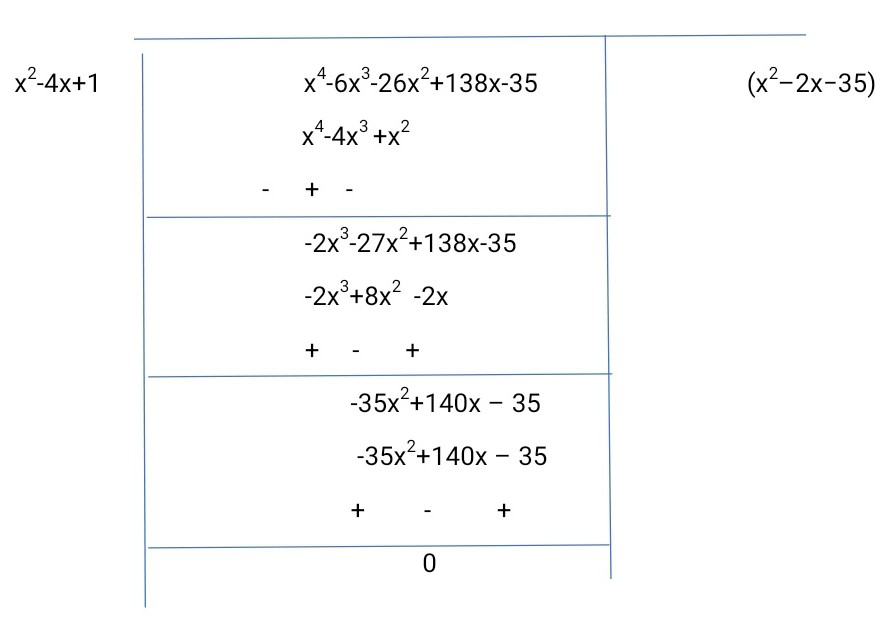
Therefore, x2-4x+1 is a factor of polynomial f(x).
Let it be g(x) = x2-4x+1
By dividing f(x) by g(x) we get another factor of f(x)
x4-6x3-26x2+138x-35 = (x2-4x+1)(x2 –2x−35)
On factorizing (x2–2x−35) by splitting the middle term
x2–(7−5)x −35 = x2– 7x+5x-35
=x(x −7)+5(x−7)
(x+5)(x−7) = 0
x= −5 and x = 7.
Therefore, all four zeroes of given polynomial equation are: 2+√3, 2-√3, −5 and 7.
Exercise 2.4 in Chapter 2 of Class 10 NCERT Mathematics focuses on the division algorithm for polynomials. This crucial concept teaches students how to divide polynomials of various degrees, find quotients and remainders, and apply the division algorithm effectively. The exercise covers a range of problems, from simple divisions to more complex ones, helping students build a strong foundation in polynomial manipulation. Understanding this topic is essential for advanced algebraic concepts and problem-solving in mathematics.