|
VOOZH | about |
|
VOOZH | about |
(i) 2, 7, 12,…., to 10 terms.
(ii) − 37, − 33, − 29,…, to 12 terms
(iii) 0.6, 1.7, 2.8,…….., to 100 terms
(iv) 1/15, 1/12, 1/10, ……, to 11 terms
Solution:
(i) Given, 2, 7, 12,…, to 10 terms
For this A.P., we have,
first term, a = 2
common difference, d = a2 − a1 = 7−2 = 5
no. of terms, n = 10
Sum of nth term in AP series is,
Sn = n/2 [2a +(n-1)d]
Substituting the values,
S10 = 10/2 [2(2)+(10 -1)×5]
= 5[4+(9)×(5)]
= 5 × 49 = 245
(ii) Given, −37, −33, −29,…, to 12 terms
For this A.P.,we have,
first term, a = −37
common difference, d = a2− a1
= (−33)−(−37)
= − 33 + 37 = 4
no. of terms, n = 12
Sum of nth term in AP series is,
Sn = n/2 [2a+(n-1)d]
Substituting the values,
S12 = 12/2 [2(-37)+(12-1)×4]
= 6[-74+11×4]
= 6[-74+44]
= 6(-30) = -180
(iii) Given, 0.6, 1.7, 2.8,…, to 100 terms
For this A.P.,
first term, a = 0.6
common difference, d = a2 − a1 = 1.7 − 0.6 = 1.1
no. of terms, n = 100
Sum of nth term in AP series is,
Sn = n/2[2a +(n-1)d]
S12 = 50/2 [1.2+(99)×1.1]
= 50[1.2+108.9]
= 50[110.1]
= 5505
(iv) Given, 1/15, 1/12, 1/10, ……, to 11 terms
For this A.P.,
first term, a = 1/5
common difference, d = a2 –a1 = (1/12)-(1/5) = 1/60
number of terms, n = 11
Sum of nth term in AP series is,
Sn = n/2 [2a + (n – 1) d]
Substituting the values, we have,
= 11/2(2/15 + 10/60)
= 11/2 (9/30)
= 33/20
(i) 7+ 10 1/2 + 14 + ......... + 84
(ii) 34 + 32 + 30 + ……….. + 10
(iii) − 5 + (− 8) + (− 11) + ………… + (− 230)
Solutions:
(i) Given,
First term, a = 7
nth term, an = 84
Common difference, d = 10 1/2 - 7 = 21/2 - 7 = 7/2
Let 84 be the nth term of this A.P.
Then,
an = a(n-1)d
Substituting these values,
84 = 7+(n – 1)×7/2
77 = (n-1)×7/2
22 = n−1
n = 23
We know that, sum of n term is;
Sn = n/2 (a + l), l = 84
Sn = 23/2 (7+84)
= (23×91/2) = 2093/2
= 1046 1/2
(ii) Given,
first term, a = 34
common difference, d = a2−a1 = 32−34 = −2
nth term, an= 10
Let 10 be the nth term of this A.P.,
Now,
an = a +(n−1)d
10 = 34+(n−1)(−2)
−24 = (n −1)(−2)
12 = n −1
n = 13
Sum of n terms is;
Sn = n/2 (a +l), l = 10
= 13/2 (34 + 10)
= (13×44/2) = 13 × 22
= 286
(iii) Given:
First term, a = −5
nth term, an= −230
Common difference, d = a2−a1 = (−8)−(−5)
⇒d = − 8+5 = −3
Let us assume −230 be the nth term of this A.P.
Since,
an= a+(n−1)d
−230 = − 5+(n−1)(−3)
−225 = (n−1)(−3)
(n−1) = 75
n = 76
Sum of n terms, is equivalent to,
Sn = n/2 (a + l)
= 76/2 [(-5) + (-230)]
= 38(-235)
= -8930
(i) Given a = 5, d = 3, an = 50, find n and Sn.
(ii) Given a = 7, a13 = 35, find d and S13.
(iii) Given a12 = 37, d = 3, find a and S12.
(iv) Given a3 = 15, S10 = 125, find d and a10.
(v) Given d = 5, S9 = 75, find a and a9.
(vi) Given a = 2, d = 8, Sn = 90, find n and an.
(vii) Given a = 8, an = 62, Sn = 210, find n and d.
(viii) Given an = 4, d = 2, Sn = − 14, find n and a.
(ix) Given a = 3, n = 8, S = 192, find d.
(x) Given l = 28, S = 144 and there are total 9 terms. Find a.
Solutions:
(i) Given values, we have,
a = 5, d = 3, an = 50
The nth term in an AP,
an = a +(n −1)d,
Substituting the given values, we have,
⇒ 50 = 5+(n -1)×3
⇒ 3(n -1) = 45
⇒ n -1 = 15
Obtaining the value of n, we get,
⇒ n = 16
Now, sum of n terms is equivalent to,
Sn = n/2 (a +an)
Sn = 16/2 (5 + 50) = 440
(ii) Given values, we have,
a = 7, a13 = 35
The nth term in an AP,
an = a+(n−1)d,
Substituting the given values, we have,
⇒ 35 = 7+(13-1)d
⇒ 12d = 28
⇒ d = 28/12 = 2.33
Now, Sn = n/2 (a+an)
Obtaining the final value, we get,
S13 = 13/2 (7+35) = 273
(iii) Given values, we have,
a12 = 37, d = 3
The nth term in an AP,
an = a+(n −1)d,
Substituting the given values, we have,
⇒ a12 = a+(12−1)3
⇒ 37 = a+33
Obtaining the value of a, we get,
⇒ a = 4
Now, sum of nth term,
Sn = n/2 (a+an)
= 12/2 (4+37)
Obtaining the final value,
= 246
(iv) Given that,
a3 = 15, S10 = 125
The formula of the nth term in an AP,
an = a +(n−1)d,
Substituting the given values, we have,
a3 = a+(3−1)d
15 = a+2d ………….. (i)
Also,
Sum of the nth term,
Sn = n/2 [2a+(n-1)d]
S10 = 10/2 [2a+(10-1)d]
125 = 5(2a+9d)
25 = 2a+9d …………….. (ii)
Solving eq (i) by (ii),
30 = 2a+4d ………. (iii)
And, by subtracting equation (iii) from (ii), we get,
−5 = 5d
that is,
d = −1
Substituting in equation (i),
15 = a+2(−1)
15 = a−2
a = 17 =
And,
a10 = a+(10−1)d
a10 = 17+(9)(−1)
a10 = 17−9 = 8
(v) Given:
d = 5, S9 = 75
Sum of n terms in AP is,
Sn = n/2 [2a +(n -1)d]
Substituting values, we get,
S9 = 9/2 [2a +(9-1)5]
25 = 3(a+20)
25 = 3a+60
3a = 25−60
a = -35/3
Also,
an = a+(n−1)d
Substituting values, we get,
a9 = a+(9−1)(5)
= -35/3+8(5)
= -35/3+40
= (35+120/3) = 85/3
(vi) Given:
a = 2, d = 8, Sn = 90
Sum of n terms in an AP is,
Sn = n/2 [2a +(n -1)d]
Substituting values, we get,
90 = n/2 [2a +(n -1)d]
⇒ 180 = n(4+8n -8) = n(8n-4) = 8n2-4n
Solving the eq, we get,
⇒ 8n2-4n –180 = 0
⇒ 2n2–n-45 = 0
⇒ 2n2-10n+9n-45 = 0
⇒ 2n(n -5)+9(n -5) = 0
⇒ (n-5)(2n+9) = 0
Since, n can only be a positive integer,
Therefore,
n = 5
Now,
∴ a5 = 8+5×4 = 34
(vii) Given:
a = 8, an = 62, Sn = 210
Since, sum of n terms in an AP is equivalent to,
Sn = n/2 (a + an)
210 = n/2 (8 +62)
Solving,
⇒ 35n = 210
⇒ n = 210/35 = 6
Now, 62 = 8+5d
⇒ 5d = 62-8 = 54
⇒ d = 54/5 = 10.8
(viii) Given :
nth term, an = 4, common difference, d = 2, sum of n terms, Sn = −14.
Formula of the nth term in an AP,
an = a+(n −1)d,
Substituting the values, we get,
4 = a+(n −1)2
4 = a+2n−2
a+2n = 6
a = 6 − 2n …………………. (i)
Sum of n terms is;
Sn = n/2 (a+an)
-14 = n/2 (a+4)
−28 = n (a+4)
From equation (i), we get,
−28 = n (6 −2n +4)
−28 = n (− 2n +10)
−28 = − 2n2+10n
2n2 −10n − 28 = 0
n2 −5n −14 = 0
n2 −7n+2n −14 = 0
n (n−7)+2(n −7) = 0
Solving for n,
(n −7)(n +2) = 0
Either n − 7 = 0 or n + 2 = 0
n = 7 or n = −2
Since, we know, n can neither be negative nor fractional.
Therefore, n = 7
From equation (i), we get
a = 6−2n
a = 6−2(7)
= 6−14
= −8
(ix) Given values are,
first term, a = 3,
number of terms, n = 8
sum of n terms, S = 192
We know,
Sn = n/2 [2a+(n -1)d]
Substituting values,
192 = 8/2 [2×3+(8 -1)d]
192 = 4[6 +7d]
48 = 6+7d
42 = 7d
Solving for d, we get,
d = 6
(x) Given values are,
l = 28,S = 144 and there are total of 9 terms.
Sum of n terms,
Sn = n/2 (a + l)
Substituting values, we get,
144 = 9/2(a+28)
(16)×(2) = a+28
32 = a+28
Calculating, we get,
a = 4
Solution:
Let us assume that there are n terms of the AP. 9, 17, 25 …
For this A.P.,
We know,
First term, a = 9
Common difference, d = a2−a1 = 17−9 = 8
Sum of n terms, is;
Sn = n/2 [2a+(n -1)d]
Substituting the values,
636 = n/2 [2×a+(8-1)×8]
636 = n/2 [18+(n-1)×8]
636 = n [9 +4n −4]
636 = n (4n +5)
4n2 +5n −636 = 0
4n2 +53n −48n −636 = 0
Solving, we get,
n (4n + 53)−12 (4n + 53) = 0
(4n +53)(n −12) = 0
that is,
4n+53 = 0 or n−12 = 0
On solving,
n = (-53/4) or n = 12
We know,
n cannot be negative or fraction, therefore, n = 12 is the only plausible value.
Solution:
Given:
first term, a = 5
last term, l = 45
Also,
Sum of the AP, Sn = 400
Sum of AP is equivalent to
Sn = n/2 (a+l)
Substituting the values,
400 = n/2(5+45)
400 = n/2(50)
Number of terms, n =16
Since, the last term of AP series is equivalent to
l = a+(n −1)d
45 = 5 +(16 −1)d
40 = 15d
Solving for d, we get,
Common difference, d = 40/15 = 8/3
Solution:
Given:
First term, a = 17
Last term, l = 350
Common difference, d = 9
The last term of the AP can be written as;
l = a+(n −1)d
Substituting the values, we get,
350 = 17+(n −1)9
333 = (n−1)9
Solving for n,
(n−1) = 37
n = 38
Sn = n/2 (a+l)
S38 = 13/2 (17+350)
= 19×367
= 6973
Solution:
Given:
Common difference, d = 7
Also,
22nd term, a22 = 149
By the formula of nth term of an AP,
an = a+(n−1)d
Substituting values, we get,
a22 = a+(22−1)d
149 = a+21×7
149 = a+147
a = 2 = First term
Sum of n terms,
Sn = n/2(a+an)
S22 = 22/2 (2+149)
= 11×151
= 1661
Solution:
Given:
Second term, a2 = 14
Third term, a3 = 18
Also,
Common difference, d = a3−a2 = 18−14 = 4
a2 = a+d
14 = a+4
Therefore,
a = 10 = First term
And,
Sum of n terms;
Sn = n/2 [2a + (n – 1)d]
Substituting values,
S51 = 51/2 [2×10 (51-1) 4]
= 51/2 [2+(20)×4]
= 51 × 220/2
= 51 × 110
= 5610
Solution:
Given:
S7 = 49
S17 = 289
Since, we know
Sn = n/2 [2a + (n – 1)d]
Substituting values, we get,
S7= 7/2 [2a +(n -1)d]
S7 = 7/2 [2a + (7 -1)d]
49 = 7/2 [2a + 6d]
7 = (a+3d)
a + 3d = 7 ………………. (i)
Similarly,
S17 = 17/2 [2a+(17-1)d]
Substituting values, we get,
289 = 17/2 (2a +16d)
17 = (a+8d)
a +8d = 17 ………………. (ii)
Solving (i) and (ii),
5d = 10
Solving for d, we get,
d = 2
Now, obtaining value for a, we get,
a+3(2) = 7
a+ 6 = 7
a = 1
Therefore,
Sn = n/2[2a+(n-1)d]
= n/2[2(1)+(n – 1)×2]
= n/2(2+2n-2)
= n/2(2n)
= n2
(i) an = 3+4n
(ii) an = 9−5n
Solutions:
(i) an = 3+4n
Calculating,
a1 = 3+4(1) = 7
a2 = 3+4(2) = 3+8 = 11
a3 = 3+4(3) = 3+12 = 15
a4 = 3+4(4) = 3+16 = 19
Now d =
a2 − a1 = 11−7 = 4
a3 − a2 = 15−11 = 4
a4 − a3 = 19−15 = 4
Hence, ak + 1 − ak holds the same value between all pairs of successive terms. Therefore, this is an AP with common difference as 4 and first term as 7.
Sum of nth term is;
Sn = n/2[2a+(n -1)d]
Substituting the value, we get,
S15 = 15/2[2(7)+(15-1)×4]
= 15/2[(14)+56]
= 15/2(70)
= 15×35
= 525
(ii) an = 9−5n
Calculating, we get,
a1 = 9−5×1 = 9−5 = 4
a2 = 9−5×2 = 9−10 = −1
a3 = 9−5×3 = 9−15 = −6
a4 = 9−5×4 = 9−20 = −11
Common difference, d
a2 − a1 = −1−4 = −5
a3 − a2 = −6−(−1) = −5
a4 − a3 = −11−(−6) = −5
Hence, ak + 1 − ak holds the same value between all pairs of successive terms. Therefore, this is an AP with common difference as −5 and first term as 4.
Sum of nth term is;
Sn = n/2 [2a +(n-1)d]
S15 = 15/2[2(4) +(15 -1)(-5)]
Substituting values,
= 15/2[8 +14(-5)]
= 15/2(8-70)
= 15/2(-62)
= 15(-31)
= -465
Solution:
Given:
Sn = 4n−n2
First term can be obtained by putting n=1,
a = S1 = 4(1) − (1)2 = 4−1 = 3
Also,
Sum of first two terms = S2= 4(2)−(2)2 = 8−4 = 4
Second term, a2 = S2 − S1 = 4−3 = 1
Common difference, d = a2−a1 = 1−3 = −2
Also,
Nth term, an = a+(n−1)d
= 3+(n −1)(−2)
= 3−2n +2
= 5−2n
Therefore, a3 = 5−2(3) = 5-6 = −1
a10 = 5−2(10) = 5−20 = −15
Therefore, the sum of first two terms is equivalent to 4. The second term is 1.
And, the 3rd, the 10th, and the nth terms are −1, −15, and 5 − 2n respectively.
Solution:
The first positive integers that are divisible by 6 are 6, 12, 18, 24 ….
Noticing this series,
First term, a = 6
Common difference, d= 6.
Sum of n terms, we know,
Sn = n/2 [2a +(n – 1)d]
Substituting the values, we get
S40 = 40/2 [2(6)+(40-1)6]
= 20[12+(39)(6)]
= 20(12+234)
= 20×246
= 4920
Solution:
The first few multiples of 8 are 8, 16, 24, 32…
Noticing this series,
First term, a = 8
Common difference, d = 8.
Sum of n terms, we know,
Sn = n/2 [2a+(n-1)d]
Substituting the values, we get,
S15 = 15/2 [2(8) + (15-1)8]
= 15/2[6 +(14)(8)]
= 15/2[16 +112]
= 15(128)/2
= 15 × 64
= 960
Solution:
The odd numbers between 0 and 50 are 1, 3, 5, 7, 9 … 49.
Therefore, we can see that these odd numbers are in the form of A.P.
Now,
First term, a = 1
Common difference, d = 2
Last term, l = 49
Last term is equivalent to,
l = a+(n−1) d
49 = 1+(n−1)2
48 = 2(n − 1)
n − 1 = 24
Solving for n, we get,
n = 25
Sum of nth term,
Sn = n/2(a +l)
Substituting these values,
S25 = 25/2 (1+49)
= 25(50)/2
=(25)(25)
= 625
Solution:
The given penalties form and A.P. having first term, a = 200 and common difference, d = 50.
By the given constraints,
Penalty that has to be paid if contractor has delayed the work by 30 days = S30
Sum of nth term, we know,
Sn = n/2[2a+(n -1)d]
Calculating, we get,
S30= 30/2[2(200)+(30 – 1)50]
= 15[400+1450]
= 15(1850)
= 27750
Therefore, the contractor has to pay Rs 27750 as penalty for 30 days delay.
Solution:
Let us assume the cost of 1st prize be Rs. P.
Then, cost of 2nd prize = Rs. P − 20
Also, cost of 3rd prize = Rs. P − 40
These prizes form an A.P., with common difference, d = −20 and first term, a = P.
Given that, S7 = 700
Sum of nth term,
Sn = n/2 [2a + (n – 1)d]
Substituting these values, we get,
7/2 [2a + (7 – 1)d] = 700
Solving, we get,
a + 3(−20) = 100
a −60 = 100
a = 160
Therefore, the value of each of the prizes was Rs 160, Rs 140, Rs 120, Rs 100, Rs 80, Rs 60, and Rs 40.
Solution:
The number of trees planted by the students form an AP, 1, 2, 3, 4, 5………………..12
Now,
First term, a = 1
Common difference, d = 2−1 = 1
Sum of nth term,
Sn = n/2 [2a +(n-1)d]
S12 = 12/2 [2(1)+(12-1)(1)]
= 6(2+11)
= 6(13)
= 78
Number of trees planted by 1 section of the classes = 78
Therefore,
Number of trees planted by 3 sections of the classes = 3×78 = 234
Solution:
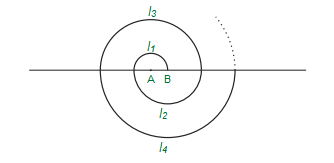
We know,
Perimeter of a semi-circle = πr
Calculating ,
P1 = π(0.5) = π/2 cm
P2 = π(1) = π cm
P3 = π(1.5) = 3π/2 cm
Where, P1, P2, P3 are the lengths of the semi-circles respectively.
Now, this forms a series, such that,
π/2, π, 3π/2, 2π, ….
P1 = π/2 cm
P2 = π cm
Common difference, d = P2 – P1 = π – π/2 = π/2
First term = P1= a = π/2 cm
Sum of nth term,
Sn = n/2 [2a + (n – 1)d]
Therefore, Sum of the length of 13 consecutive circles is;
S13 = 13/2 [2(π/2) + (13 – 1)π/2]
Solving, we get,
= 13/2 [π + 6π]
=13/2 (7π)
= 13/2 × 7 × 22/7
= 143 cm
Solution:
The numbers of logs in rows are in the form of an A.P. 20, 19, 18…
Given,
First term, a = 20 and common difference, d = a2−a1 = 19−20 = −1
Let us assume a total of 200 logs to be placed in n rows.
Thus, Sn = 200
Sum of nth term,
Sn = n/2 [2a +(n -1)d]
S12 = 12/2 [2(20)+(n -1)(-1)]
400 = n (40−n+1)
400 = n (41-n)
400 = 41n−n2
Solving the eq, we get,
n2−41n + 400 = 0
n2−16n−25n+400 = 0
n(n −16)−25(n −16) = 0
(n −16)(n −25) = 0
Now,
Either (n −16) = 0 or n−25 = 0
n = 16 or n = 25
By the nth term formula,
an = a+(n−1)d
a16 = 20+(16−1)(−1)
= 20−15
= 5
And, the 25th term is,
a25 = 20+(25−1)(−1)
= 20−24
= −4
Therefore, 200 logs can be placed in 16 rows and the number of logs in the 16th row is 5, since the number of logs can't be negative as in case of 25th term.
[Hint: to pick up the first potato and the second potato, the total distance (in meters) run by a competitor is 2×5+2×(5+3)]
Solution:
The distances of potatoes from the bucket are 5, 8, 11, 14…, which form an AP.
Now, we know that the distance run by the competitor for collecting these potatoes are two times of the distance at which the potatoes have been kept.
Therefore, distances to be run w.r.t distances of potatoes is equivalent to,
10, 16, 22, 28, 34,……….
We get, a = 10 and d = 16−10 = 6
Sum of nth term, we get,
S10 = 12/2 [2(20)+(n -1)(-1)]
= 5[20+54]
= 5(74)
Solving we get,
= 370
Therefore, the competitor will run a total distance of 370 m.