|
VOOZH | about |
|
VOOZH | about |
The Triangles are fundamental geometric shapes studied in Class 10 Mathematics. They are crucial for understanding the properties and relationships between the angles, sides, and overall structure of the shapes in Euclidean geometry. Exercise 6.1 in Chapter 6 of the NCERT textbook delves into the properties of the triangles and their applications offering the foundation for the more advanced concepts in geometry.
A triangle is a polygon with three edges and three vertices. The sum of the internal angles of the triangle is always 180 degrees. There are several types of triangles classified based on their sides and angles:
Solution:
All circles are similar because they have radius in fixed proportion.
Solution:
All squares are similar because the ratio of corresponding sides are equal.
Solution:
All Equilateral triangles are similar because the ratio of corresponding sides are equal.
Solution:
Two polygons of the same number of sides are similar, if (a) their corresponding angles are equal and (b) their corresponding sides are proportional.
Solution:
(i) Similar figures.
- All rectangular boards are similar
- All circular rings are similar
(ii) Non-similar figures
- A notebook and a pen are non-similar
- A rectangle and a circle are non-similar.
Solution:
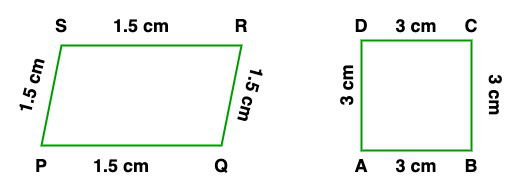
Both the figures are non-similar. For similarity, the corresponding angles should be equal and corresponding sides are in the same ratio. But in this figure ratio of corresponding sides (AB/PQ = AS/PS = DC/SR = CB/RQ = 3/1.5 = 2) but corresponding angles are not equal.