|
VOOZH | about |
|
VOOZH | about |
In this article, we provide detailed solutions to the questions in Exercise 6.2 of Chapter 6: Triangles from the NCERT Class 10 Mathematics textbook. The chapter focuses on various theorems related to triangles, including the Basic Proportionality Theorem (Theorem 6.1) and its converse (Theorem 6.2). These theorems help in understanding the properties of similar triangles and parallel lines.
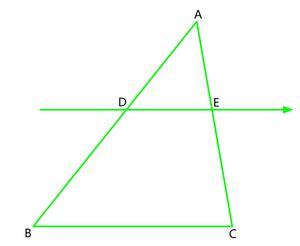
If a line is drawn parallel to one side of a triangle to intersect the other two sides in distinct points, the other two sides are divided in the same ratio.
If a line divides any two sides of a triangle in the same ratio, then the line is parallel to the third side.
Solution:
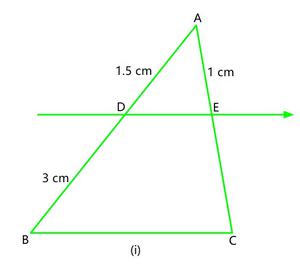
(i) Here, In △ ABC,
DE || BC
So, according to Theorem 6.1
⇒
⇒EC =
EC = 2 cm
Hence, EC = 2 cm.
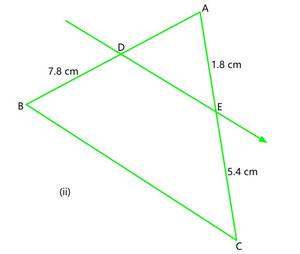
(ii) Here, In △ ABC,
So, according to Theorem 6.1 , if DE || BC
⇒
⇒AD =
AD = 2.4 cm
Hence, AD = 2.4 cm.
Solution:
According to the Theorem 6.2,
If a line divides any two sides of a triangle in the same ratio, then the line is parallel to the third side.
So, lets check the ratios
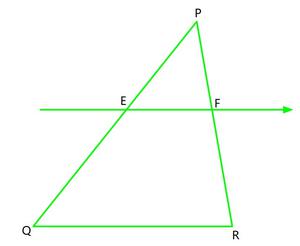
Here, In △ PQR,
= 1.3 ...........................(i)
= 1.5 ...........................(ii)
As,
Hence, EF is not parallel to QR.
Solution:
According to the Theorem 6.2,
If a line divides any two sides of a triangle in the same ratio, then the line is parallel to the third side.
So, lets check the ratios
Here, In △ PQR,
...........................(i)
...........................(ii)
As,
Hence, EF is parallel to QR.
Solution:
EQ = PQ - PE = 1.28 - 0.18 = 1.1
and, FR = PR - PF = 2.56 - 0.36 = 2.2
According to the Theorem 6.2,
If a line divides any two sides of a triangle in the same ratio, then the line is parallel to the third side.
So, lets check the ratios
Here, In △ PQR,
...........................(i)
...........................(ii)
As,
Hence, EF is parallel to QR.
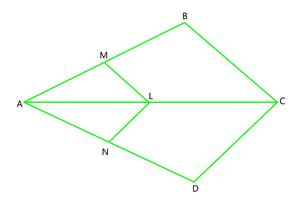
Solution:
Here, In △ ABC,
According to Theorem 6.1, if LM || CB
then,..................................(I)
and, In △ ADC,
According to Theorem 6.1, if LN || CD
then,..................................(II)
From (I) and (II), we conclude that
Hence Proved !!
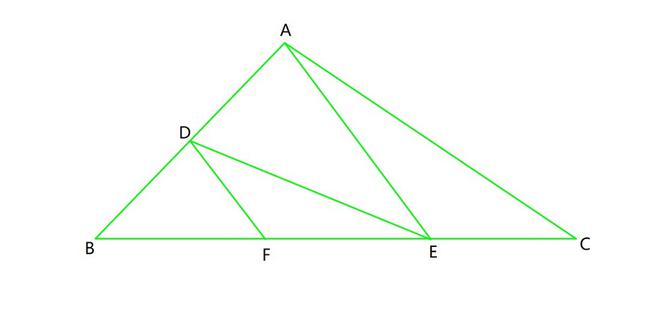
Solution:
Here, In △ ABC,
According to Theorem 6.1, if DE || AC
then,..................................(I)
and, In △ ABE,
According to Theorem 6.1, if DF || AE
then,..................................(II)
From (I) and (II), we conclude that
Hence Proved !!
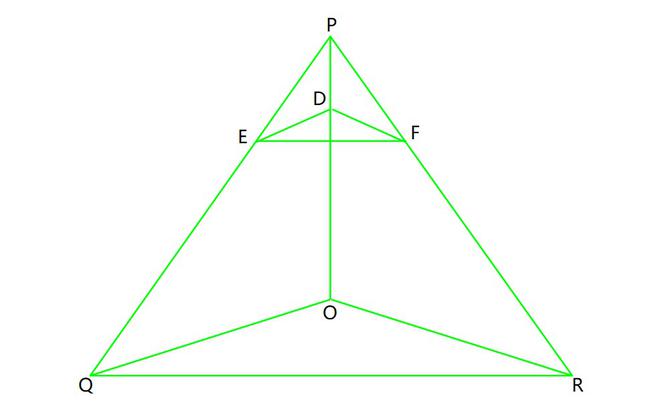
Solution:
Here, In △ POQ,
According to Theorem 6.1, if DE || OQ
then,..................................(I)
and, In △ POR,
According to Theorem 6.1, if DF || OR
then,..................................(II)
From (I) and (II), we conclude that
....................................(III)
According to Theorem 6.2 and eqn. (III)
EF || QR, in △ PQR
Hence Proved !!
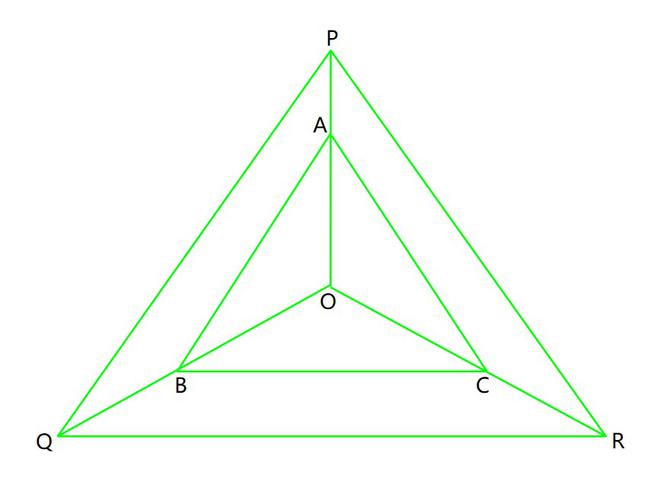
Solution:
Here, In △ POQ,
According to Theorem 6.1, if AB || PQ
then,..................................(I)
and, In △ POR,
According to Theorem 6.1, if AC || PR
then,..................................(II)
From (I) and (II), we conclude that
....................................(III)
According to Theorem 6.2 and eqn. (III)
BC || QR, in △ OQR
Hence Proved !!
Solution:
Given, in ΔABC, D is the midpoint of AB such that AD=DB.
A line parallel to BC intersects AC at E
So, DE || BC.
We have to prove that E is the mid point of AC.
As, AD=DB
⇒= 1 …………………………. (I)
Here, In △ ABC,
According to Theorem 6.1, if DE || BC
then,..................................(II)
From (I) and (II), we conclude that
= 1
= 1
AE = EC
E is the midpoint of AC.
Hence proved !!
Solution:
Given, in ΔABC, D and E are the mid points of AB and AC respectively
AD=BD and AE=EC.
We have to prove that: DE || BC.
As, AD=DB
⇒= 1 …………………………. (I)
and, AE=EC
⇒= 1 …………………………. (II)
From (I) and (II), we conclude that
= 1 ...................(III)
According to Theorem 6.2 and eqn. (III)
DE || BC, in △ ABC
Hence Proved !!
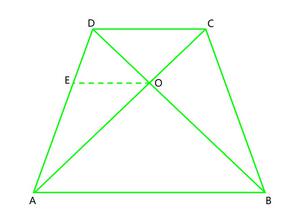
Solution:
From the point O, draw a line EO touching AD at E, in such a way that,
EO || DC || AB
Here, In △ ADB,
According to Theorem 6.1, if AB || EO
then,..................................(I)
and, In △ ADC,
According to Theorem 6.1, if AC || PR
then,..................................(II)
From (I) and (II), we conclude that
After rearranging, we get
Hence Proved !!
Solution:
From the point O, draw a line EO touching AD at E, in such a way that,
EO || DC || AB
Here, In △ ADB,
According to Theorem 6.1, if AB || EO
then,..................................(I)
(Given)
(After rearranging) ......................................(II)
From (I) and (II), we conclude that
......................................(III)
According to Theorem 6.2 and eqn. (III)
EO || DC and also EO || AB
⇒ AB || DC.
Hence, quadrilateral ABCD is a trapezium with AB || CD.
Chapter 6 of Class 10 Mathematics delves into the properties of triangles, particularly focusing on theorems that deal with parallel lines and proportional segments. The exercises help solidify the understanding of these concepts by applying theorems to solve various geometric problems.