|
VOOZH | about |
|
VOOZH | about |
Chapter 6 of the NCERT Class 10 Mathematics textbook covers the topic of Triangles. Exercise 6.3 specifically deals with the various properties and theorems related to the triangles focusing on proving certain geometric statements.
This exercise is fundamental for grasping the concepts of similarity and congruence in triangles which are essential for the A triangle is a three-sided polygon that consists of the three edges and three vertices.
Solution:
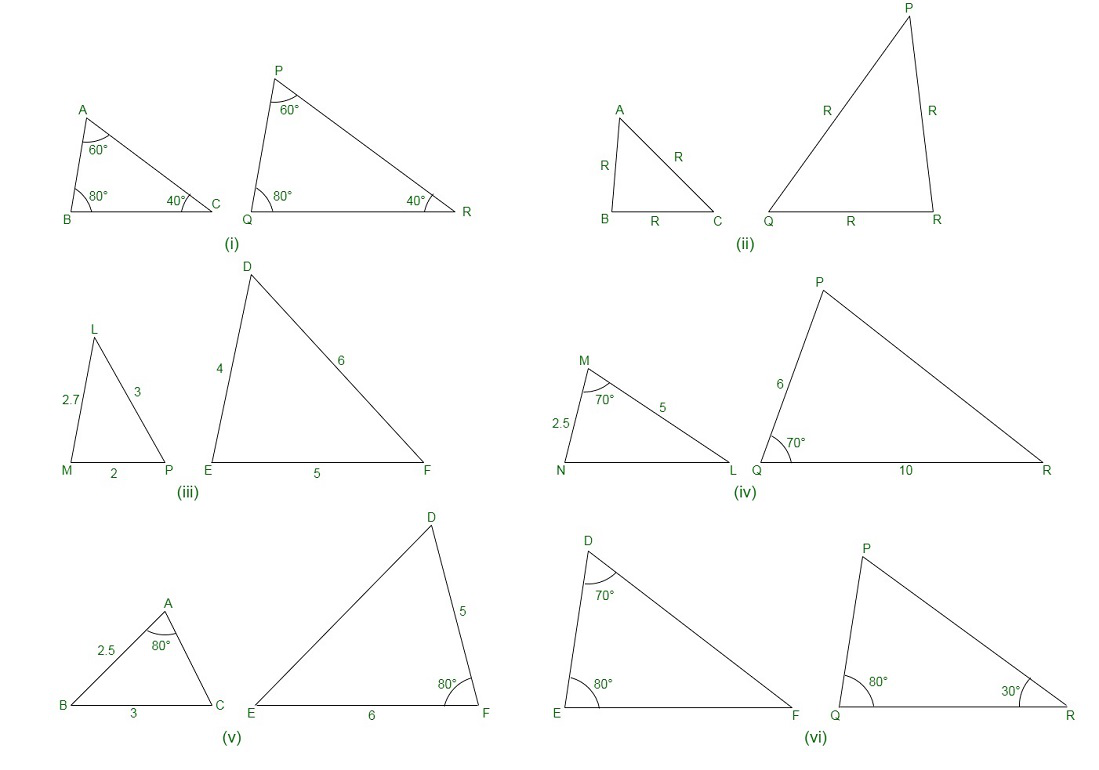
(i) We have, in ΔABC and ΔPQR,
∠A = ∠P = 60°
∠B = ∠Q = 80°
∠C = ∠R = 40°
By AAA similarity criterion, we have
∴ ΔABC ~ ΔPQR
(ii) We have, in ΔABC and ΔPQR,
Computing the ratios of corresponding sides,
AB/QR = 2.5/5 = 1/2
BC/RP = 2/4 = 1/2
CA/PQ = 3/6 = 1/2
AB/QR = BC/RP = CA/PQ
Now,
By SSS similarity criterion, we have
ΔABC ~ ΔQRP
(iii) We have, in ΔLMP and ΔDEF,
Now,
LM = 2.7, MP = 2, LP = 3, EF = 5, DE = 4, DF = 6
Computing the ratios of the corresponding sides,
MP/DE = 2/4 = 1/2
PL/DF = 3/6 = 1/2
LM/EF = 2.7/5 = 27/50
Since, MP/DE = PL/DF ≠ LM/EF
Therefore, ΔLMP and ΔDEF are not similar.
(iv) In ΔMNL and ΔQPR, it is given,
Computing the ratios of the corresponding sides,
MN/QP = ML/QR = 1/2
And,
∠M = ∠Q = 70°
By SAS similarity criterion
ΔMNL ~ ΔQPR
(v) In ΔABC and ΔDEF, we have,
AB = 2.5, BC = 3, ∠A = 80°, EF = 6, DF = 5, ∠F = 80°
Computing the ratios of the corresponding sides,
AB/DF = 2.5/5 = 1/2
And, BC/EF = 3/6 = 1/2
⇒ ∠B ≠ ∠F
Therefore, ΔABC and ΔDEF are not similar.
(vi) In ΔDEF,
By angle sum property of a triangle,
∠D + ∠E + ∠F = 180°
⇒ 70° + 80° + ∠F = 180°
⇒ ∠F = 180° – 70° – 80°
⇒ ∠F = 30°
Similarly, In ΔPQR,
By angle sum property of a triangle,
∠P + ∠Q + ∠R = 180
⇒ ∠P + 80° + 30° = 180°
⇒ ∠P = 180° – 80° -30°
⇒ ∠P = 70°
Now, in ΔDEF and ΔPQR, we have
∠D = ∠P = 70° [equal corresponding angles]
∠F = ∠Q = 80°
∠F = ∠R = 30°
Therefore,
By AAA similarity criterion,
ΔDEF ~ ΔPQR
Solution:
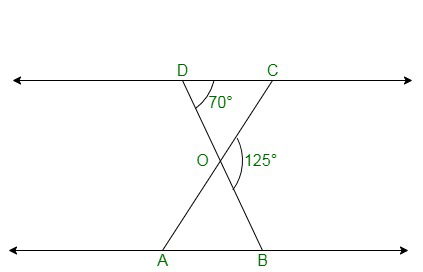
We know, DOB is a straight line, as given.
Therefore, ∠DOC + ∠COB = 180°
Also,
∠BOC = 125°
⇒ ∠DOC = 180° – 125°
= 55°
In ΔDOC
By angle sum property of a triangle,
∠DCO + ∠CDO + ∠DOC = 180°
∠CDO = 70°
⇒ ∠DCO + 70º + 55º = 180°
⇒ ∠DCO = 55°
Also, given,
ΔODC ∝ ¼ ΔOBA,
Therefore, ΔODC ~ ΔOBA.
Since, we know that the corresponding angles are equal in similar triangles,
Therefore, ∠OAB = ∠OCD
⇒ ∠ OAB = 55°
∠OAB = ∠OCD
∠OAB = 55°
Solution:
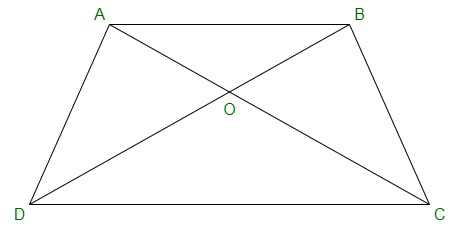
👁 ImageIn ΔDOC and ΔBOA,
Since, AB || CD, therefore the alternate interior angles are equal,
That is, ∠CDO = ∠ABO ....(i)
And,
∠DCO = ∠BAO ...(ii)
Also, vertically opposite angles are equal;
That is,∠DOC = ∠BOA...(iii)
Hence, by AAA similarity criterion,
ΔDOC ~ ΔBOA [From eq(i) , (ii) and (iii)]
Since the triangles are similar, therefore the corresponding sides are proportional.
DO/BO = OC/OA
⇒OA/OC = OB/OD
Hence, proved.
Solution:
We have,
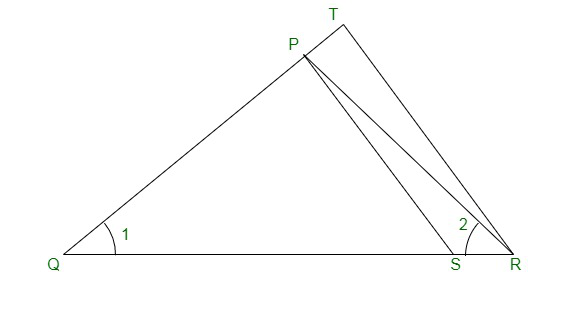
In ΔPQR,
∠PQR = ∠PRQ
That is, PQ = PR .…(i)
Given,
QR/QS = QT/PR
By using eq(i), we obtain,
QR/QS = QT/QP …….(ii)
In ΔPQS and ΔTQR,
QR/QS = QT/QP [By using eq(ii)]
∠Q = ∠Q
By SAS similarity criterion, therefore,
ΔPQS ~ ΔTQR
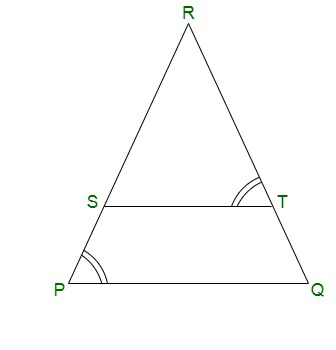
Solution:
We know,
S and T are the points on sides PR and QR of ΔPQR.
And, ∠P = ∠RTS.
👁 ImageIn ΔRPQ and ΔRTS,
Given,
∠RTS = ∠QPS
∠R = ∠R (Common angle)
By AAA similarity criterion,
∴ ΔRPQ ~ ΔRTS
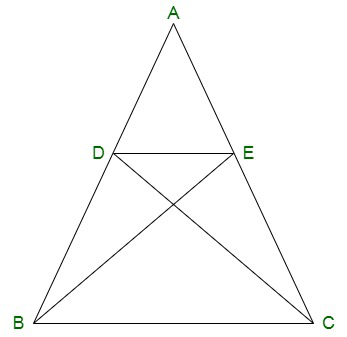
Solution:
Given, ΔABE ≅ ΔACD.
By CPCT, we have
∴ AB = AC ……….(i)
And, AD = AE …………(ii)
In ΔADE and ΔABC,
On dividing the eq.(ii) by eq(i), we obtain,
AD/AB = AE/AC
Also, by common angle,
∠A = ∠A
By SAS similarity criterion, we have,
∴ ΔADE ~ ΔABC
(i) ΔAEP ~ ΔCDP
(ii) ΔABD ~ ΔCBE
(iii) ΔAEP ~ ΔADB
(iv) ΔPDC ~ ΔBEC
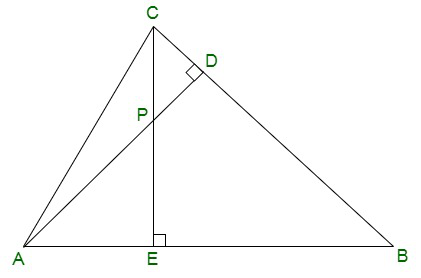
Solution:
Given, altitudes AD and CE of ΔABC intersect each other at the point P.
(i) In ΔAEP and ΔCDP,
Since, both of the angles are 90° each.
∠AEP = ∠CDP
Since,
∠APE = ∠CPD (Vertically opposite angles)
By AA similarity criterion, we have,
ΔAEP ~ ΔCDP
(ii) In ΔABD and ΔCBE,
Since, both of the angles are 90° each.
∠ADB = ∠CEB
∠ABD = ∠CBE (Common Angles)
By AA similarity criterion, we have,
ΔABD ~ ΔCBE
(iii) In ΔAEP and ΔADB,
Since, both of the angles are 90° each.
∠AEP = ∠ADB
∠PAE = ∠DAB (Common angles)
By AA similarity criterion, we have,
ΔAEP ~ ΔADB
(iv) In ΔPDC and ΔBEC,
Since, both of the angles are 90° each.
∠PDC = ∠BEC
∠PCD = ∠BCE (Common angles)
By AA similarity criterion, we have,
ΔPDC ~ ΔBEC
Solution:
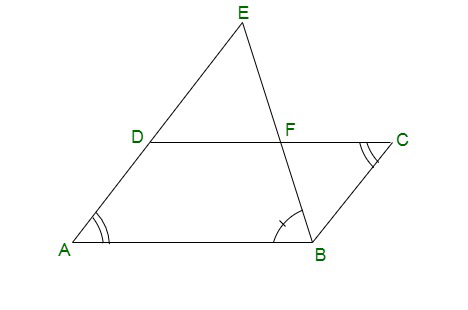
Given,
👁 ImageE is a point on the side AD produced of a parallelogram ABCD and BE intersects CD at F.
Now,
In ΔABE and ΔCFB,
Since, the opposite angles of a parallelogram are equal, we have,
∠A = ∠C
Also, since AE || BC
∠AEB = ∠CBF (Alternate interior angles)
By AA similarity criterion,
∴ ΔABE ~ ΔCFB
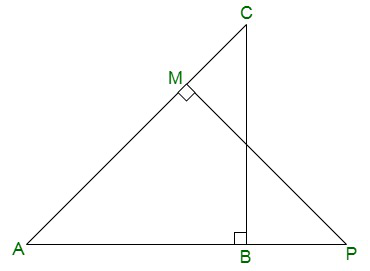
(i) ΔABC ~ ΔAMP
(ii) CA/PA = BC/MP
Solution:
Given,
ABC and AMP are two right triangles, right-angled at B and M respectively.
(i) In ΔABC and ΔAMP, we have,
∠CAB = ∠MAP (common angles)
Since, both of the angles are equivalent to 90°
∠ABC = ∠AMP
By AA similarity criterion, we have,
∴ ΔABC ~ ΔAMP
(ii) As, ΔABC ~ ΔAMP (AA similarity criterion) [proved in part (i)]
Therefore, we know,
If two triangles are similar then the corresponding sides are always equal,
Hence, CA/PA = BC/MP
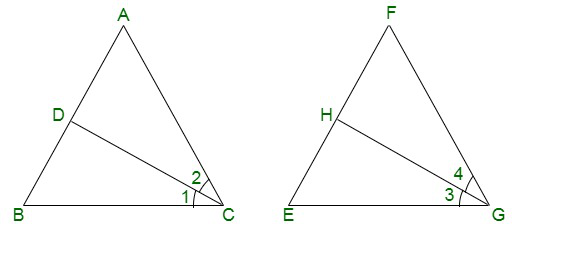
(i) CD/GH = AC/FG
(ii) ΔDCB ~ ΔHGE
(iii) ΔDCA ~ ΔHGF
Solution:
Given,
CD and GH are respectively the bisectors of ∠ACB and ∠EGF such that D and H lie on sides AB and FE of ΔABC and ΔEFG respectively.
👁 Image(i) We have,
ΔABC ~ ΔFEG.
Therefore,
∠A = ∠F, ∠B = ∠E, and ∠ACB = ∠FGE
Now, since,
∠ACB = ∠FGE
∴ ∠ACD = ∠FGH (Angle bisector)
And, ∠DCB = ∠HGE
In ΔACD and ΔFGH,
∠A = ∠F
∠ACD = ∠FGH
By AA similarity criterion, we have,
∴ ΔACD ~ ΔFGH
⇒CD/GH = AC/FG
(ii) In ΔDCB and ΔHGE,
Proved in part (i)
∠DCB = ∠HGE
∠B = ∠E
By AA similarity criterion,
∴ ΔDCB ~ ΔHGE
(iii) In ΔDCA and ΔHGF,
Since, we have already proved,
∠ACD = ∠FGH
∠A = ∠F
By AA similarity criterion,
∴ ΔDCA ~ ΔHGF
Solution:
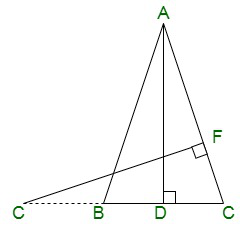
Given, ABC is an isosceles triangle.
Since, the sides of an isosceles triangle are equal, we have,
∴ AB = AC
⇒ ∠ABD = ∠ECF
In ΔABD and ΔECF,
Since, each of the following angles are 90°.
∠ADB = ∠EFC
Since, we have already proved,
∠BAD = ∠CEF
By AA similarity criterion, we have,
∴ ΔABD ~ ΔECF
Solution:
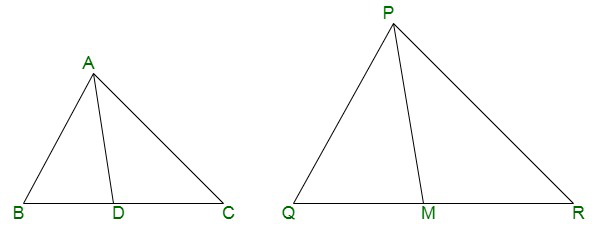
Given that in ΔABC and ΔPQR,
AB is proportional to PQ
BC is proportional to QR
AD is proportional to PM
That is, AB/PQ = BC/QR = AD/PM
We know,
AB/PQ = BC/QR = AD/PM
Since, D is the midpoint of BC and M is the midpoint of QR
⇒AB/PQ = BC/QR = AD/PM
By SSS similarity criterion, we have,
⇒ ΔABD ~ ΔPQM
Now, since the corresponding angles of two similar triangles are equal, we obtain,
∴ ∠ABD = ∠PQM
⇒ ∠ABC = ∠PQR
Now,
In ΔABC and ΔPQR
AB/PQ = BC/QR ………….(i)
∠ABC = ∠PQR ……………(ii)
From equation (i) and (ii), we get,
By SAS similarity criterion, we have,
ΔABC ~ ΔPQR
Solution:
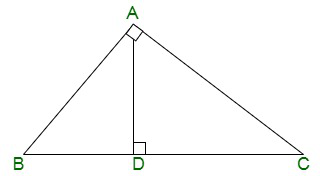
Given, D is a point on the side BC of a triangle ABC such that ∠ADC = ∠BAC.
👁 ImageIn ΔADC and ΔBAC,
∠ADC = ∠BAC
∠ACD = ∠BCA (Common angles)
By AA similarity criterion, we have,
∴ ΔADC ~ ΔBAC
Since, the corresponding sides of similar triangles are in proportion, we obtain,
∴ CA/CB = CD/CA
That is, CA2 = CB.CD.
Hence, proved.
Solution:
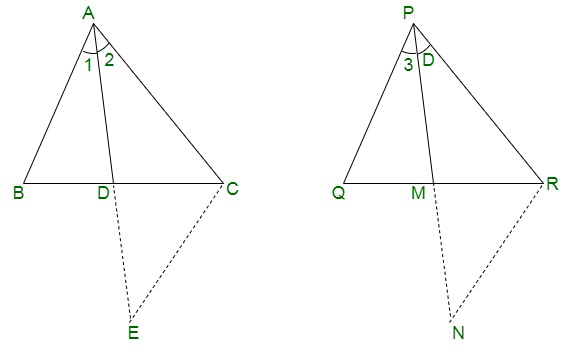
Given, Two triangles ΔABC and ΔPQR in which AD and PM are medians such that;
Now,
AB/PQ = AC/PR = AD/PM
Construction,
Produce AD further to E so that AD = DE. Now, join CE.
Similarly, produce PM further until N such that PM = MN. Join RN.
👁 ImageIn ΔABD and ΔCDE, we have
From the construction done,
AD = DE
Now, since AP is the median,
BD = DC
and, ∠ADB = ∠CDE [Vertically opposite angles are equal]
By SAS criterion,
∴ ΔABD ≅ ΔCDE
By CPCT, we have,
⇒ AB = CE……………..(i)
In ΔPQM and ΔMNR,
From the construction done,
PM = MN
Now, since PM is the median,
QM = MR
and, ∠PMQ = ∠NMR [Vertically opposite angles are equal]
By SAS criterion,
∴ ΔPQM = ΔMNR
By CPCT,
⇒ PQ = RN …………………(ii)
Now, AB/PQ = AC/PR = AD/PM
From equation (i) and (ii), we conclude,
⇒CE/RN = AC/PR = AD/PM
⇒ CE/RN = AC/PR = 2AD/2PM
We know,
2AD = AE and 2PM = PN.
⇒ CE/RN = AC/PR = AE/PN
By SSS similarity criterion,
∴ ΔACE ~ ΔPRN
Thus,
∠2 = ∠4
And, ∠1 = ∠3
∴ ∠1 + ∠2 = ∠3 + ∠4
⇒ ∠A = ∠P ………………….(iii)
Now, in ΔABC and ΔPQR, we have
AB/PQ = AC/PR [Given]
From equation (iii), we have,
∠A = ∠P
By SAS similarity criterion,
∴ ΔABC ~ ΔPQR
Solution:
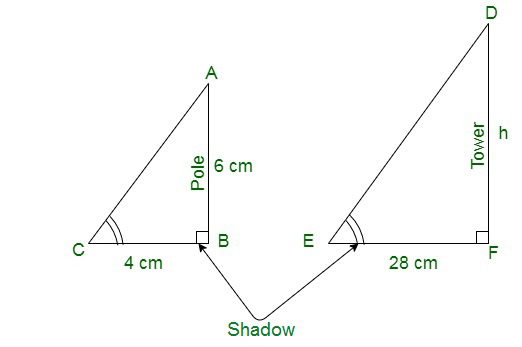
Given, Length of the vertical pole = 6m
Length of shadow of the tower = 28 m
👁 ImageShadow of the pole = 4 m
Let us assume the height of tower to be h m.
In ΔABC and ΔDEF,
∠C = ∠E (By angular elevation of sum)
Since, the following angles are equivalent to 90°
∠B = ∠F
By AA similarity criterion, we have,
∴ ΔABC ~ ΔDEF
Since, if two triangles are similar corresponding sides are proportional
∴ AB/DF = BC/EF
Substituting values,
∴ 6/h = 4/28
⇒h = (6×28)/4
⇒ h = 6 × 7
⇒ h = 42 m
Hence, the height of the tower specified is 42 m.
Solution:
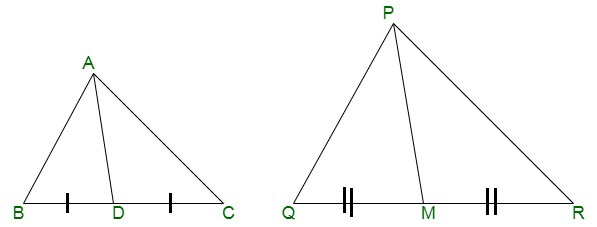
Given, ΔABC ~ ΔPQR
👁 ImageSince, the corresponding sides of similar triangles are in proportion.
∴ AB/PQ = AC/PR = BC/QR……………(i)
And, ∠A = ∠P, ∠B = ∠Q, ∠C = ∠R ………….…..(ii)
Since, AD and PM are the medians, they will divide their opposite sides correspondingly.
∴ BD = BC/2 and QM = QR/2 ………….(iii)
From equations (i) and (iii), we obtain,
AB/PQ = BD/QM …………….(iv)
In ΔABD and ΔPQM,
From equation (ii), we have
∠B = ∠Q
From equation (iv), we have,
AB/PQ = BD/QM
By SAS similarity criterion, we have,
∴ ΔABD ~ ΔPQM
That is, AB/PQ = BD/QM = AD/PM
Exercise 6.3 in Chapter 6 of the NCERT Class 10 Mathematics textbook provides students with the practice problems to reinforce their understanding of the triangles. By solving these exercises, students can apply geometric theorems and properties to the prove statements and solve real-world problems involving the triangles. Mastery of these concepts is crucial for further studies in the geometry and other areas of mathematics.