|
VOOZH | about |
|
VOOZH | about |
Solution:
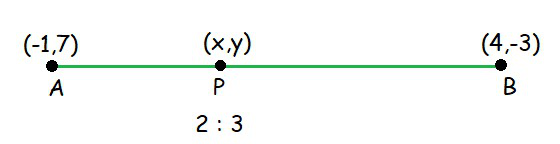
Let the point P (x,y) divides the line AB in the ratio 2:3
👁 Image
where,
m = 2 and n = 3
x1 = -1 and y1 = 7
x2 = 4 and y2 = -3
so, the x coordinate of P will be,
x =
x =
x =
x = 1
and now, the y coordinate of P will be,
y =
y =
y =
y = 3
Hence, the coordinate of P(x,y) is (1,3)
Solution:
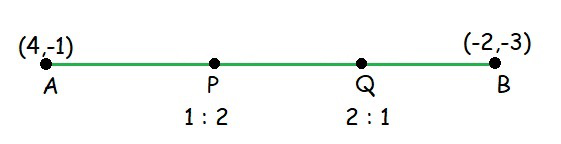
Let the point P (x1,y1) and Q(x2,y2) trisects the line.
So, we can conclude that
P divides the line AB in the ratio 1:2.
and Q divides the line AB in the ratio 2:1.
👁 Image
m = 1 and n = 2
x1 = 4 and y1 =-1
x2 = -2 and y2 = -3
so, the x coordinate of P will be,
x =
x =
x = 2
and now, the y coordinate of P will be,
y =
y =
y =
Hence, the coordinate of P is (2,).
m = 2 and n = 1
x1 = 4 and y1 =-1
x2 = -2 and y2 = -3
so, the x coordinate of Q will be,
x =
x =
x = 0
and now, the y coordinate of Q will be,
y =
y =
y =
Hence, the coordinate of Q is (0,).
Solution:
As the given data,
AD = 100 m
Preet posted red flag at of the distance AD
= ( ×100) m
= 20m from the starting point of 8th line.
Therefore, the coordinates of this point will be (8, 20).
Similarly, Niharika posted the green flag at th of the distance AD
= ( ×100) m
= 25m from the starting point of 2nd line.
Therefore, the coordinates of this point will be (2, 25).
Distance between these flags can be calculated by using distance formula,
Distance between two points having coordinates (x1,y1) and (x2,y2) = √((x1-x2)2 + (y1-y2)2)
Distance between these flags = √((8-2)2 + (20-25)2)
= √(62 + 52)
Distance between these flags = √61 m
Now as, Rashmi has to post a blue flag exactly halfway between the two flags. Hence, she will post the blue flag in the mid- point of the line joining these points. where,
m = n =1
(x1,y1) = (8, 20)
(x2,y2) = (2, 25)
x =
x =
x =
x = 5
and now, the y coordinate of Q will be,
y =
y =
y =
y = 22.5
Hence, Rashmi should post her blue flag at 22.5m on 5th line.
Solution:
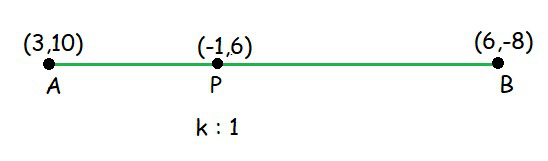
Lets consider the ratio in which the line segment joining (-3, 10) and (6, -8) is divided by point (-1, 6) be k :1.
👁 Image
m = k and n =1
(x1,y1) = (3, 10) and (x2,y2) = (6,-8)
x = -1
x =
-1 =
-1(k+1) = 6k+3
k =
Hence, the required ratio is 2:7.
Solution:
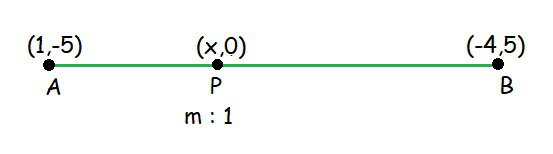
Let the point P divides the line segment joining A (1, – 5) and B (– 4, 5) in the ratio m : 1.
Therefore, the coordinates of the point of division, say P(x, y) and,
We know that y-coordinate of any point on x-axis is 0.
P(x, 0)
👁 Image
m = m and n = 1
(x1,y1) = (1, -5)
(x2,y2) = (-4,5)
so, as the y coordinate of P is 0,
y =
0 =
5m-5=0
m = 1
So, x-axis divides the line segment in the ratio 1:1.
and, x =
x =
x =
Hence, the coordinate of P is (,0).
Solution:
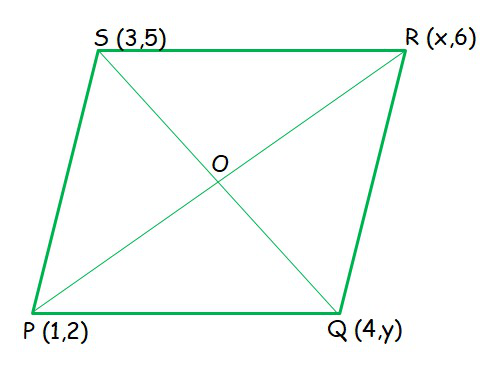
Let P, Q, R and S be the points of a parallelogram : P(1,2), Q(4,y), R(x,6) and S(3,5).
👁 Image
Mid point of PR = Mid point of QS (The diagonals of a parallelogram bisect each other, the midpoint O is same)
- Mid point of PR
m = 1 and n = 1
(x1,y1) = (1, 2)
(x2,y2) = (x,6)
so, the x coordinate of O will be,
xo =
xo =
xo =
and now, the y coordinate of O will be,
yo =
yo =
yo = 4
So, the coordinate of O is ( , 4) .................(1)
- For mid point QS
m = 1 and n = 1
(x1,y1) = (3,5)
(x2,y2) = (4,y)
so, the x coordinate of O will be,
xo =
xo =
xo =
and now, the y coordinate of O will be,
yo =
yo =
yo =
also , the coordinate of O is .................(2)
From (1) and (2)
and 4 =
x = 6 and y = 3
Solution:
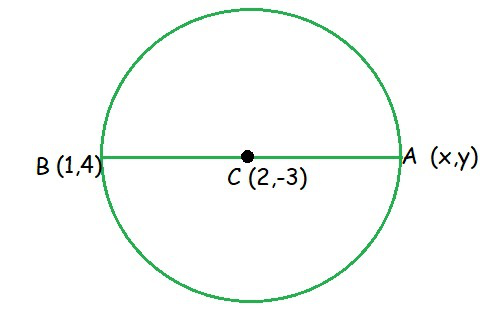
Let the coordinates of point A be (x, y).
Mid-point of AB is C(2, – 3), which is the centre of the circle.
and, Coordinate of B = (1, 4)
👁 Image
For mid point of two points (x1,y1) and (x2,y2)
x =
y =
By using this formula, we get
(2, -3) = ,
= 2 and = -3
x + 1 = 4 and y + 4 = -6
x = 3 and y = -10
The coordinates of A (3,-10).
Solution:
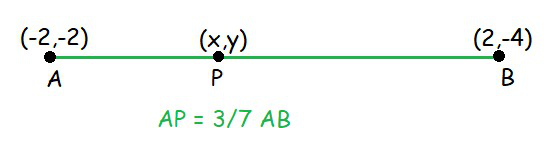
The coordinates of point A and B are (-2,-2) and (2,-4) respectively. Since AP = AB
👁 Image
= --------(1)
subtract 1 from both sides,
- 1 = - 1
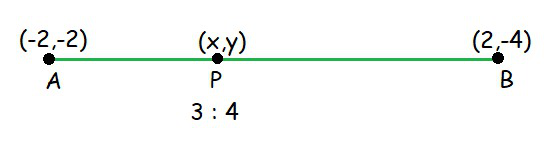
Therefore, AP: PB = 3:4
Point P divides the line segment AB in the ratio 3:4.
👁 Image
Here,
m = 3 and n = 4
(x1,y1) = (-2,-2)
(x2,y2) = (2,-4)
so, the x coordinate of P will be,
x =
x =
x =
and now, the y coordinate of P will be,
y =
y =
y = \frac{-20}{7}
Hence, the coordinate of P(x,y) is .
Solution:
Line segment joining A(– 2, 2) and B(2, 8) divided into four equal parts.
👁 Image
- We can say that Q is the mid point of AB
Here,
m = 1 and n = 1
(x1,y1) = (-2,2)
(x2,y2) = (2,8)
so, the x coordinate of Q will be,
x =
x =
x = 0
and now, the y coordinate of Q will be,
y = \mathbf{\frac{my_2 + ny_1}{m+n}}
y =
y = 5
Hence, the coordinate of Q is (0,5)...................................(1)
- We can say that P is the mid point of AQ
Here,
m = 1 and n = 1
(x1,y1) = (-2,2)
(x2,y2) = (0,5)
so, the x coordinate of P will be,
x =
x =
x = -1
and now, the y coordinate of P will be,
y =
y =
y =
Hence, the coordinate of P is (-1,)...................................(2)
- Now, we can say that R is the mid point of BQ
Here,
m = 1 and n = 1
(x1,y1) = (2,8)
(x2,y2) = (0,5)
so, the x coordinate of R will be,
x =
x =
x = 1
and now, the y coordinate of R will be,
y =
y =
y =
Hence, the coordinate of R is (1,)...................................(3)
From (1), (2) and (3) we conclude that
Three points between A and B are (-1,), (0,5) and (1,).
Solution:
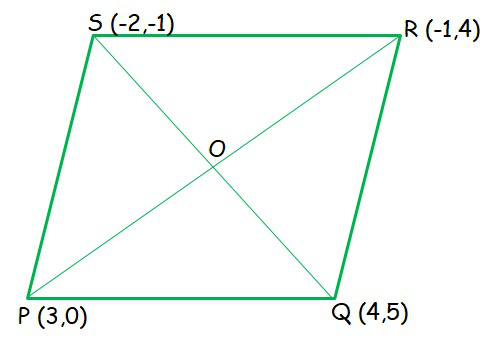
Let P(3, 0), Q (4, 5), R(– 1, 4) and S (– 2, – 1) are the vertices of a rhombus PQRS.
👁 Image
Area of a rhombus = ½ (product of its diagonals)
Length of diagonal 1 (PR) = √((3-(-1))2+(0-4)2) = √32 = 4√2 units
Length of diagonal 2 (QS) = √((4-(-2))2+(5-(-1))2) = √72 = 6√2 units
Area of a rhombus = ½ × 4√2 × 6√2
Area of a rhombus = 24 sq. units