|
VOOZH | about |
|
VOOZH | about |
Given: 2x + y – 4 = 0 line divides the line segment joining the points A(2, -2) and B(3, 7)
Find: Ratio in which the given line divides the line segment joining the points A and B
So, the co-ordinates of C is
Now, let us considered the ratio is k:1
=
=
But c lies on 2x+y-4=0
So,
2 - 4 = 0
9k = 2
k/1 = 2/9
Hence, the ratio is 2:9
Find: Here, we have to find a relation between x and y, if the points (x, y), (1, 2), and (7, 0) are collinear.
If the given points are collinear then the area of the triangle is 0(created using these points).
So,
Area of triangle = 1/2[x1(y2 - y3) + x2(y3 - y1) + x3(y1 - y2)] = 0
=> x(2 - 0) + 1(0 - y) + 7(y - 2) = 0
=> x(2)+ 1(-y) + 7y - 14 = 0
=> 2x - y + 7y - 14 = 0
=> 2x + 6y - 14 = 0
On dividing by 2 on both sides, we get
x + 3y - 7 = 0
Hence, the required relation is x + 3y - 7 = 0
Let us considered point A(6, -6), B(3, -7), and C(3, 3) and P(x, y) is the center of the circle.
So, AP = BP = CP(radii are equal)
Now first we take
AP = BP
√((x2 - x1)2 + (y2 - y1)2) = √((x2 - x1)2 + (y2 - y1)2)
(x - 6)2 + (y + 6)2 = (x - 3)2 + (y + 7)2
x2 + 36 - 12x + y2 + 36 + 12y = x2 + 9 - 6x + y2 + 49 + 14y
36 - 12x + 36 + 12y = 9 - 6x + 49 + 14y
-12x + bx + 12y - 14y + 72 - 58 = 0
-6x - 2y + 14 = 0
6x + 2y - 14 = 0
On divided by 2 on both side, we get
3x + y - 7 = 0 -(1)
Now, we take
BP = CP
√((x2 - x1)2 + (y2 - y1)2) = √((x2 - x1)2 + (y2 - y1)2)
(x - 3)2 + (y + 7)2 = (x - 3)2 + (y - 3)2
y2 + 72 + 2(y)(7) = y2 + 32 - 2(y)(3)
49 + 14y = 9 - 6y
14y + 6y = 9 - 49
20y = -40
y = -40/20
y = -2
Now, on putting value of y = -2 in eq(1), we get
3x - 2 - 7 = 0
3x - 9 = 0
3x = 9
X = 9/3 = 3
Hence, the center P(x, y) = (3, -2)
Let us considered ABDC is a square, and its two opposite vertices are A(-1, 2) and C(3, 2).
Let point O intersect line AC and BD.
Now, first we will find the coordinate of point O(x, y)
As we know that O is the mid point of line AC,
x = (3 - 1)/2 = 1
y = (2 + 2)/2 = 2
So, the coordinate of point O is (1, 2)
Now we will find the side of the Square
AC = √((3 + 1)2 + (2 - 2)2)
AC = √16 = 4
So in triangle ACD, using hypotenuse theorem, we get
a = 2√2
So, each side of the square is 2√2
For the coordinate of D:
Let us assume that the coordinate of D is (x1, y1).
As we know that the sides of the squares are equal
so, AD = CD
√((x2 - x1)2 + (y2 - y1)2) = √((x2 - x1)2 + (y2 - y1)2)
√(x1 + 1)2 + (y1 - 2)2 = √(x1 - 3)2 + (y1 - 2)2
(x1 + 1)2 + (y1 - 2)2 = (x1 - 3)2 + (y1 - 2)2
(x1 + 1)2 = (x1 - 3)2
x12 + 1 + 2x1 = x12 + 9 - 6x1
1 + 2x1 = 9 - 6x1
2x1 + 6x1 = 9 - 1
8x1 = 8
x1 = 1
Now, CD2 = ((x2 - x1)2 + (y2 - y1)2)
8 = (x1 - 3)2 + (y1 - 2)2
8 = x12 + 9 - 6x1 + y12 + 4 - 4y1
y1 - 2 =2
y1 = 4
So the coordinate of D is (1, 4)
For the coordinate of B:
Let B(x2, y2) and as we know BOD is a line segment so,
1 = x2 + 1/2
x2 = 1
2 = y2 + 4/2
y2 = 0
So the coordinate of B = (1, 0)
(i) Now taking A as an origin the coordinates of the vertices of the triangle are
P = (4, 6)
Q = (3, 2)
R = (6, 5)
(ii) Now taking C as an origin the coordinates of the vertices of the triangle are
P = (12, 2)
Q = (13, 6)
R = (10, 3)
Finding the area of triangle, when A as a origin the coordinates of the vertices
of the triangle are P(4, 6), Q(3, 2), and R(6, 5)
Area1 = 1/2[x1(y2 - y3) + x2(y3 - y1) + x3(y1 - y2)]
= [4(2 - 5) + 3(5 - 6) + 6(6 - 2)]/2
= [-12 - 3 + 24]/2
= [-15 + 24]/2
= 9/2 sq. unit
Finding the area of triangle, when C as a origin the coordinates of the vertices
of the triangle are P(12, 2), Q(13, 6), and R(10, 3)
Area2 = [12(6 - 3) + 13(3 - 2) + 10(2 - 6)]/2
= [12(3) + 13(1) + 10(-4)]/2
= [36 + 13 - 40]/2
= [49 - 40]/2
= 9/2 Sq.unit
So, here we observed that the Area1 = Area2
Solution:
Given: AD/AB = AE/AC = 1/4
To find: Area of ∆ADE
Since D and E divides AB and AC is the same ratio 1:4 then DE||BC -(Using theorem 6.2)
Now, In ∆ADE and ∆ABC
∠A = ∠A -(Common angle)
∠D = ∠B -(Corresponding angles)
∴∆ADE~∆ABC -(AA similarity)
ar.(ADE)/ar.(ABC) = (AD/AB)2 = 1/16
Area of ∆ABC = 1/2[x1(y2 - y3) + x2(y3 - y1) + x3(y1 - y2)]
= [4(5 - 2) + 1(2 - 6) + 7(6 - 5)]/2
= [4(3) + 1(-4) + 7(1)]/2
= [12 - 4 + 7]/2
= [19 - 4]/2
= 15/2 sq.unit
ar.(ADE)/ar.(ABC) = -(1/10)
ar.(ADE) = (1/16) × ar.(ABC)
ar.(ADE) = (1/16) × (15/2) = 15/32 sq.unit
So, we get
ar.(ADE):ar.(ABC) = 1:16
(i) The median from A meters BC at D. Find the coordinates of the point D.
(ii) Find the coordinates of the point P on the AD, such that AP: PD = 2: 1.
(iii) Find the coordinates of points Q and R on medians BE and CF respectively, such that BQ: QE = 2: 1 and CR: RF = 2: 1.
(iv) What do you observe?
[Note: The points which are common to all the three medians is called centroid and this point divides each median in the ratio 2: 1]
(v) If A(x1, y1), B(x2, y2), and C(x3, y3) are the vertices of ∆ABC, find the coordinates of the centroid of the triangles.
Solution:
Given: The vertices of ∆ABC are A(4, 2), B(6, 5) and C(1, 4)
(i) Co-ordinates of D = Midpoint of BC
=
=
= [7/2, 9/2]
= (3.5, 4.5)
(ii) Co-ordinates of P =
=
=
= [11/3, 11/3]
(iii) Co-ordinates E = Midpoint of AC
=
=
= (2.5, 3)
(iv) We observe that the points P, Q and R coincide, i.e the medians of AD, BE, and
concurrent at the point [11/3, 11/3]. This point is known as the centroid of the triangle.
(v) As AD is median, thus D is midpoint of BC
So the co-ordinates of D:
=
=
Co-ordinates of G:
= [\frac{x_2m_1+m_2x_1 }{m_1+m_2},\frac{y_2m_1+y_1m_12}{m_1+m_2}]
Solution:
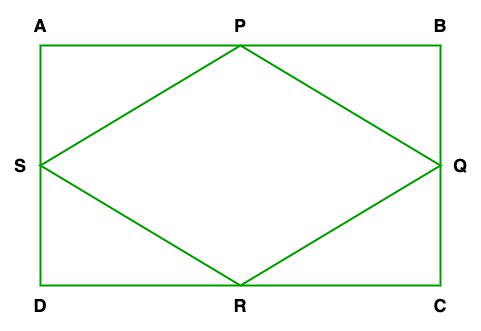
👁 ImageGiven: Points A(-1, -1), B(-1, 4), C(5, 4) and D(5, -1) and P, Q, R and S are the mid-points of AB, BC, CD, and DA
So,
= (-2/2, -1, 3/2)
= (4/2, 8/2) = (2, 4)
= (10/2, 8/2) = (5, 3/2)
= (4/2, -2/2) = (2, 1)
So, the length of
= √(61/4)
The length of
= √(61/4)
The length of
= √(61/4)
The length of
= √(61/4)
The length of the diagonal
= √25 = 5
The length of the diagonal
= √36 = 6
Hence, all fours sides are equal(i.e., PQ = QR = RS = SP) but the diagonals are
not equal to each other(i.e. QS ≠ PR).
Therefore, given quadrilateral PQRS is a rhombus.