|
VOOZH | about |
|
VOOZH | about |
Chapter 9 of the Class 10 NCERT Mathematics textbook focuses on the "Some Applications of Trigonometry" exploring how trigonometric concepts can be applied to solve real-world problems. Exercise 9.1 | Set 2 is designed to reinforce students' understanding of these applications by providing practical problems involving heights and distances. This exercise is crucial for developing problem-solving skills and applying theoretical knowledge to practical scenarios.
In this chapter, students learn to use trigonometric ratios to solve problems related to heights and distances. This involves applying concepts such as the sine, cosine, and tangent functions to real-life situations like calculating the height of the building or the distance between two points. Understanding these applications is important for grasping how trigonometry is used in various fields such as engineering, architecture, and physics. This exercise helps students practice these concepts and develop their analytical skills.
Solution:
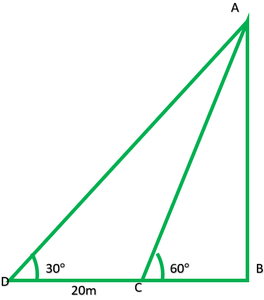
In fig: AB = tower = ?
CB = canal = ?
In rt. ∆ABC,
tan60° =
h/x = √3
h = √3 x -(1)
In rt. ∆ABD
= tan 30°
= 1/√3
h = (x + 20)/√3 -(2)
From (1) and (2)
√3/1 = (x + 20)/√3
3x = x + 20
3x - x = 20
2x = 20
X = 20/2
X = 10
Width of the canal is 10m
Putting value of x in equation 1
h = √3 x
= 1.732(10)
= 17.32
Height of the tower 17.32m.
Solution:
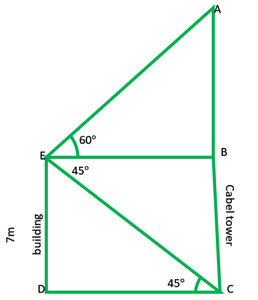
👁 ImageIn fig: ED = building = 7m
AC = cable tower = ?
In rt ∆EDC,
= tan45°
7/x = 1/1
DC = 7
Now, EB = DC = 7m
In rt. ∆ABE,
= tan60°
AB/7 = √3/1
Height of tower = AC = AB + BC
7√3 + 7
= 7(√3 + 1)
= 7(1.732 + 1)
= 7(2.732)
Height of cable tower = 19.125m
Solution:
👁 ImageIn fig:
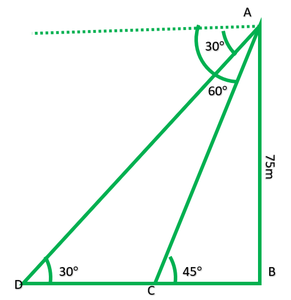
AB = lighthouse = 75m
D and C are two ships
DC = ?
In rt. ∆ABD,
= tan30°
75/BD = 1/√3
BD = 75√3
In rt. ∆ABC
= tan45°
75/BC = 1/1
BC = 75
DC = BD - BC
= 75√3 - 75
75(√3 - 1)
75(1.372 - 1)
34.900
Hence, distance between two sheep is 34.900
Solution:
In fig: AB = AC - BC
= 88.2 - 1.2
= 81m
In rt. ∆ABE
= 87/EB = tan30°
87/EB = 1/√3
EB = 87√3
In rt. ∆FDE
= tan60°
√3 ED = 87
ED = 87/√3
DB = DB - ED
87√3 - 87/√3
87(√3 - 1/√3)
= 87(3 - 1/√3)
= 87(2/√3) = 174/√3 * √3/√3
= 174 * √3/3 = 58√3
58 * 1.732 = 100.456m
Distance traveled by balloon is 100.456m
Solution:
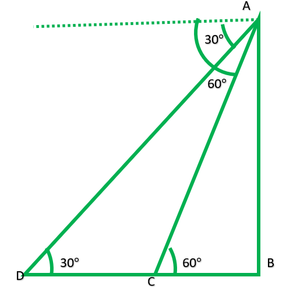
👁 ImageIn fig: AB is tower
In rt. ∆ABD
= tan30°
= 1/√3
DB = √3 AB -(1)
In rt. ∆ABC
= tan60°
BC = AB/√3 -(2)
DC = DB - BC
= √3 AB - AB/√3
AB(3 - 1/√3)
CD = 2AB/√3
S1 = S2
\frac{D1}{T1} = \frac{D2}{T2}
2/√3AB/6 = AB/√3/t
2t = 6
t = 6/2
t = 3sec
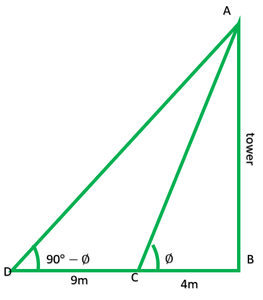
Solution:
👁 ImageIn fig: AB is tower
To prove: AB = 6m
Given: BC = 4m DB = 9m
In ∆ABC
= tanθ
AB/4 = tanθ -(1)
In ∆ABD
= tan (90°-θ)
AB/9 = 1/ tanθ
9/AB = tanθ -(2)
From (1) and (2)
AB/4 = 9/AB
AB2 = 36
AB = √36
AB = √(6 * 6)
AB = 6m
Height of the tower is 6m.
Read More: