|
VOOZH | about |
|
VOOZH | about |
Solution:
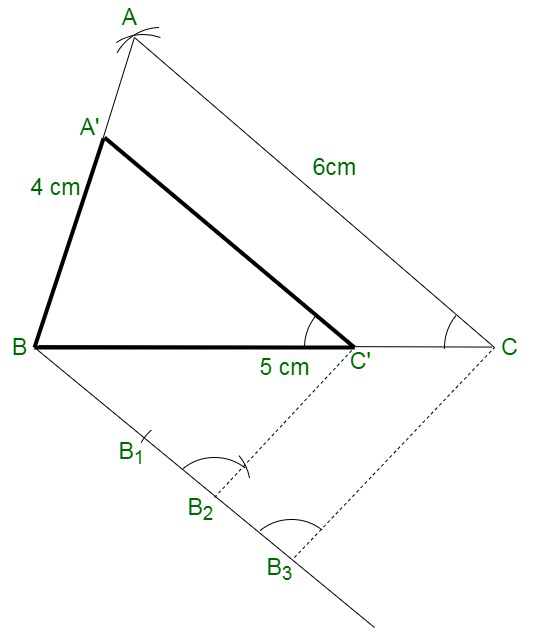
Follow these steps for the construction:
Step 1: Construct a line segment BC of 5 cm.
Step 2: From the centre B take the radius of 4 cm and from the centre C take the radius 6 cm, construct arcs bisecting each other at the point A.
Step 3: Connect the lines AB and AC.
After that we will have ABC as the triangle.
Step 4: Construct a ray BX creating an acute angle with the line BC and break off 3 equal parts creating
BB1 = B1B2 = B2B3.
Step 5: Further connect B3C.
Step 6: Construct B’C’ parallel to B3C and C’A’ parallel to CA
Therefore,
We have the required triangle ΔA’BC’.
Solution:
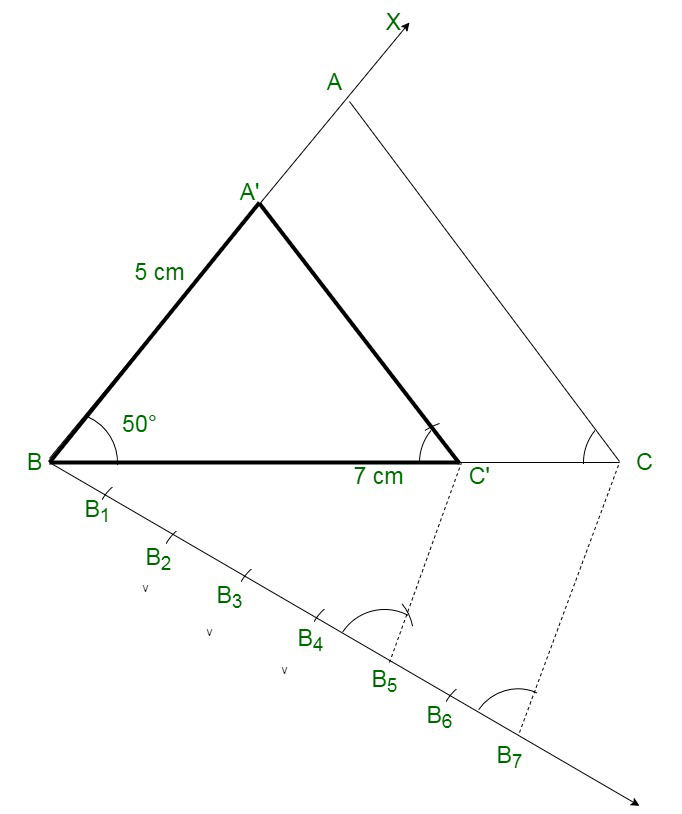
Follow these steps for the construction:
Step 1: Construct a line segment BC of 7 cm.
Step 2: Construct a ray BX an angle of 50° and break off BA = 5 cm.
Step 3: Connect AC.
After that we have ABC is the triangle.
Step 4: Construct a ray BY creating an acute angle with BC and break off 7 equal parts creating
BB = B1B2 = B2B3 = B3B4 = B4Bs = B5B6 = B6B7
Step 5: Now connect B7 and C
Step 6: Construct B5C’ parallel to B7C and C’A’ parallel to CA.
Therefore,
We have the required triangle ΔA’BC’.
Solution:
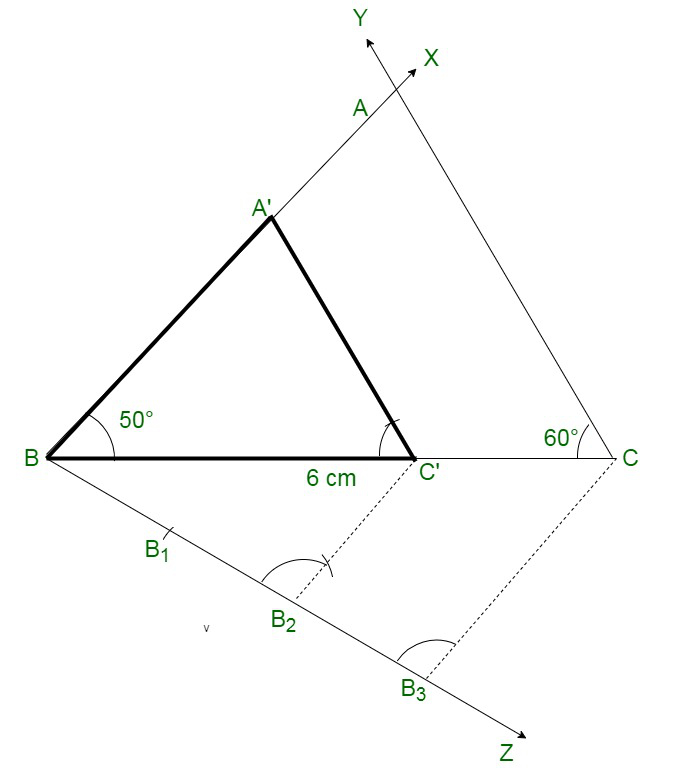
Follow these steps for the construction:
Step 1: Construct a line segment BC of 6 cm.
Step 2: Construct a ray BX creating an angle of 50° and CY creating 60° Along BC which bisect each other at A. After that, ABC is the triangle.
Step 3: From B, Construct one more ray BZ creating an acute angle below BC and intersect 3 equal parts, creating BB1 = B1B2 = B2B2.
Step 4: Connect B3C.
Step 5: From B2, Construct B2C’ parallel to B3C and C’A’ parallel to CA.
Therefore,
We have the required triangle ΔA’BC’.
Solution:
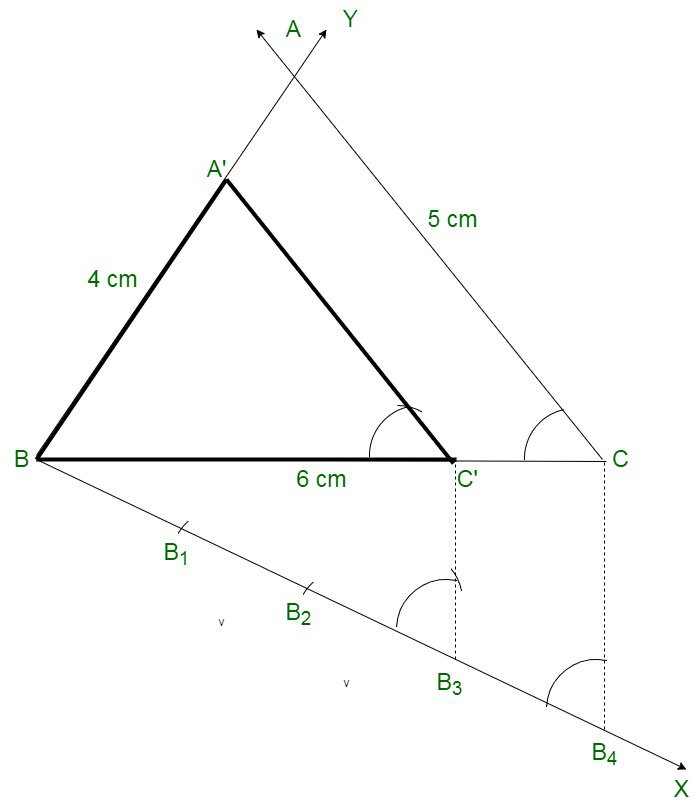
Follow these steps for the construction:
Step 1: Construct a line segment BC of 6 cm.
Step 2: Along centre B and radius 4 cm and Along centre C and radius 5 cm,
Construct arcs’ bisecting each other at A.
Step 3: Connect AB and AC.
After that ABC is the triangle,
Step 4: Construct a ray BX creating an acute angle along BC and break off 4 equal parts creating BB1= B1B2 = B2B3 = B3B4.
Step 5: Connect B4 and C.
Step 6: From B3C Construct C3C’ parallel to B4C and from C’,
Step 7: Construct C’A’ parallel to CA.
Therefore,
We have the required triangle ΔA’BC’.
Solution:
Follow these steps for the construction:
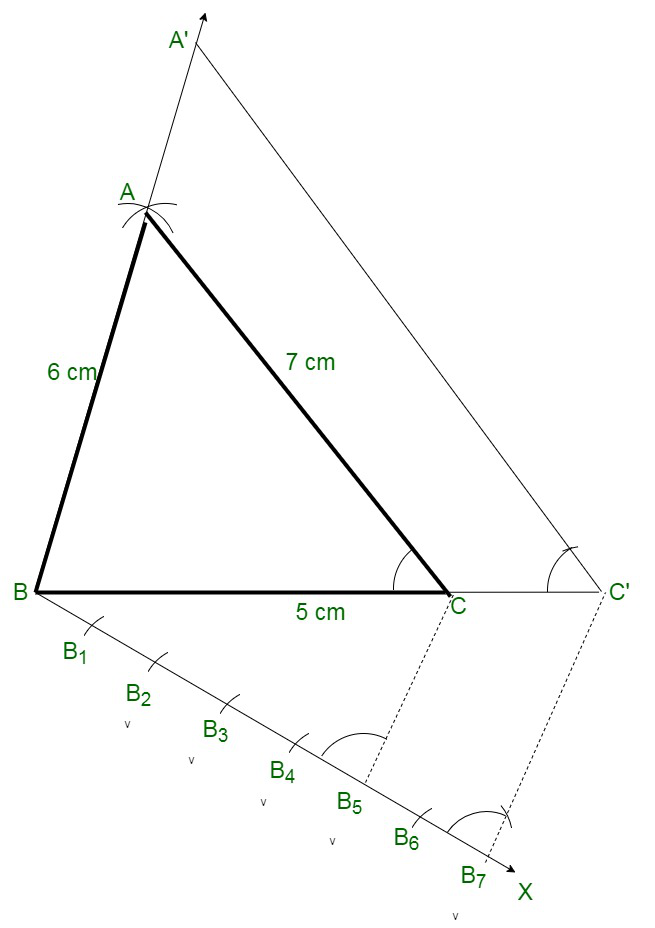
Step 1: Construct a line segment BC of 5 cm.
Step 2: Along centre B and radius 6 cm and Along centre C and radius 7 cm,
Construct arcs bisecting each other at A.
Step 3: Connect AB and AC.
After that ABC is the triangle.
Step 4: Construct a ray BX creating an acute angle along BC and break off 7 equal parts creating
BB1 = B1B2 = B2B3 = B3B4 = B4B5 = B5B6 = B6B7.
Step 5: Connect B5 and C.
Step 6: From B7, Construct B7C’ parallel to B5C and C’A’ parallel CA.
Therefore,
We have the required triangle ΔA’BC’.
Solution:
Follow these steps for the construction:
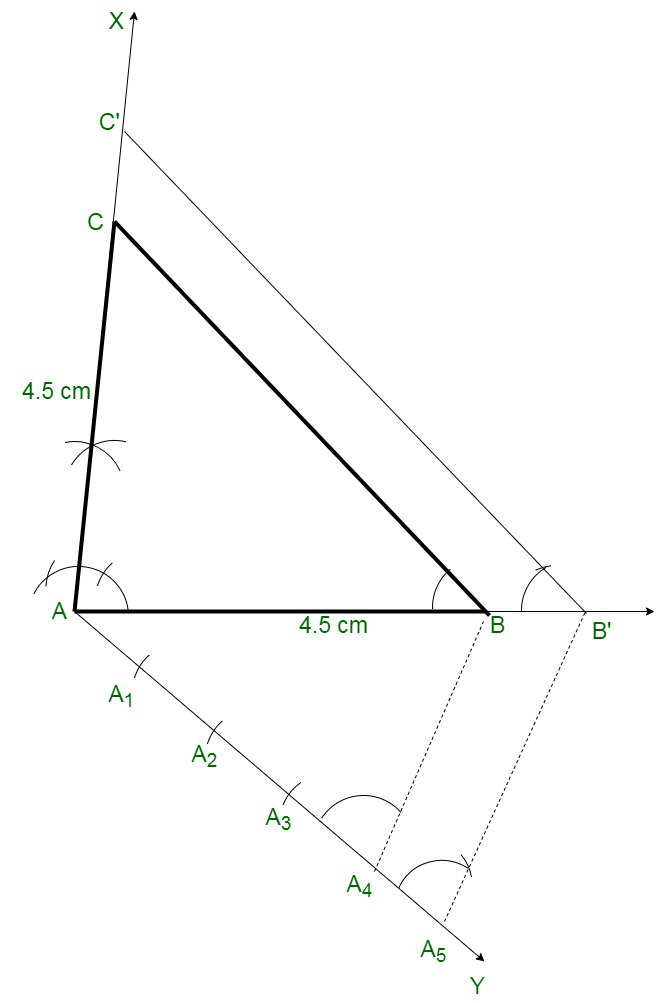
Step 1: Construct a line segment AB of 4.5 cm.
Step 2: At A, Construct a ray AX perpendicular to AB and break off AC = AB = 4.5 cm.
Step 3: Connect BC.
After that ABC is the triangle.
Step 4: Construct a ray AY creating an acute angle along AB and break off 5 equal parts creating
AA1 = A1A2 = A2A3 = A3A4 = A4A5
Step 5: Connect A4 and B.
Step 6: From 45, Construct 45B’ parallel to A4B and B’C’ parallel to BC.
Therefore,
We have the required triangle ΔAB’C’.
Solution:
Follow these steps for the construction:
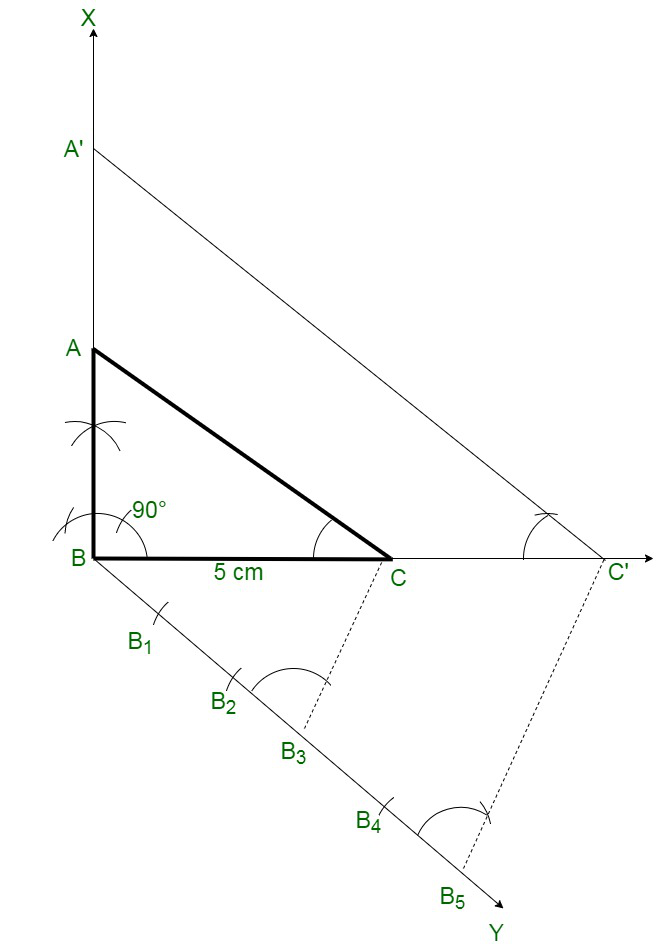
Step 1: Construct a line segment BC of 5 cm.
Step 2: At B, Construct perpendicular BX and break off BA = 4 cm.
Step 3: Connect AC ,
After that ABC is the triangle
Step 4: Construct a ray BY creating an acute angle along BC, and break off 5 equal parts creating
BB1 = B1B2 = B2B3 = B3B4 = B4B5.
Step 5: Connect B3 and C.
Step 6: From B5, Construct B5C’ parallel to B3C and C’A’ parallel to CA.
Therefore,
We have the required triangle ΔA’BC’.
Solution:
Follow these steps for the construction:
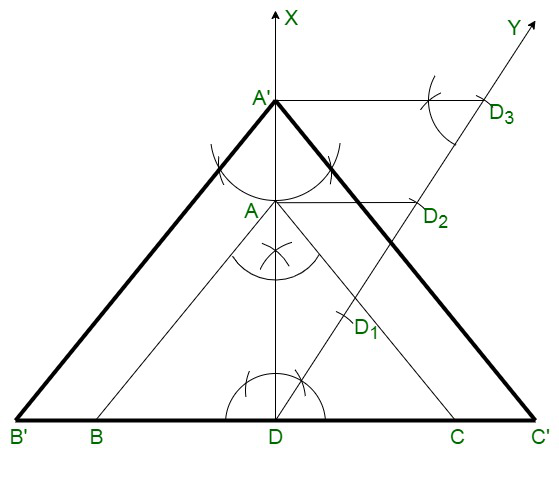
Step 1: Construct a line segment BC of 8 cm.
Step 2: Construct its perpendicular bisector DX and break off DA = 4 cm.
Step 3: Connect AB and AC.
After that ABC is the triangle.
Step 4: Construct a ray DY creating an acute angle along OA and break off 3 equal parts creating
DD1 = D1D2 = D2D3 = D3D4.
Step 4: Connect D2.
Step 5: Construct D3A’ parallel to D2A and A’B’ parallel to AB meeting BC at C’ and B’ respectively.
Therefore,
We have the required triangle ΔB’A’C’.
Solution:
Follow these steps for the construction:
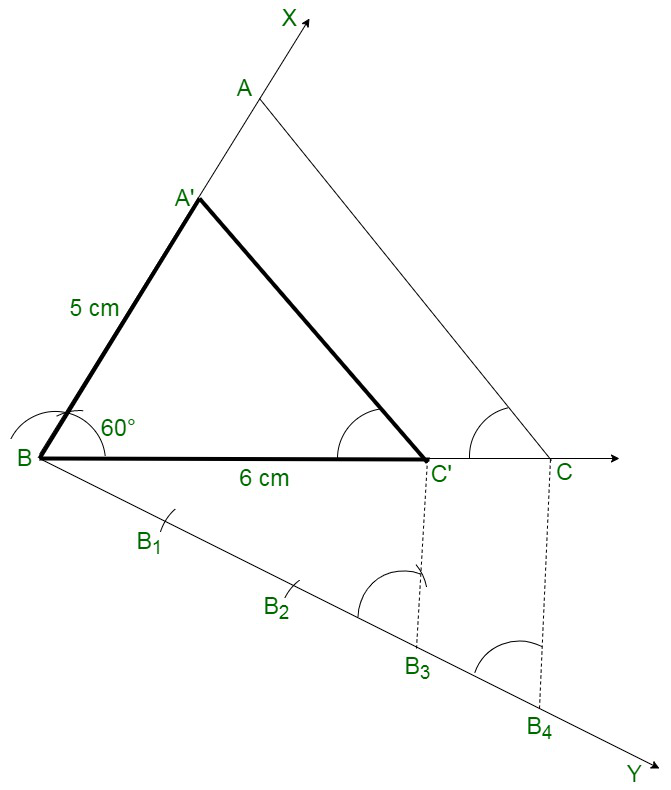
Step 1: Construct a line segment BC of 6 cm.
Step 2: At B, Construct a ray BX creating an angle of 60° Along BC and break off BA of 5 cm.
Step 3: Connect AC. After that ABC is the triangle.
Step 4: Construct a ray BY creating an acute angle along BC and break off 4 equal parts creating
BB1= B1B2 = B2B3=B3B4.
Step 5: Connect B4 and C.
Step 6: From B3, Construct B3C’ parallel to B4C and C’A’ parallel to CA.
Therefore,
We have the required triangle ΔA’BC’.
Solution:
Follow these steps for the construction:
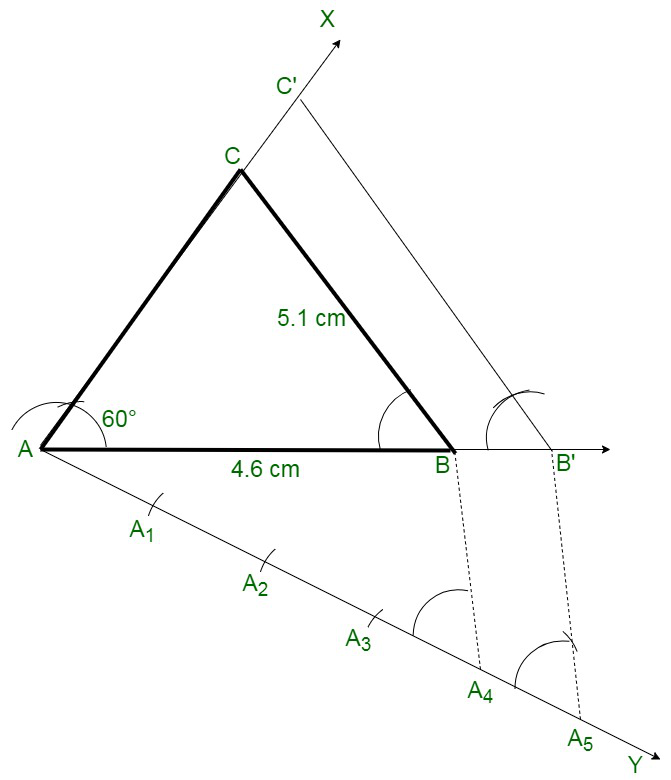
Step 1: Construct a line segment AB of 4.6 cm.
Step 2: At A, Construct a ray AX creating an angle of 60°.
Step 3: Along centre B and radius 5.1 cm.
Construct an arc bisecting AX at C.
Step 4: Connect BC.
After that ABC is the triangle.
Step 5: From A, Construct a ray AX creating an acute angle along AB and break off 5 equal parts creating
AA1 = A1A2 = A2A3 = A3A4=A4A5.
Step 6: Connect A4 and B.
Step 7: From A5, ConstructA5B’ parallel to A4B and B’C’ parallel to BC.
Therefore,
We have the required triangle ΔC’AB’.