|
VOOZH | about |
|
VOOZH | about |
In Chapter 11 of Class 10 RD Sharma, we delve into the topic of "Constructions" where students learn the practical aspects of geometry by drawing various geometric figures. This chapter helps students understand the step-by-step methods to construct specific angles, triangles, and other shapes using geometric tools like a compass, ruler, and protractor. Mastery of these techniques is essential for developing precision and accuracy in geometric constructions.
The Constructions involve creating precise geometric figures using only a compass and a straightedge. This chapter focuses on constructing angles, bisectors, and triangles based on the given measurements. By following systematic steps students can accurately draw shapes that meet the specific requirements outlined in the exercises.
Solution:
👁 ImageFollow these steps for the construction:
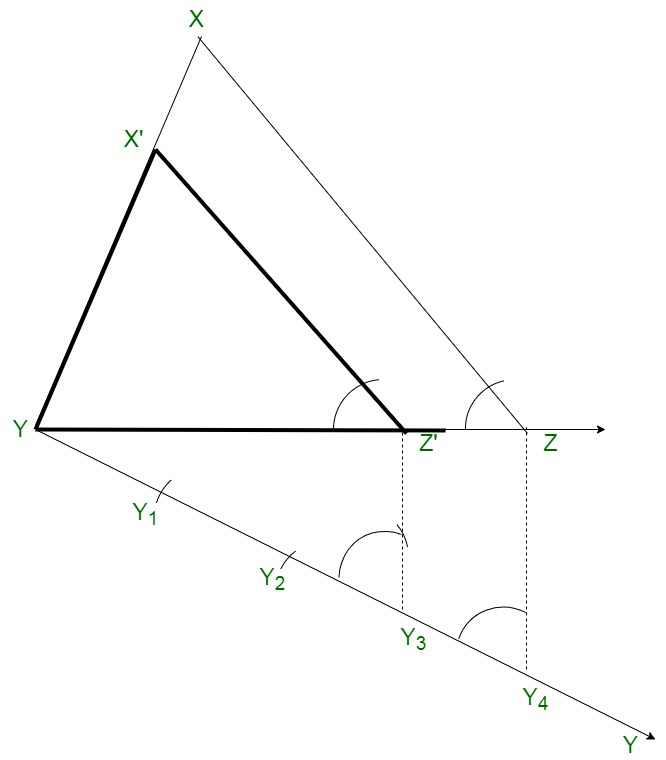
Step 1: Construct a triangle XYZ along some feasible data.
Step 2: Construct a ray YL creating an acute angle along XZ and break off 5 equal parts creating
YY1= Y1Y2 = Y2Y3 = Y3Y4.
Step 3: Connect Y4 and Z.
Step 4: From Y3, construct Y3Z’ parallel to Y4Z and Z’X’ parallel to ZX.
Therefore,
We have the required triangle ΔX’YZ’.
Solution:
👁 ImageFollow these steps for the construction
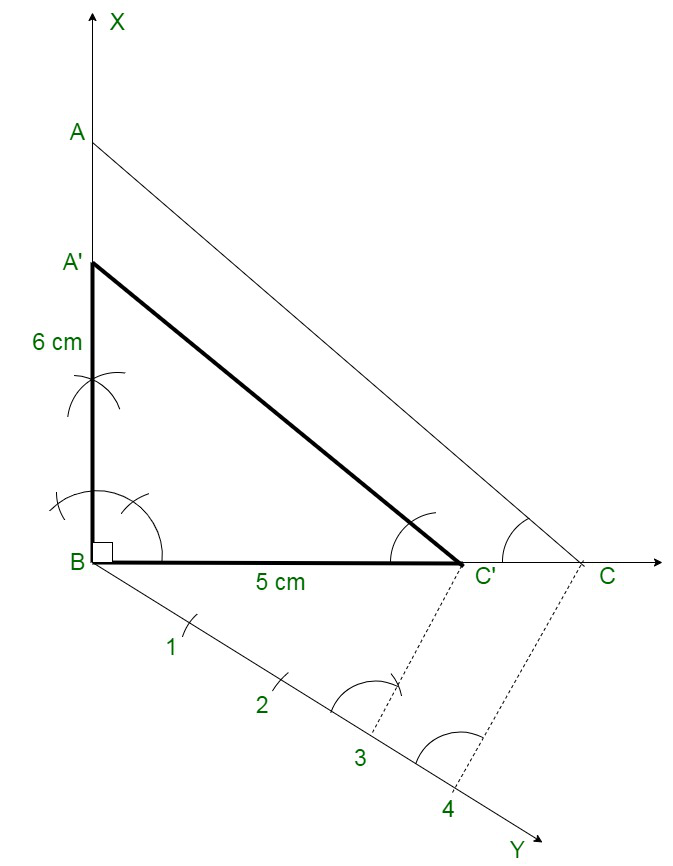
Step 1: Construct right ΔABC right angle at B and BC of 8 cm and BA of 6 cm.
Step 2: Construct a line BY creating a cut angle along BC and break off 4 equal parts.
Step 3: Connect 4C and Construct 3C’ || 4C and C’A’ parallel to CA.
Therefore,
We have the required triangle ΔBC’A’ is the required triangle.
Solution:
👁 ImageFollow these steps for the construction:
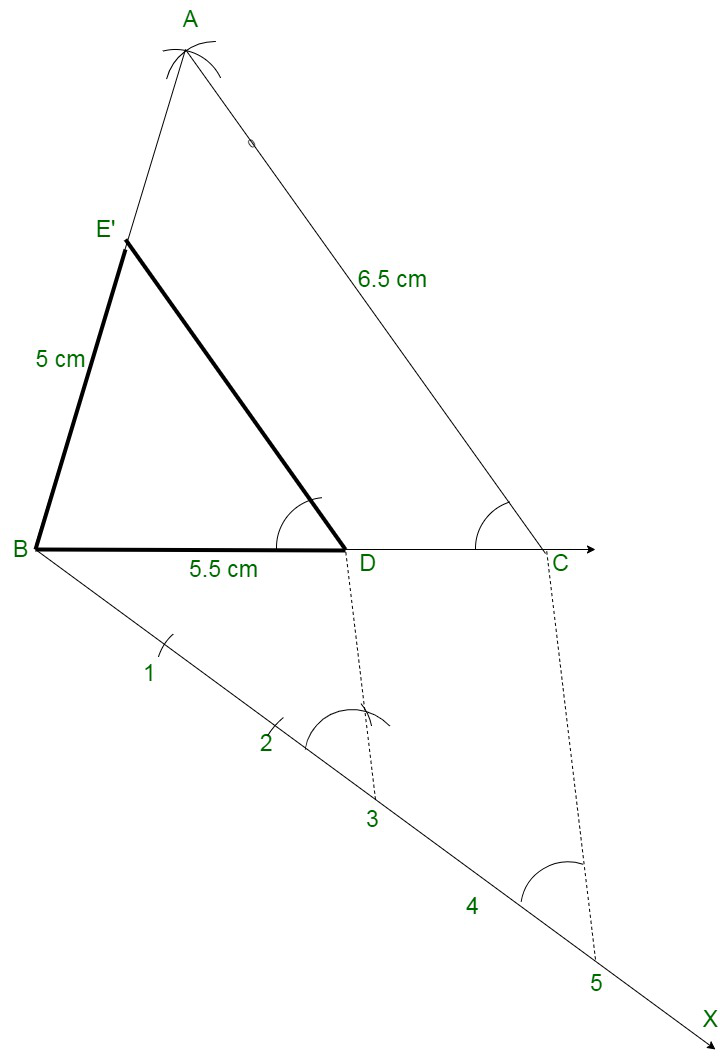
Step 1: Construct a line segment BC of 5.5 cm.
Step 2: Along centre B and radius 5 cm and along centre C and radius 6.5 cm,
Construct arcs that bisect each other at A
Step 3: Connect BA and CA. ΔABC is the given triangle.
Step 4: At B, construct a ray BX creating an acute angle and break off 5 equal parts from BX.
Step 5: Connect C5 and Construct 3D || 5C which connects BC at D.
From D, construct DE || CA which meets AB at E.
Therefore,
We have the required triangle ΔEBD.
Solution:
👁 ImageFollow these steps for the construction:
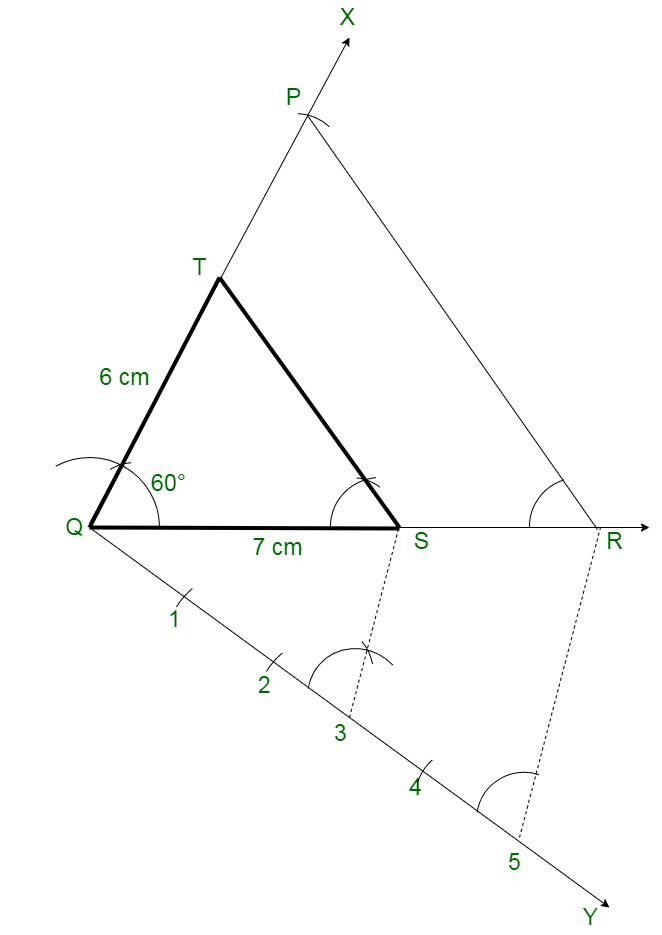
Step 1: Construct a line segment QR = 7 cm.
Step 2: At Q construct a ray QX creating an angle of 60° and cut of PQ = 6 cm.
Connect PR.
Step 3: Construct a ray QY creating an acute angle and break off 5 equal parts.
Step 4: Connect 5, R and through 3, construct 3, S parallel to 5, R which meet QR at S.
Step 5: Through S, construct ST || RP meeting PQ at T.
Therefore,
We have the required ΔQST.
Solution:
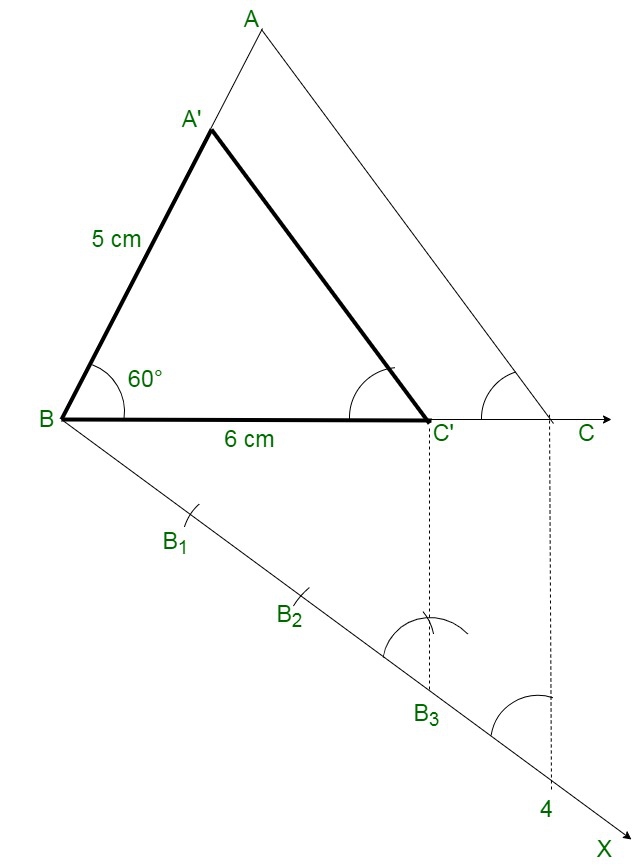
👁 ImageFollow these steps for the construction:
Step 1: To construct a triangle ABC
Along side of BC of 6 cm,
AB of 5 cm and ∠ABC = 60°.
Step 2: Construct a ray BX, which creates an acute angle ∠CBX below the line BC.
Step 4: Make four points B1, B2, B3 and B4 on BX such that BB1 = B1B2 = B2B3 = B3B4.
Step 5: Connect B4C and construct a line through B3 parallel to B4C bisecting BC to C’.
Step 6: Construct a line through C’ parallel to the line CA to intersect BA at A’.
Therefore,
We have the required triangle ΔABC.
Solution:
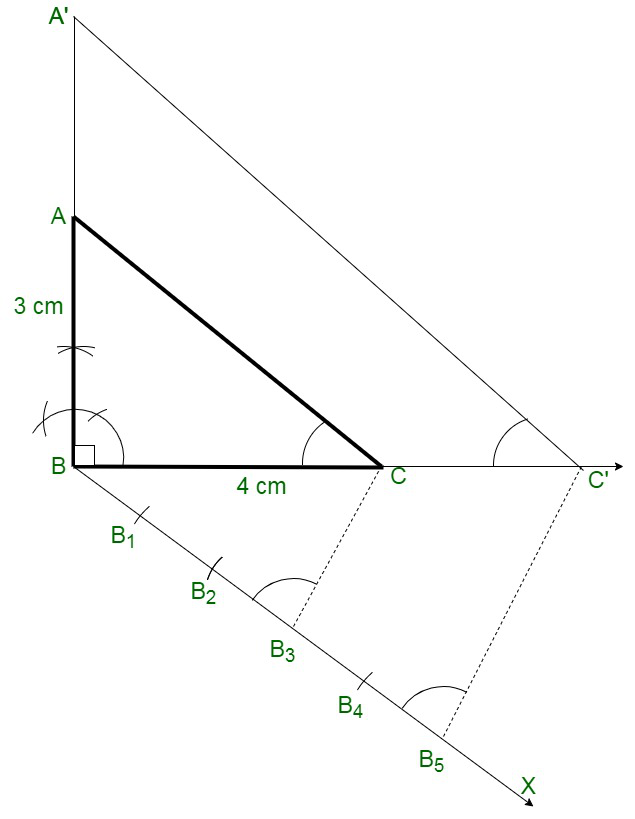
👁 ImageFollow these steps for the construction:
Step 1: Construct a right triangle ABC in which the sides (other than the hypotenuse) are
of lengths 4 cm and 3 cm. ∠B = 90°.
Step 2: Construct a line BX, that creates an acute angle ∠CBX below the line BC.
Step 3: Mark 5 points B1, B22, B3, B4 and B5 on BX such that BB1 = B1B2 = B2B3 = B3B4 = B4B5.
Step 4: Connect B3 to C and Construct a line through B5 parallel to B3C,
bisecting the extended line segment BC at C’.
Step 5: Construct a line through C’ parallel to CA bisecting the extended line segment BA at A’.
Therefore,
We have the required triangle ΔA'BC'.
Solution:
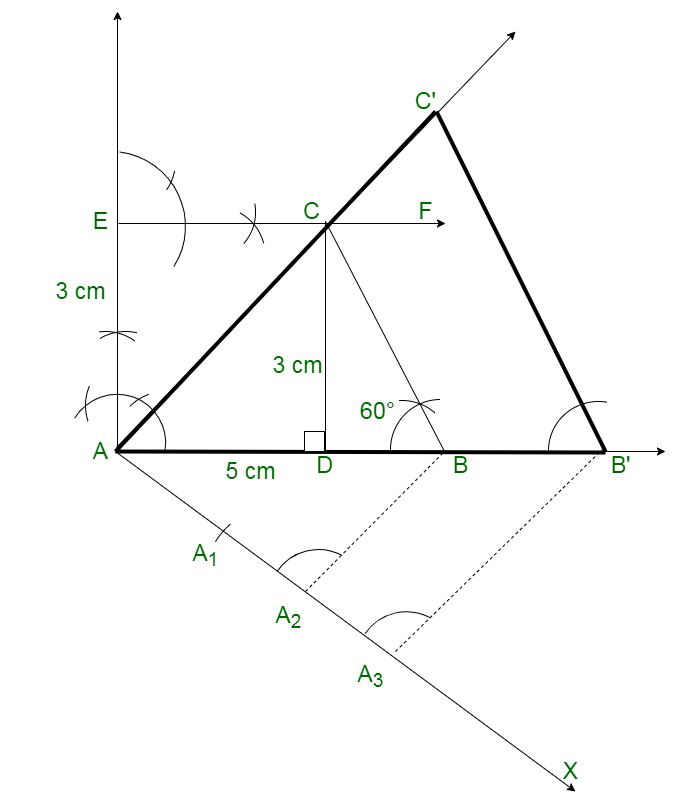
👁 ImageFollow these steps for the construction:
Step 1: Construct a line segment AB of 5 cm.
Step 2: At A, construct a perpendicular and break off AE = 3 cm.
Step 3: From E, construct EF || AB.
Step 4: From B, construct a ray creating an angle of 60 meeting EF at C.
Step 5: Connect CA. After that ABC is the triangle.
Step 6: From A, construct a ray AX creating an acute angle along AB and break
off 3 equal parts creating AA1 = A1A2 = A2A3.
Step 7: Connect A2 and B.
Step 8: From A , construct A^B’ parallel to A2B and B’C’ parallel to BC.
Therefore,
We have the required triangle ΔC’AB’.
Read More:
In Exercise 11.2 | Set 2 of Chapter 11, "Constructions" from RD Sharma's Class 10 Mathematics students practice fundamental construction techniques essential for the accurate geometrical problem-solving. The exercise reinforces the understanding of the constructing triangles, bisectors and other geometric figures using the compass and ruler. Mastering these skills is crucial for the higher-level geometry and helps build a solid foundation for the future mathematical studies.