|
VOOZH | about |
|
VOOZH | about |
Solution:
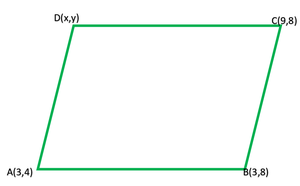
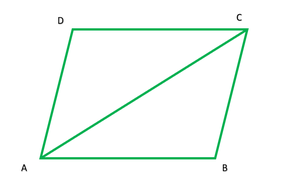
Let ABCD be a parallelogram and vertices will be A (3, 4), B (3, 8), C (9, 8)
and the co-ordinates of fourth vertex D be(x, y)
Now AB =
Similarly, BC =
and DA =
Hence, ABCD is a ||gm
Here, AB = CD and BC = AD
CD =
On squaring both sides we get
(x - 9)2 + (y - 8)2 = (4)2
x2 - 18x + 81 + y2 - 16y + 64 = 16
x2 + y2 - 18x - 16y = 16 - 81 - 64
x2 + y2 - 18x - 16y = -129 ...........(i)
Similarly, AD =
On squaring both sides we get
(3 - x)2 + (4 - y)2 = 26
9 + x2 - 6x + 16 + y2 - 8y = 36
x2 + y2 - 6x - 8y = 36 - 9 - 16
x2 + y2 - 6x - 8y = 11 ...........(ii)
Now on subtracting eq(i) from (ii), we get
12x + 8y = 140
3x + 2y = 35
2y = 35 - 3x
y = (35 - 3x)/2 ...........(iii)
Now substituting the value of y in eq (ii)
4x2 + 1225 + 9x2 - 210x - 24x - 560 = 44
13x2 - 186 + 621 = 0
13x2 - 117x - 69x + 621 = 0
13x(x - 9) - 69(x - 9) = 0
(x - 9)(13x - 69) = 0
Either x - 9 = 0, then x = 9
or 13x - 69 = 0, then x69/13 which is not possible
So, x = 9
Hence, the vertex will be (9,4)
Solution:
Let us considered P (h, k) be the point which is equidistant from the points A (-5, 4) and B (-1, 6).
So, PA = PB
Therefore, (PA)2 = (PB)2
Now by distance formula, we get
(-5 - h)2 + (4 - k)2 = (-1 - h)2 + (6 - k)2
25 + h2 + 10h + 16 + k2 - 8k = 1h2 + 2h + 36 + k2 - 12k
25 + 10h + 16 - 8k = 1 + 2h + 36 - 12k
8h + 4k + 41 - 37 = 0
8h + 4k + 4 = 0
2h + k + 1 = 0 .......(i)
Midpoint of AB = ((-5 - 1)/2, (4 + 6)/2) = (-3, 5)
At point (-3, 5), from eq(i)
2h + k = 2(-3) + 6
-6 + 5 = -1
2h + k + 1 = 0
So, the mid-point of AB satisfy the Eq. (i).
Hence, infinite number of points, in fact all points which are solution
of the equation 2h + k + 1 = 0, are equidistant from the point A and B.
Replacing h, k, by x, y in above equation, we have 2x + y + 1 = 0
Solution:
According to the question
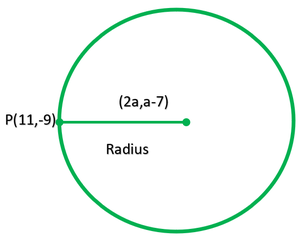
Distance between the centre C (2a, a - 1) and the point P (11, -9), which lie on the circle = Radius of circle
So, Radius of circle = .....(i)
Given that, length of diameter = 10√2
Therefore, length of radius = Length of diameter/2
= 10√2/2 = 5√2
Now put this value in eq(i), we get
Squaring on both sides, we get
50 = (11 - 2a)2 + (2 + a)2
50 = 121 + 4a2 - 44a + 4 + a2 + 4a
5a2 - 40a + 75 = 0
a2 - 8a + 15 = 0
a2 - 5a - 3a + 15 = 0
a(a - 5) - 3(a - 5) = 0
(a - 5)(a - 3) = 0
So, a = 3, 5
Hence, the required values of a are 5 and 3.
Solution:
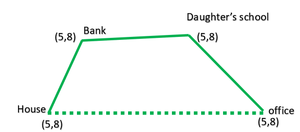
According to the figure
Distance between two points
Now, distance between house and bank
Distance between bank and daughter's
School
Distance between daughter's school and office
Total distance (house+bank+school+office) travelled = 5 + 10 + 12 = 27 units
Distance between house to offices
= 24.59 = 24.6km
So, the extra distance travelled by Ayush in reaching his office = 27 - 24.6 = 2.4km.
Hence, the required extra distance travelled by Ayush is 2.4 km
Solution:
Let us considered P (0, 2) is equidistant from A (3, k) and B (k, 5)
PA = PB
=> PA2 = PB2
Therefore, PA2 = (0 - 3)2 + (2 - k)2
= (-3)2 + (2 - k)2
= k2 - 4k + 13
Similarly, PB2 = (k - 0)2 + (5 - 2)2
= k2 + (3)2 = k2 + 9
Therefore, PA = PB
PA2 = PB2
k2 - 4k + 13 = k2 + 9
-4k = 9 - 13
-4k = -4
k = -4/-4 = 1
Hence, K = 1.
(i) interior,
(ii) the exterior of the triangle.
Solution:
Let us considered the third vertex of an equilateral triangle be (x, y).
So, the vertices are A (-4, 3), B (4,3) and C (x, y).
We know that, in equilateral triangle the angle between two
adjacent side is 60 and all three sides are equal.
Therefore, AB = BC = CA
AB2 = BC2 = CA2 .....(i)
Now, taking first two parts
AB2 = BC2
(4 + 4)2 + (3 - 3)2 = (x - 4)2 + (y - 3)2
64 + 0 = x2 + 16 - 8x + y2 + 9 - 6y
x2 + y2 - 8x - 6y = 39 .....(ii)
Now, taking first and third parts.
AB2 = CA2
(4 + 4)2 + (3 - 3)2 = (x - 4)2 + (y - 3)2
64 + 0 = x2 + 16 - 8x + y2 + 9 - 6y
x2 + y2 - 8x - 6y = 39
On subtracting eq(ii) from (iii), we get
x = 0
Now, put the value of x in eq(ii), we get
0 + y2 - 0 - 6y = 39
y2 - 6y - 39 = 0
Therefore, y =
So, the points of third vertex are
(0, 3+√3)or(3 - 4√3)
But it is given that, the origin lies in the interior of the ∆ABC and the x-coordinate of third vertex is zero.
So, y-coordinate of third vertex should be negative.
Hence, the requirement coordinate of third vertex,
C = (0, 3 – 4√3)
Solution:
Let us considered the co-ordinates of the vertices A, B, C and D of a rhombus are A (-3, 2), B (-5, -5), C (2, -3) and D (4, 4)
or AB2 = (-2)2 + (-7)2 = 4 + 49 = 53
Similarly, BC2 = (2 + 5)2 + (-3 + 5)2
= (7)2 + (2)2 = 49 + 4 = 53
CD2 = (4 - 2)2 + (4 + 3)2
= (2)2 + (7)2 = 4 + 48 = 53
and DA2 = (-3 - 4)2 + (2 - 4)2
= (-7)2 + (-2)2 = 49 + 4 = 53
Therefore, we see that AB = BC = CD = DA = √53
Now diagonals AC =
and diagonal BD =
Therefore, sides are equal but diagonal are not equal
Hence, ABCD is a rhombus
Now we find the area of rhombus = Product of diagonal/2
= (5√2 × 9√2)/2
= 9/2
= 45sq.units
Solution:
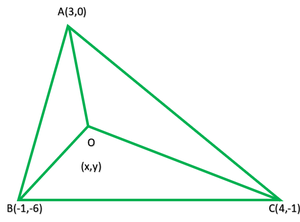
Let us considered ABC is a triangle whose vertices are A (3, 0), B (-1, -6) and C (4, -1)
So, O be the circumcenter of the triangle ABC and so the co-ordinates be (x, y)
Therefore, OA = OB = OC
OA2 = OB2 = OC2
Now OA =
OA2 = (x2 - x1)2 + (y2 - y1)2
= (x - 3)2 + (y - 0)2
= (x - 3)2 + y2
OB2 = (x + 1)2 +(y + 6)2
and OC2 = (x - 4)2 + (y + 1)2
Therefore, OA2 = OB2
(x - 3)2 + y2 = (x + 1)2 + (y + 6)2
x2 - 6x + 9 + y2 = x2 + 2x + 1 + y2 + 12y + 36
-6x - 2x - 12y = 1 + 36 - 9
-8x - 12y = 28
2x + 3y = -7 ........(i)
Therefore, OB2 = OC2
(x + 1)2 + (y + 6)2 = (x - 4)2 + (y + 1)2
x2 + 2x + 1 + y2 + 12y + 36 = x2 - 8x + 16 + y2 + 2y + 1
2x + 12y + 37 + 8x - 2y = 17
10x + 10y = 17 - 37 = -20
x + y = -2 ........(ii)
On multiply eq(i) by 1 and (ii) by 2, we get
2x + 3y = -7
2x + 2y = -4
Now, on substituting y = -3, we get
x + y = -2
x - 3 = -2
x = -2 + 3 = 1
Radius = OA = = √13
Solution:
The required point is on x-axis
Its ordinate will be O
So, the co-ordinates of the required point P (x, 0)
It is given that the point P is equidistant from the points A (7, 6) and B (-3, 4)
Now AP
Therefore, AP2 = (x - 7)2 + 36
Similarly, BP2 = (x + 3)2 + (0 - 4)2
= (x + 3)2 + 16
Therefore, AP = BP
AP2 = BP2
Therefore, (x - 7)2 + 36 = (x + 3)2 + 16
x2 - 14x + 49 + 36 = x2 + 6x + 9 + 16
x2 - 14x - x2 - 6x = 25 - 85
-20x = -60
x = -60/-20 = 3
Therefore, the required point will be (3, 0)
Solution:
(i) Given points are given A (5, 6), B (1, 5), C (2, 1) and D (6, 2)
Now AB2 = (x2 - x1)2 + (y2 - y1)2
= (1 - 5)2 + (5 - 6)2
= (-4)2 + (-1)2 = 16 + 1 = 17
Similarly, BC = (2 - 1)2 + (1 - 5)2
= (1)2 + (-4)2
= 1 + 16 = 17
CD = (6 - 2)2 + (2 - 1)2 + (4)2 + (1)2
= 16 + 1 = 17
and DA = (5 - 6)2 + (6 - 2)2
= (-1)2 + (4)2
= 1 + 16 = 17
Diagonals AC2 = (2 - 5)2 + (1 - 6)2
= (-3)2 + (-5)2
= 9 + 25
=34
and BD2 = (6 - 1)2 + (2 - 5)2
= (5)2 + (-3)2
= 25 + 9 = 34
We conclude that
AB = BC = CD = DA and diagonals AC = BD
Hence, ABCD is a square.
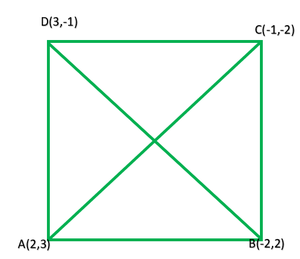
(ii) Given points A(2, 3), B(-2, 2), C(-1, -2) and D(3, -1)
Similarly,
Therefore, AB, BC, CD and DA are equal and diagonals AC and BD are also equal
Hence, ABCD is a square.
(iii) Using distance formula
Since, PQ = PR = RQ = 4, so, the point P, Q, R form an equilateral triangle.
Solution:
Let us considered point P lies on x-axis
So, the coordinates of point P be (x, 0)
It is given that P is equidistant from A (-2, 5) and B (2, -3)
AP2 = (x + 2)2 + (-5)2
= (x + 2)2 + 25
BP2 = (x - 2)2 + (0 + 3)2
= (x - 2)2 + 9
AP = BP
So, AP2 = BP2
(x + 2)2 + 25 = (x - 2)2 + 9
x2 + 4x + 4 + 25 = x2 - 2x + 4 + 9
x2 + 4x - x2 + 4x = 13 - 29
8x = -16
x = -16/8
x = -2
Hence, the co-ordinates of point P are(-2, 0)
Solution:
Given that the co-ordinates of P (6, -1), Q(1, 3), and R(x, 8)
Also, PQ = QR
By using the distance formula
D =
We find the length of PQ and QR
PQ2 = (1 - 6)2 + (3 + 1)2
= (-5)2 + (4)2
= 25 + 16 = 41
QR2 = (x - 1)2 + (8 - 3)2
= (x - 1)2 + (5)2 = (x - 1)2 + 25
It is given that PQ = QR
So PQ2 = QR2
41 = (x - 1)2 + 25
(x - 1)2 = 41 - 25 = 16 = (±4)2
x - 1 = ±4
If x - 1 = 4, then x = 1 + 4 = 5
If x - 1 = -4 then x = -4 + 1 = -3
Hence, the value of x = 5, -3
Solution:
Let us consider ABC is a triangle whose vertices are A(0, 0), B(5, 5), and C(-5, 5)
Now
AB2 = (√50)2 = 50
Similarly, BC2 = (-5 - 5)2(5 - 5)2
= (-10)2 + (0)2 = 100 + 0 = 100
and CA2 = (0 + 5)2 + (0 - 5)2
= (5)2 + (-5)2 = 25 + 25 = 50
Here, we conclude that AB = CA
Also, AB2 + CA2 = 50 + 50 = 100 = BC2
Hence, the triangle ABC is a right triangle.
Solution:
Let us consider P(x, y) is equidistant from the points A (5, 1) and B (1,5),
It is given that PA = PB
Also, PA2 = PB2
Now, PA=
On squaring both sides, we get
(5 - x)2 + (1 - y)2 = (1 - x)2 + (5 - y)2
25 + x2 - 10x + 1 + y2 - 2y = 1 + x2 - 2x + 25 + y2 - 10y
-10x - 2y + 26 = -2x - 10y + 26
-10x - 2y = -2x - 10y
-10x + 2x = -10y + 2y
-8x = -8xy
x = y
Solution:
Given that Q (0, 1) is equidistant from P (5, -3) and R (x, 6)
So, PQ = RQ
Also, PA2 = PB2
Now
PQ2 = 41
Similarly, RQ2 = (-x)2 + (1 - 6)2
= (-x)2 + (-5)2 = x2 + 25
It is given that PQ = RQ
So,x2 + 25 = 41
x2 = 41 - 25
x2 = (±4)2
x = ±4
Now, QR = √x2 + 25 = √41
So, when x = 4, then
or when x = -4, then
Solution:
Given that the distance between P (2, -3) and Q (10, y) = 10
So,
On squaring both side we get
64 + (y + 3)2 = 100
(y + 3)2 = 100 - 64
(y + 3)2 = 36
y + 3 = (±6)2
So, when y + 3 = 6, then y = 6 - 3 = 3
Or when y + 3 = -6, then y = -6 - 3 = -9
Hence, y = 3, -9
Solution:
Given that the point P (k – 1, 2) is equidistant from A (3, k) and B (k, 5)
So, PA = PB
Also, PA2 = PB2
(k - 1 - 3)2 + (2 - k)2 = (k - 1 - k)2 + (2 - 5)2
(k - 4)2 + (2 - k)2 = (-1)2 + (-3)2
k2 - 8k + 16 + 4 - 4k + k2 = 1 + 9
2k2 - 12k + 20 - 10 = 0
2k2 - 12k + 10 = 0
k2 - k - 5k + 5 = 0
k(k - 1) - 5(k - 5) = 0
(k - 1)(k - 5) = 0
Either k - 1 = 0, then k = 1
or k - 5 = 0, then k = 5
Hence, k = 1, 5
Solution:
Given that point A (0, 2) is equidistant from B (3, p) and C (p, 5)
So, AB = AC
Also, AB2 = AC2
(0 - 3)2 + (2 - p)2 = (0 - p)2 + (2 - 5)2
9 + (2 - p)2 = p2 + 9
9 + 4 + p2 - 4p = p2 + 9
p2 - 4p + 13 - p2 - 9 = 0
-4p - 4 = 0
-4p = -4
p = -4/-4 = 1
p = 1
and AB =
(i) A (-1, -2), B (1, 0), C (-1, 2), D (-3, 0)
(ii) A (-3, 5), B (3, 1), C (0, 3), D (-1, -4)
(iii) A (4, 5), B (7, 6), C (4, 3), D (1, 2)
Solution:
(i) Given points are A (-1, -2), B (1, 0), C (-1, 2), D (-3, 0)
Now
AB2 = (x2 - x1)2 + (y2 - y1)2
= (1 + 1)2 + (0 + 2)2
= (2)2 + (2)2
= 4 + 4 = 8
Similarly, BC2 = (-1 - 1)2 + (2 - 0)2
= (-2)2 + (2)2
= 4 + 4 = 8
CD2 = (-3 + 1)2 + (0 - 2)2
= (-2)2 + (-2)2
= 4 + 4 = 8
DA2 = (-1 + 3)2 + (-2 + 0)2
= (2)2 + (-2)2
= 4 + 4 = 8
Diagonal AC2 = (-1 + 1)2 + (2 + 2)2
= (0)2 + (4)2 = 0 + 16 = 16
and BD2 = (-3 - 1)2 + (0 - 0)2 = (-4)2 + (0) = 16
Therefore, the sides are equal and diagonals are also equal
Hence, the quadrilateral ABCD is a square.
(ii) Given points are A (-3, 5), B (3, 1), C (0, 3), D (-1, -4)
Now AB
AB2 = (x2 - x1)2 + (y2 - y1)2
= (3 + 3)2 + (1 - 5)2
= (6)2 + (-4)2
= 36 + 16 = 52
Similarly, BC2 = (0 - 3)2 + (3 - 1)2
= (-3)2 + (2)2
= 9 + 4 = 13
CD2 = (-1 - 0)2 + (-4 - 3)2
= (-1)2 + (-7)2
= 1 + 49 = 50
DA2 = (-3 + 1)2 + (5 + 4)2
= (-2)2 + (9)2
= 4 + 81 = 85
Diagonal AC2 = (0 + 3)2 + (3 - 5)2 = (3)2 + (-2)2 = 9 + 4 = 13
In triangle ABC
The length of AB = √52, AC = √13, BC = √13
AC + BC = √13 + √13 = 2√13
= √4 * 13 = √52
AC + BC = AB
Triangle ABC is not possible
Hence, ABCD is not a quadrilateral
(iii) Points A (4, 5), B (7, 6), C (4, 3), D (1, 2)
Now AB
AB2 = (x2 - x1)2 + (y2 - y1)2
= (7 - 4)2 + (6 - 5)2
= (3)2 + (1)2
= 9 + 1 = 10
Similarly, BC2 = (4 - 7)2 + (3 - 6)2
= (3)2 + (-3)2 = 9 + 9 = 18
CD2 = (1 - 4)2 + (2 - 3)2
= (-3)2 + (-1)2
= 9 + 1 = 10
DA2 = (4 - 1)2 + (5 - 2)2 = (3)2 + (3)2 = 9 + 9 = 18
Here AB = CD and BC = DA
Diagonal AC2 = (4 - 4)2 + (3 - 5)2
= (0)2 + (-2)2
= 0 + 4 = 4
and BD2 = (1 - 7)2 + (2 - 6)2 = (-6)2 + (-4)2
= 36 + 16 = 52
Hence the opposite sides are equal and diagonals are not equal.
So, ABCD is a parallelogram.
Solution:
Let the given points are A (7, 1) and B (3, 5) and mid point be M
Coordinates of mid-point AB = ((7 + 3)/2, (1 + 5)/2) = (5, 3)
Now slope of AB(m1)
Slope of perpendicular to AB(m2) = -1/m1 = -(-1) = -1
So, the equation of the perpendicular line passing through multiple y - y1 = m(x - x1)
y - 3 = 1(x - 5)
y - 3 = x - 5
x - y = -3 + 5
x - y = 2