|
VOOZH | about |
|
VOOZH | about |
Chapter 14 of RD Sharma Class 10 Mathematics delves into the fascinating world of Coordinate Geometry, with Exercise 14.3 specifically focusing on the concepts of area of triangles and quadrilaterals in the coordinate plane. This section bridges the gap between algebra and geometry, allowing students to solve geometric problems using algebraic methods. The coordinate system provides a powerful framework for analyzing geometric shapes and their properties, enabling students to calculate areas of various polygons by utilizing the coordinates of their vertices.
Solution:
Assume P(x, y) be the needed point.
After applying the Section Formula,
As we know that here the coordinates are
Now here we have,
x1 = – 1
y1 = 3
x2 = 4
y2 = -7
m : n = 3 : 4
Thus,
Hence,
The coordinates of P are (8/7, -9/7)
(i) (5, – 6) and (-7, 5)
(ii) (3, – 2) and (-3, – 4)
(iii) (2, – 2) and (-7, 4)
Solution:
(i) Assume P and Q are the points of trisection for AB
Thus,
AP = PQ = QB
👁 ImageThus,
P divides AB within in the ratio of 1 : 2,
After putting in Section Formula,
The coordinates of P are
After this,
Q also divides AB within in the ratio of 2 : 1.
Hence, their coordinates are
(ii) Assume P and Q are the points of trisection of AB i.e., AP = PQ = QB
👁 ImageThus, P divides AB within in the ratio of 1 : 2.
Therefore, after putting in the Section Formula,
The coordinates of P are
After this,
Q also divides as within in the ratio of 2 : 1
Thus, the coordinates of Q are shown as
(iii) Assume P and Q are the points of the trisection of AB
i.e., AP = PQ = OQ
👁 ImageAs, P divides AB within in the ratio 1 : 2.
Thus, the coordinates of P, by putting in the Section Formula, are shown as
After this,
Q also divides AB putting in the ration 2 : 1.
Thus, the coordinates of Q are shown as
Solution:
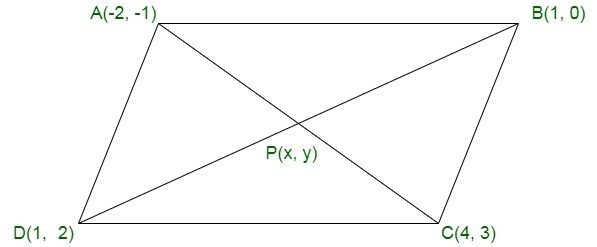
👁 ImageAssume: A(-2, -1), B(1, 0), C(4, 3) and D(1, 2) are the given points.
Assume P(x, y) is the point of intersection of the diagonals of the
parallelogram as formed by the given points. as shown in the fig.
As we know that, the diagonals of a parallelogram bisect each other.
Hence,
The coordinates of P are (1, 1).
Solution:
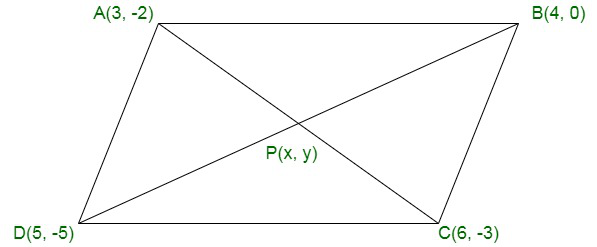
👁 ImageAssume: A(3, -2), B(4, 0), C(6, -3) and D(5, -5)
Assume P(x, y) is the point of intersection of diagonals AC and BD of ABCD. As shown in the fig.
Now, the mid-point of AC is shown as,
Mid - point of AC
Now again, the mid-point of BD is shown as,
Thus, suppose that diagonals AC and BD bisect each other.
Also, as we know that diagonals of a parallelogram bisect each other.
Hence,
ABCD is a parallelogram.
Solution:
Given: P(9a – 2, -b) divides the line segment joining A(3a + 1, -3) and B(8a, 5) in the ratio 3 : 1
After applying Section Formula
Coordinates of P are
And,
Now, lets solve for a, we will have
(9a – 2) × 4 = 24a + 3a + 1
36a – 8 = 27a + 1
9a = 9
a = 1
Now, lets solve for b, we will have
4x – b = 15 – 3
-4b = 12
b = -3
Hence,
The values of a and b are 1 and -3 respectively.
Solution:
Given: (a, b) is the mid-point of the line segment A(10, -6) and B(k, 4)
Thus,
(a, b) =
a = and b = -1
2a = 10 + k
k = 2a – 10
Given, a – 2b = 18
Apply b = -1 above we will get,
a – 2(-1) = 18
a = 18 – 2 = 16
Since,
k = 2(16) – 10 = 32 – 10 = 22
Therefore,
AB = = 2√61 units
Solution:
Assume: Point P(2, y) divide the line segment joining the points A(-2, 2) and B(3, 7) in the ratio k : 1
Thus, the coordinates of P will be given by
Also, given the coordinates of P are (2, y)
So,
Thus, solving for k, we will get
2(k + 1) = (3k – 2)
2k + 2 = 3k – 2
k = 4
Now use the value of k to find y,
we have
y =
y = 6
Hence,
The ratio 4 : 1 and y = 6
Solution:
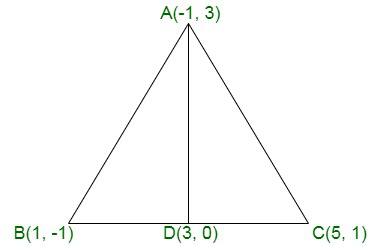
👁 ImageAssume AD is the median through A.
Such that, AD is the median, D is the mid-point of BC
Thus,
The coordinates of D are = (3 , 0)
Therefore,
The length of median AD = = 5 units
Solution:
👁 ImageGiven: AP = PQ = QR = RS = SB
Since,
Q is the mid-point of A and S
Then,
y + p = 14 ….. (i)
Thus,
Since S divides QB in the ratio 2 : 1
= 9
Therefore,
p = 14 – 9 = 5
Hence,
x = 4,
y = 9
and
p = 5
Solution:
Assume, A(1, 1) is the given vertex and
D(-2, 3), E(5, 2) be the mid-points of AB and AC
So, D and E are the mid-points of AB and AC
x1 + 1 = 4
x1 = -5
y1 + 1 = 6
y1 = 5
Thus, the coordinates of B are (-5, 5)
Now,
x2 + 1 = 10
x2 = 9
y2 + 1 = 4
y2 = 3
Hence,
The coordinates of C are (9, 3)
Hence,
The other vertices of the triangle are (-5, 5) and (9, 3).
Solution:
Assume P(-2, -3) and Q(9, 3) be the given points.
Assume y-axis divides PQ in the ratio k : 1 at R(0, y)
Thus, the coordinates of R are shown by
After, equating
= 0
3k – 2 = 0
k = 2/3
Hence,
The ratio is 2 : 3
After putting k = 2/3 in the coordinates of R, we will get
R (0, 1)
Solution:
Assume A(-3, -1) and B(-8, -9) are the given points.
And,
Assume P be the point that will divide AB in the ratio of k : 1
Thus, the coordinates of P can be shown by
Therefore, given coordinates of P
After equating, we will get
-8k - 3 = -5k – 5
3k = 2
k = 2/3
Hence, the point P divides AB in the ratio 2 : 3
Solution:
Since, (x, y) is the mid-point
x = (3 + k)/2 and y = (4 + 7)/2 = 11/2
Given: Mid-point lies on the line 2x + 2y + 1 = 0
3 + k + 11 + 1 = 0
Therefore,
k = -15
Solution:
Given: Points A() and B(2, -5)
Assume the point P() and divide the line segment AB into the ratio of k : 1
Thus, as we know that
Hence, we will equate the abscissa we will get;
3(k + 1) = 4(2k + 1/2)
3k + 3 = 8k + 2
5k = 1
k = 1/5
Hence,
The point P() divides in ratio of 1 : 5.
Solution:
Assume A(-2, -3) and B(5, 6) are the given points.
(i) Assume x-axis divides AB in the ratio of k : 1 at the point P.
Hence, the coordinates of the point of division are shown as,
Thus, P lies in the x-axis,
The y – coordinate is zero.
Therefore,
6k – 3 = 0
k = 1/2
Therefore,
Required ratio is 1 : 2
Applying value of k in the coordinates of P
We will get, P
(ii) Assume y-axis divides AB in the ratio of k : 1 at the point Q.
Hence, the coordinates of the point of division are shown as,
Thus, Q lies on the y-axis,
The x – ordinate is zero.
Therefore,
Therefore,
Required ratio is 2 : 5
Applying the value k in the coordinates of Q
We will get, Q
Solution:
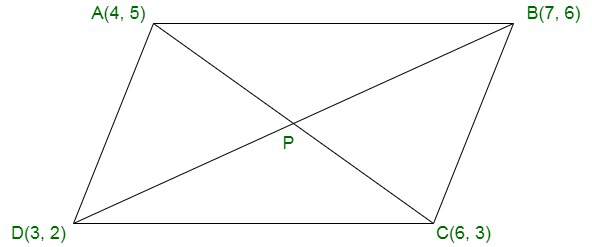
👁 ImageAssume A (4, 5), B(7, 6), C(6, 3) and D(3, 2) are the given points, as shown in the fig
And,
Let the point P be the point of intersection of AC and BD.
Mid-point of AC coordinates are = (5, 4)
Mid-point of BD coordinates are = (5, 4)
Therefore, we can see that the mid-point of AC and BD are same.
Hence,
ABCD is a parallelogram.
Now,
AC = = √8 units
and,
BD = = √32 units
Therefore,
AC ≠ BD
Hence, ABCD is not a rectangle.
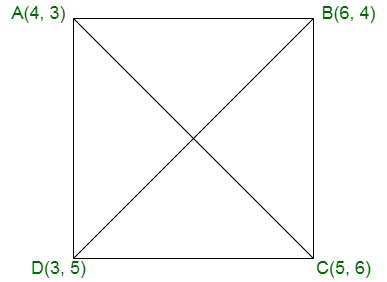
Solution:
👁 ImageAssume A(4, 3), B(6, 4), C(5, 6), and D(3, 5) are the given points, as shown in the figure.
By applying Distance Formula:
We can see that the length of all the sides are same.
Now,
The length of diagonals are;
The length of both the diagonals are same.
Hence, we can say that the given points are the angular points of a square.
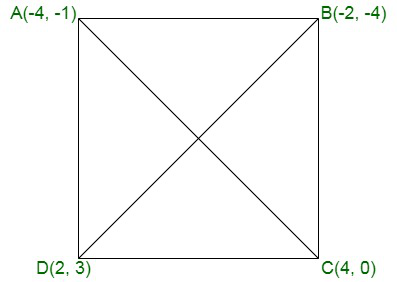
Solution:
👁 ImageAssume A(-4, -1), B(-2, -4), C(4, 0) and D(2, 3) are the given points.
Now,
Mid-point of AC coordinates are
Mid-point of BD coordinates are
Hence,
We can see that AC and BD have the same point.
And,
Now for the diagonals
Thus length of diagonals are also same.
Hence, the given points are the vertices of a rectangle.
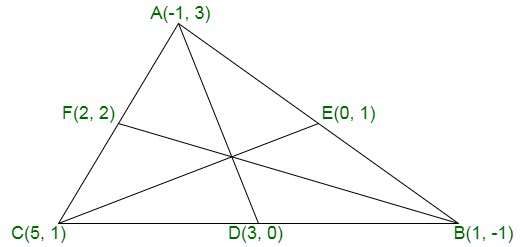
Solution:
👁 ImageAssume AD, BF and CE are the medians of ΔABC
Coordinates of D are = (3, 0)
Coordinates of E are = (0, 1)
Coordinates of F are = (2, 2)
Now,
Obtaining the length of the respectively medians:
Length of AD = = 5 units
Length of BF = = 10 units
Length of CE = = 5 units
Solution:
Assume the point on the x-axis be (x, 0). {y – coordinate is zero}
And,
Allow this point to divide the line segment AB in the ratio of k : 1.
After applying the Section Formula for the y-coordinate,
we will get
7k – 3 = 0
k = 3/7
Hence, x - axis divides the line segment AB in the ratio of 3 : 7.
Solution:
Assume P divide the line joining A and B
and
Allow it to divide the segment in the ratio of k : 1
After applying the Section Formula for the y – coordinate
we will get
2(k + 1) = -3k + 5
2k + 2 = -3k + 5
5k = 3
k = 3/5
Therefore,
The line segment AB is divided by P in the ratio of 3 : 5
By applying the value of k,
We will get the x – coordinate as
x = 12 + 60/8 = 72/8 = 9
Hence, the coordinates of point P is (9, 2).
Exercise 14.3 of Chapter 14 equips students with essential tools and techniques for analyzing and solving problems related to areas of geometric shapes in the coordinate plane. Through a combination of algebraic and geometric approaches, students learn to calculate areas of triangles and quadrilaterals using coordinate geometry, understand the properties of various quadrilaterals through their vertices, and solve complex problems involving points, lines, and areas in the coordinate system. This knowledge forms a crucial foundation for advanced mathematics, particularly in fields such as calculus and analytical geometry, while also developing students' logical reasoning and problem-solving abilities.