|
VOOZH | about |
|
VOOZH | about |
The Coordinate Geometry is a crucial chapter in Class 10 Mathematics offering a blend of algebra and geometry. It provides students with the tools to analyze geometric shapes using the coordinate plane making it easier to study the properties and relationships of the points, lines, and figures. Exercise 14.3 focuses on applying the concepts of the distance formula section formula and area of the triangles helping students build a strong foundation in analytical geometry.
The Coordinate Geometry involves the study of geometric figures using the coordinate plane. It allows us to calculate distances between the points find midpoints and determine the area of the triangles and other figures using algebraic equations. This branch of geometry simplifies the analysis of shapes by converting geometric problems into algebraic ones making it an essential tool in mathematics.
Solution:
Assume P divide A(-3, 10) and B(6, -8) in the ratio of k : 1
Given: coordinates of P as (-1, y)
After applying the section formula for x – coordinate,
We will get
Therefore,
AB is divided by point P in the ratio of 2 : 7
By applying the value of k, to find the y-coordinate
We will get
y = (-16 + 70)/(2 + 7) = 54/9
y = 6
Hence,
The y-coordinate of P is 6.
Solution:
Assume the coordinates of point A be (x, y)
Given: AB is the diameter,
So the center in the mid-point of the diameter
Thus,
(2, -3) = (x + 1/ 2, y + 4/2)
2 = x + 1/2 and -3 = y + 4/2
4 = x + 1 and -6 = y + 4
x = 3 and y = -10
Hence, the coordinates of A are (3, -10)
Solution:
Consider A(-2, 1), B(1, 0), C(x , 3) and D(1, y) are the given points of the parallelogram.
As we know that the diagonals of a parallelogram bisect each other.
Thus,
Coordinates of mid-point of AC = Coordinates of mid-point of BD
((x - 2)/2, (3 - 1)/2) = (1+1)/2, (y + 0)/2
((x - 2)/2, 1) = (1, y/2)
(x - 2)/2 = 1
x - 2 = 2
x = 4
and y/2 = 1
y = 2
Hence, the value of x is 4 and the value of y is 2.
Solution:
Given: A(2, 0), B(9, 1), C(11, 6) and D(4, 4).
Mid-point of AC coordinates are
Mid-point of BD coordinates are
Here,
Coordinates of the mid-point of AC ≠ Coordinates of mid-point of BD,
ABCD is not a parallelogram.
Hence,
ABCD cannot be a rhombus too.
Solution:
Assume the line segment AB is divided by point (-4, 6) in the ratio of k : 1.
After applying the Section Formula,
We will get
-4k -4 = 3k - 6
7k = 2
k : 1 = 2 : 7
We can also check for the y-coordinate also.
Hence,
The ratio in which the line segment AB is divided by point (-4,6) is 2 : 7.
Solution:
Assume P(5, -6) and Q(-1, -4) be the given points.
Consider the line segment PQ is divided by y-axis in the ratio k : 1.
After applying the Section Formula for the x-coordinate (as it’s zero)
We will get,
-k + 5 = 0
k = 5
Therefore,
The ratio in which the y-axis divides the given 2 points is 5 : 1
Now further, for finding the coordinates of the point of division
On putting k = 5, we will get
Therefore,
The coordinates of the point of division are (0, -13/3)
Solution:
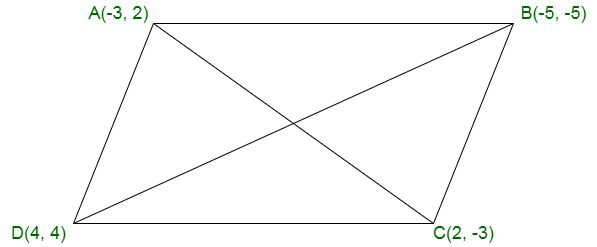
👁 ImageGiven: A(-3, 2), B(-5, 5), C(2, -3) and D(4, 4)
Further,
Mid-point of AC coordinates are
And,
Mid-point of BD coordinates are
Therefore,
The mid-point for both the diagonals are the same.
Thus,
ABCD is a parallelogram.
Now,
For the sides
AB = BC
We can see that ABCD is a parallelogram with adjacent sides equal.
Therefore,
ABCD is a rhombus.
Solution:
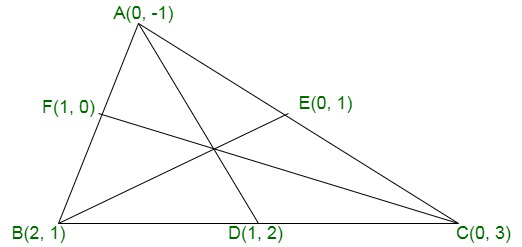
👁 ImageAssume AD, BE and CF be the medians of ΔABC
Now,
Coordinates of D are = (1, 2)
Coordinates of E are = (0, 1)
Coordinates of F are = (1, 0)
Further,
The length of the medians
Length of the median AD = = √10 units
Length of the median BE = = 2 units
Length of the median CF = = = √10 units
Solution:
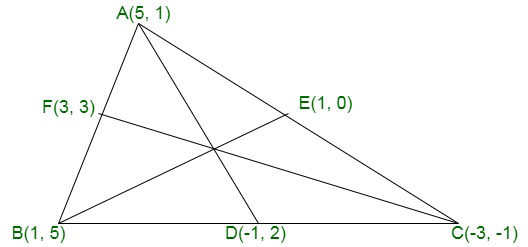
👁 ImageGiven: Vertices of ΔABC as A(5, 1), B(1, 5) and C(-3, -1).
Consider AD, BE and CF be the medians
Coordinates of D are = (-1, 2)
Coordinates of E are = (1, 0)
Coordinates of F are = (3, 3)
Further,
The length of the medians
Length of the median AD = = √37 units
Length of the median BE = = 5 units
Length of the median CF = = √52 units
Solution:
👁 ImageConsider A(-4, 0) and B(0, 6) as they are the given points
And,
Assume P, Q and R be the points which divide AB is four equal points, as shown in the fig.
Thus,
As we know that AP : PB = 1 : 3
By applying the Section Formula the coordinates of P are
And,
We can see that Q is the mid-point of AB
Thus, the coordinates of Q are
Finally,
The ratio of AR : BR is 3 : 1
Then, after applying the Section Formula the coordinates of R are
Solution:
Assume M be the mid-point of AB. Coordinates of the mid-point of this line segment joining two points A (5, 7) and B (3, 9).
Now coordinates of the mid-point of the line segment joining the points (8, 6) and (0, 10) are;
Thus, this is the same as the first case.
Solution:
Assume M be the mid-point of the line segment joining the points (6, 8) and (2, 4)
Now
Coordinates of M will be
Now,
Distance between the points (4, 6) and (1, 2)
= 5 units
Solution:
Here, Point P divides the line segment joining the points (1, 4) and (5, 2) in the ratio of AP : PB = 3 : 4
Coordinates of P will be
Solution:
If ABCD is a parallelogram,
Then its diagonal AC and BD will bisect each other at O
Consider O is the mid-point of AC,
Then coordinates of O will be;
And assume O is the mid-point of BD,
Then coordinates of O will be;
We see that coordinates of the mid-points of AC and BD are same
Therefore, AC and BD bisect each other at O
Now, length of AC
and length of BD =
We can see that AC = BD
Therefore, ABCD is a rectangle.
Solution:
Assume the ratio be r : s in which P (m, 6) divides the line segment joining the points A (-4, 3) and B (2, 8)
Therefore,
and
⇒ 8r + 3s = 6r + 6s
⇒ 8r - 6r = 6s - 3s
⇒ 2r = 3s
Therefore,
Ratio is 3 : 2
Now,
Hence, m = -2/5
Solution:
Assume the point P (-6, a) divides the join of A (-3, -1) and B (-8, 9) in the ratio m : n
Therefore,
-6 = (-8m -3n)/(m + n)
-6m - 6n = -8m - 3n
8m - 6m = 6n - 3n
2m = 3n
m/n = 3/2
Therefore,
Ratio = 3 : 2
and
Solution:
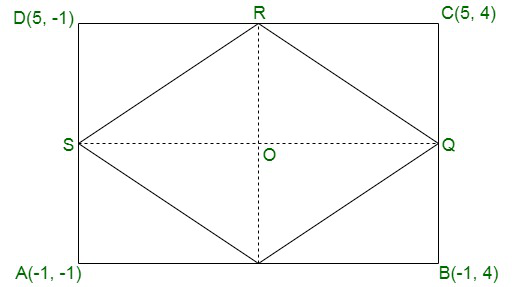
ABCD is a rectangle whose vertices are A (-1,-1), B (-1,4), C (5, 4) and D (5, -1).
P, Q, R, and S are the mid-points of the sides AB, BC, CD and DA respectively
And are joined PR and QS are also joined.
👁 ImageNow coordinates of P will be
Similarly, the coordinates of Q, will be:
Coordinates of R will be:
Coordinates of S will be:
Coordinates of P (-1, 3/2), Q (2, 4), R(5, 3/2) and S (2, -1)
Now, assume the diagonals PQ and QS intersect each other at O
Assume O is the mid-point of PR,
Then coordinates of O will be
Similarly, of O is the mid-point of QS, then the coordinates of O will be
Now, we see that the coordinates of O in both case is same and adjacent sides are also equal
Then it may be a square or a rhombus
Now length of PR =
And length of OS
Because diagonal are not equal
Hence, PQRS is a rhombus.
Solution:
Points P, Q, R and S divides AB in 5 equal parts and assume coordinates of P, Q, R and S are,
(x1, y1), (x2, y2), (x3, y3), (x4, y4)
👁 Image⇒ P divides AB in ratio 1 : 4
Therefore,
Hence, Coordinates of P are (2, 3)
⇒ Q divides AB in the ratio 2 : 3
Therefore,
Hence, Coordinates of 3, 4
⇒ R divides AB in ration 3 : 2
Therefore,
Hence, Coordinates of R are (4, 5).
Solution:
AP = 3/7 AB
7AP = 3AB
7AP = 3(AP + BP)
⇒ 7AP = 3AP + 3BP
⇒ 7AP - 3AP = 3BP
⇒ 4 AP = 3 BP
⇒
Therefore,
AP : BP = 3 : 4
Because P divides AB in the ratio of 3 : 4 whose end points are A(-2, -2) and B(2, -4)
Therefore, Coordinates of P will be
Therefore,
Coordinates of P will be
Solution:
Assume P, Q and R divides the line segment AB in four equal parts
Co-ordinates of A are (-2, 2) and of B are (2, 8)
👁 ImageIt can be seen that Q divides AB in two equal parts while P bisects AQ and R, bisect QB.
Now,
Coordinates of Q will be :
Similarly, coordinates of P will be:
Coordinates of R will be:
Hence, Coordinates of P are(1, 7/2)
Coordinates of Q are (0, 5)
Coordinates of R are (1, 13/2)
Read More:
Exercise 14.3 | Set 2 of Chapter 14 in RD Sharma's Class 10 Mathematics textbook provides the students with an opportunity to deepen their understanding of the coordinate geometry by the applying key formulas to the solve various problems. This exercise not only reinforces the concepts learned but also prepares students for more complex geometrical problems. The Mastery of these topics is crucial for success in both the board examinations and future mathematical studies.