|
VOOZH | about |
|
VOOZH | about |
Exercise 14.3 Set 3 of RD Sharma Class 10 Mathematics further expands upon the principles of Coordinate Geometry, focusing on advanced applications of area calculations in the coordinate plane. This set introduces students to more complex problem-solving scenarios, where they must apply their knowledge of coordinate geometry to tackle challenges involving triangles, quadrilaterals, and other polygons. The problems in this set are designed to enhance students' analytical thinking and help them develop a deeper understanding of the relationship between algebraic expressions and geometric figures.
Solution:
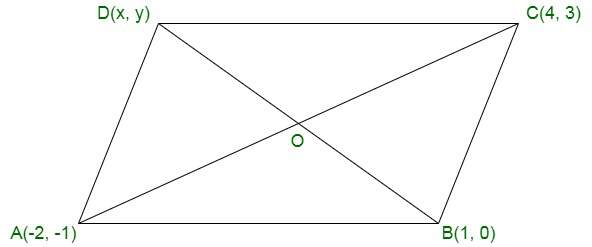
Let the coordinates of three vertices are A (-2, -1), B (1, 0), and C (4, 3)
And let the diagonals AC and BD bisect each other at O
As O is the mid-point of AC
Therefore,
Vertices of O will be
Assume coordinates of the forth vertex D be (x, y)
As O is the mid-point of BD
Thus, coordinates of O will be
Therefore(1 + x)/2 = 1
1 + x = 2
x = 1
and
y/2 = 1
y = 2
Hence, the co-ordinates of D will be (1, 2).
Solution:
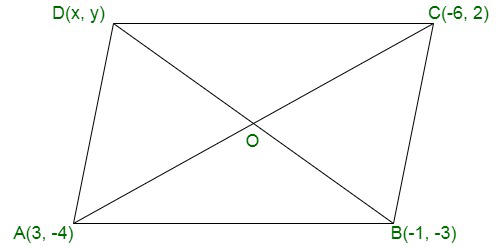
Assume the edges of a diagonal AC of a parallelogram ABCD are A (3, -4) and C (-6, 2)
Consider AC and BD bisect each other at O.
Therefore,
Mid-point of AC will be
Assume the fourth vertex of the parallelogram be (x, y)
Therefore,
Mid-point of BD will be
-1 + x = -3
x = -2
and
(-3 + y)/2 = -1
-3 + y = -2
y = -2 + 3 = 1
Hence, the coordinates of D are (-2, 1).
Solution:
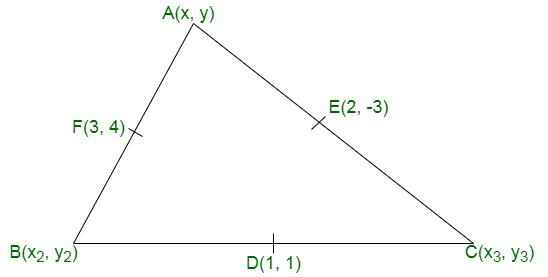
Assume A (x1, y1), B (x2, y2) and C (x3, y3) be the vertices of the ∆ABC
D, E and F are the mid-points of BC, CA and AB respectively such that their co-ordinates are D (1, 1), E (2, -3) and F (3, 4)
D is mid-point of BC
Therefore,
x2 + x3 = 2
and
y2 + y3 = 2
Similarly, E is the mid-point of AC
Therefore,
x3 + x1 = 4
and
y3 + y1 = -6
And
F is the mid-point of AB
Therefore,
x2 + x1 = 6
and
y2 + y1 = 8
Now,
x1 + x2 = 6 ..............(i)
x2 + x3 = 2 ...............(ii)
x3 + x1 = 4 ................(iii)
On adding we will get
2(x1 + x2 + x3) = 12
x1 + x2 + x3 = 6 ............(iv)
On subtracting (ii), (iii) and (i) from (iv), we get
x1 = 4, x2 = 2, x3 = 0
Similarly
y1 + y2 = 8 ..........(v)
y2 + y3 = 2 ..........(vi)
y3 + y1 = -6 .........(vii)
On adding we will get
2(y1 + y2 + y3) = 4
y1 + y2 + y3 = 2 .........(viii)
On subtracting (vi), (vii) and (v) from (viii), we get
y1 = 0
y2 = 8
y3 = -6
Hence, the vertices of ∆ABC are A (4, 0), B(2, 8), C(0, -6)
Solution:
Assume the straight line x – y – 2 = 0 divides the line segment joining the points (3, -1), (8, 9) in the ratio m : n
Co-ordinates of the point will be
and
This point (x, y) lies on the line on the line x - y - 2 = 0
⇒ (8m + 3n) - (9m - n) - 2(m + n) = 0
⇒ 8m + 3n - 9m + n - 2m - 2n = 0
⇒ -3m + 2n = 0
⇒ 2n = 3m
Hence, the ratio = 2 : 3 internally
Solution:
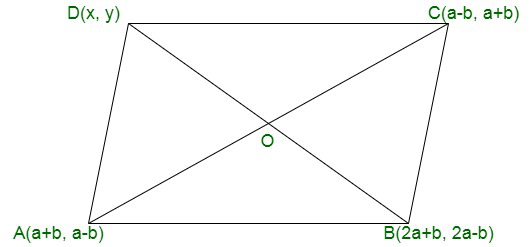
In parallelogram ABCD co-ordinates are of A (a + b, a – b), B (2a + b, 2a – b), C (a – b, a + b)
Assume coordinates of D be (x, y)
Join diagonal AC and BD
Which bisect each other at O
O is the mid-point of AC as well as BD
If O is the mid-point of AC, Then its coordinates will be
and
If O is mid-point of BD, then coordinates will be
x + 2a + b = 2a
x = 2a - 2a - b = -b
and
y + 2a - b = 2a
y = 2a - 2a + b = b
Hence, the coordinates of D will be (-b, b).
Solution:
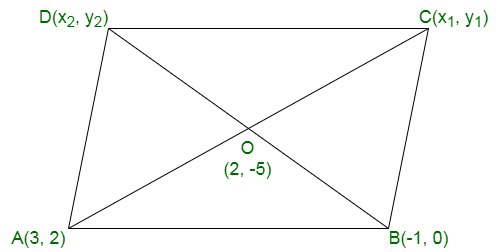
Two vertices of a parallelogram ABCD are A (3,2), and B (-1, 0) and its diagonals bisect each other at O (2, -5)
Assume the coordinates of C be (x1, y1) and of D be (x2, y2)
If O is the mid-point of AC, then
3 + x1 = 4
x1 = 4 - 3 = 1
and
and
2 + y1 = -10
y1 = -10 - 2 = -12
Therefore, the coordinates of C will be (1, -12)
Again if O is mid-point of BD then
-1 + x2 = 4
x2 = 4 + 1 = 5
and
y2 = -10
Hence, the coordinates of D will be (5, -10).
Solution:
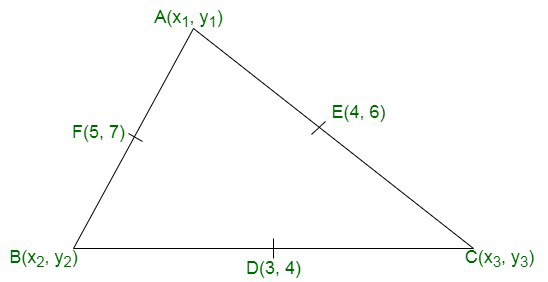
The coordinates of the mid-points of the sides BC, CA and AB are D (3, 4), E (4, 6) and F (5, 7) of the ∆ABC.
Assume the coordinates of the vertices of the triangle be A (x,1 y1), B (x2, y2), and C (x3, y3).
Now the coordinates of D will be
x2 + x3 = 6
and
y2 + y3 = 4
y2 + y3 = 8
Similarly, the coordinates of E will be
x3 + x1 = 8
and
and
y1 + y2 = 14
Now,
x2 + x3 = 6 .......(i)
x3 + x1 = 8 ........(ii)
x1 + x2 = 10 ........(iii)
On adding we will get
2(x1 + x2 + x3) = 24
⇒ x1 + x2 + x3 = 24/2 = 12 ...........(iv)
On subtracting each from (iv),
We will get
x1 = 6, x2 = 4 and x3 = 2
Similarly,
y2 + y3 = 8 ........(v)
y3 + y1 = 12 .........(vi)
y1 + y2 = 14 ........(vii)
On Adding, we will get
2(y1 + y2 + y3) = 34
⇒ y1 + y2 + y3 = 34/2 = 17 ........(viii)
On subtracting each from (viii),
We will get
y1 = 9
y2 = 5
y3 = 3
Hence, the coordinates will be of A (6, 9), B (4, 5) and C (2, 3)
Solution:
Two points A and B trisect the line segment joining the points P (3, 3) and Q (6, -6) and A is nearer to P and A lies also on the line 2x + y + k = 0
Now,
A divides the line segment PQ in the ratio of 1 : 2
i.e.,
PA = AQ = 1 : 2
Assume coordinates of A be (x, y), then
and
Therefore,
Coordinates of A are (4, 0)
As A lies on the line 2x + y + k = 0
Hence,
It will satisfy it
2 × 4 + 0 + k = 0
8 + k = 0
k = -8
Solution:
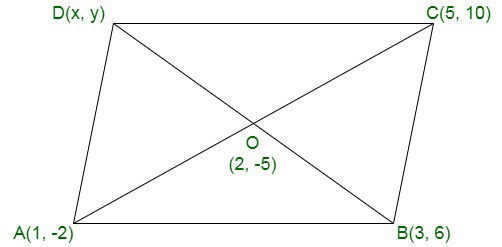
A (1, -2), B (3, 6) and C (5, 10) are the three consecutive vertices of the parallelogram ABCD
Assume (x, y) be its fourth vertex
AC and BD are its diagonals which bisect each other at O
As O is the mid-point of AC
Therefore,
Coordinates of O will be
On comparing,
3 + x = 3
3 + x = 6
x = 3
and
(6 + y)/2 = 4
6 + y = 8
y = 2
Hence, the coordinates of fourth vertex D are (3, 2).
Solution:
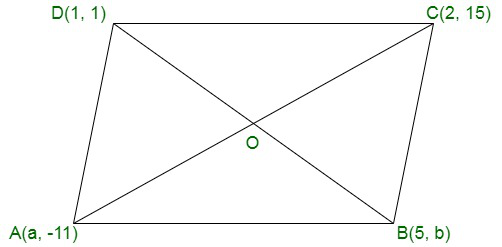
A (a, -11), B (5, b), C (2, 15) and D (1, 1) are the vertices of a parallelogram ABCD
Diagonals AC and BD bisect each other at O
As O is the mid-point of AC
Therefore,
Coordinates of O will be
Similarly, O is the mid-point of BD also
Therefore,
Coordinates of O will be
(2 + a)/2 = 3
b + 1 = 4
b = 3
Hence,
a = 4
b = 3
Solution:
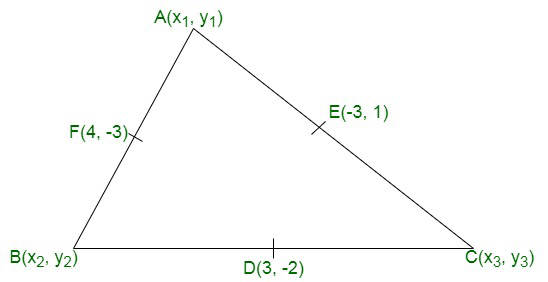
In a ∆ABC,
D, E and F are the mid-points of the sides BC, CA and AB respectively and co-ordinates of D, E and F are (3, -2), (-3, 1) and (4, -3) respectively.
Assume the coordinates of A are (x1, y1), of B are (x2, y2) and of C are (x3, y3)
Now,
As D is the mid-point BC
Therefore,
and
As E is the mid-point of CA
Therefore,
and
and F is the mid-point of AB
Therefore,
and
Now,
x2 + x3 = 6 ........(i)
x3 + x1 = -6 ........(ii)
x1 + x2 = 8 .........(iii)
On adding we get
2(x1 + x2 + x3) = 8
⇒ x1 + x2 + x3 = 4 .......(iv)
On subtracting from (iv) we get
x1 = -2,
x2 = 10,
x3 = -4
and
y2 + y3 = -4 .......(v)
y3 + y1 = 2 .......(vi)
y1 + y2 = -6 .........(vii)
On Adding, We will get
2(y1 + y2 + y3) = -8
⇒ y1 + y2 + y3 = -4 ........(viii)
On subtracting from (viii) we get
y1 = 0,
y2 = -6,
y3 = 2
Hence, the coordinates of A are (-2, 0) of B are (10, -6) and of C (-4, 2).
Solution:
Assume line AB whose ends points are A (3, -4) and B (1, 2)
Coordinates of P and Q which trisect AB are P (p, -2) and Q
Now,
As P divides AB in the ratio 1 : 2
Therefore,
Coordinates of P will be
Similarly, Q divides AB in the ratio 2 : 1
Hence,
p = 7/3, q = 0
Solution:
Points A (2, 1), and B (5, -8) are the ends points of the line segment AB
Points P and Q trisect it and P lies on the line 2x - y + k = 0
As P divides AB in the ratio of 1 : 2
Therefore,
Coordinates of P will be
Therefore,
Coordinates of P are (3, -2)
As it lies on 2x - y + k = 0
Therefore,
It will satisfy it
2 × 3 - (-2) + k = 0
⇒ 6 + 2 + k = 0
⇒ 8 + k = 0
⇒ k = -8
(i) The median from A meets BC in D. Find the coordinates of the point D.
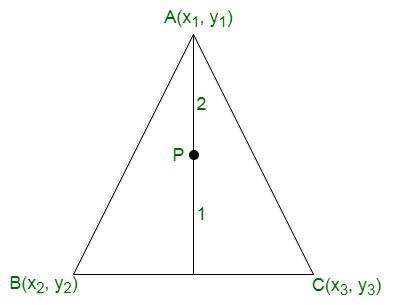
(ii) Find the coordinates of point P on AD such that AP : PD = 2 : 1.
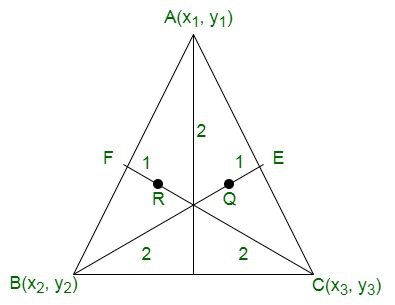
(iii) Find the coordinates of the points Q and R on medians BE and CF respectively such that BQ : QE = 2 : 1 and CR : RF = 2 : 1.
(iv) What do you observe?
Solution:
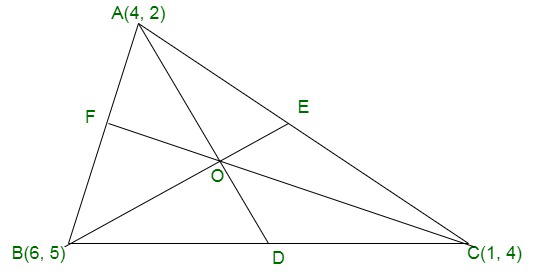
In ∆ABC, co-ordinates of A (4, 2) of (6, 5) and of (1, 4) and AD is BE and CF are the medians
such that D, E and F are the mid-points of the sides BC, CA and AB respectively
P is a point on AD such that AP : PD = 2 : 1
(i) Now coordinates of D will be
(ii) As P divides AD in the ratio of 2 : 3
Therefore,
Coordinates of P will be
Thus,
Coordinates of P are
(iii) As E and F are the mid-point if CA and AB respectively
Coordinates of E will be
and of F will be
As Q and R divides BE and CF in such a way that BQ : QE = 2 : 1 and CR : RF = 2 : 1
Therefore,
Coordinates of Q will be
and
i.e., Q1 is (11/3, 11/3)
and similarly the coordinates of R will be
and
R is (11/3, 11/3)
(iv) We can see that coordinates of P, Q and R are same
i.e., P, Q and R coincides each other.
Medians of the sides of a triangle pass through the same point which is called the centroid of the triangle.
Solution:
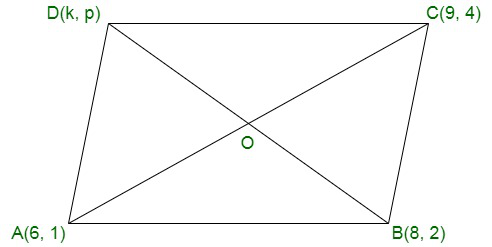
The diagonals of a parallelogram bisect each other
O is the mid-point of AC and also of BD
O is the mid-point of AC
Therefore,
Coordinates of O will be
As O is also the mid-point of BD
Therefore,
and
⇒ 8 + k = 15
⇒ k = 15 - 8 = 7
and
⇒ 2 + p = 5
⇒ p = 5 - 2 = 3
Hence,
k = 7, p = 3
Solution:
Point P divides the line segment by joining the points A (3, -5) and B (-4, 8)
Such that
⇒ AP : PB = k : 1
Assume coordinates of P be (x, y), then
and
As x + y = 0
Therefore,
4k - 2 = 0
4k = 2
k = 2/4
k = 1/2
Solution:
P is the mid-point of line segment joining the points A (-10, 4) and B (-2, 0)
Coordinates of P will be
P lies on CD also,
Let P divides C (9, 4) and D (-4, y) in the ratio m1 : m2
Therefore,
⇒ -6m1 - 6m2 = -4m1 - 9m2
⇒ -6m1 + 4m1 = -9m2 + 6m2
⇒ -2m1 = -3m2
⇒
Therefore,
m1 : m2 = 3 : 2
and
⇒ 10 = 3y - 8x
⇒ 3y = 10 + 8 = 18
⇒ y = 18/3 = 6
⇒ y = 6
Solution:
As we know that if a point (x, y) divides the line segment joining
the points (x1, y1) and (x,2 y2) in the ration m : n, then
and
Now here, C (-1, 2) divides the line segment joining A (2, 5) and B (x, y) in the ratio of 3 : 4
Now,
and
⇒ 3x + 8 = -7
and
⇒ 20 - 3y = 14
⇒ x = -5
and
⇒ y = 2
Now,
x2 + y2 = (-5)2 + (2)2
x2 + y2 = 25 + 4 = 29
Solution:
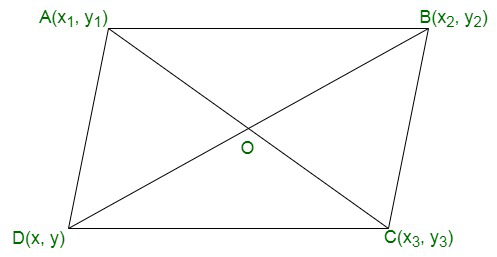
Assume the coordinates of D be (x, y). We know that diagonals of a parallelogram bisect each other.
Hence,
Mid-point of AC = Mid-point of BD
i.e., x1 + x3 = x2 + x and y1 + y3 = y2 + y
i.e, x1 + x3 - x2 = x and y1 + y3 + y2 = y
Hence, the coordinates of D are (x1 + x3 - x2, y1 + y3 + y2)
(i) The median from A meets BC at D. Find the coordinates of the point D.
(ii) Find the coordinates of the point P on AD such that AP : PD = 2 : 1.
(iii) Find the points of coordinates Q and R on medians BE and CF respectively such that BQ : QE = 2 : 1 and CR : RF = 2 : 1.
(iv) What are the coordinates of the centroid of the triangle ABC?
Solution:
Given: The points A (x1, y1), B (x2, y2) and C (x3, y3) are the vertices of ∆ABC.
(i) We know that, the median bisect the line segment into two equal parts i.e., here D is the mid-point of BC.
Therefore,
Coordinates of mid-point of BC =
D =
(ii) Assume the coordinates of a point P be (x, y)
Given that, the point P (x, y), divide the line joining A (x1, y1) and
D in the ration of 2 : 1,
Then the coordinates of P
Using internal section formula, we get
Therefore,
Required coordinates of points P =
(iii) Assume the coordinates of a point Q be (p, q)
Given: The point Q (p, q) divide the line joining B(x2, y2) and E
In the ratio of 2 : 1
Then the coordinates of Q
[Since, BE is the median of side CA. So, BE divides AC into two equal parts]
Therefore,
Mid-point of AC = Coordinates of E
⇒ E =
So, the required coordinate of point Q =
Now, let us considered that the coordinates of a point E be (α, β).
It is given that, the point R (α, β), divide the line joining C (x3, y3) and
F in the ration 2 : 1,
So, the coordinates of R be
Here, CF is the median of side AB, hence CF divides AB into two equal parts
Hence,
Mid-point of AB = Coordinates of CF
⇒ F
So, required coordinate of point R
(iv) Coordinate of the centroid of the ∆ABC = (sum of abscissa of all vertices/3, sum of all vertices/2)
Exercise 14.3 Set 3 of Chapter 14 presents a comprehensive collection of advanced problems in coordinate geometry, challenging students to apply their knowledge of area calculations, collinearity, and geometric properties in the coordinate plane. Through solving these carefully crafted questions, students develop proficiency in handling complex geometric scenarios using algebraic methods, learn to break down complicated shapes into manageable components, and understand the interconnection between different geometric concepts. This set not only reinforces the fundamental principles of coordinate geometry but also prepares students for tackling more sophisticated mathematical problems in their future academic pursuits.