|
VOOZH | about |
|
VOOZH | about |
Coordinate Geometry, also known as Analytic Geometry, is a branch of the mathematics that studies geometric properties and spatial relations using coordinate systems. This field bridges algebra and geometry by representing geometric shapes and figures through algebraic equations. It provides a powerful tool for solving problems related to the shapes, distances, and angles in a coordinate plane.
In this article, we will delve into Exercise 14.5 from Chapter 14 of RD Sharma's Class 10 Mathematics textbook. This exercise focuses on solving problems related to the coordinate geometry concepts introduced earlier in the chapter.
Coordinate Geometry involves the study of geometric figures using the coordinate system typically the Cartesian plane. Points are represented by coordinates (x,y), and various geometric concepts such as the distance, midpoint, and slope are analyzed using algebraic methods. This approach allows for the precise formulation and solution of geometric problems using equations and coordinates. The ability to translate geometric problems into algebraic equations and solve them using algebraic methods makes Coordinate Geometry an essential tool in mathematics.
Solution:
Let us assume that the points are A (a, 0), B (0, b) and C (1, 1) form a triangle ABC
Area of ∆ABC = 1/2[x1(y2 - y3) + (y3 - y1)x2 + x3(y1 - y2)]
= 1/2[a(b - 1) + 0(1 - 0) + 1(0 - b)]
= 1/2[ab - a + 0 + 1(-b)]
= 1/2[ab - a - b]
If the points are collinear, then area of ∆ABC = 0
⇒1/2(ab - a - b) = 0
⇒ab - a - b = 0
⇒ ab = a + b
Now on dividing by ab, we get
⇒
Solution:
Let us assume that the coordinates of A be (x, y) which divides the join of P (-5, 1) and Q (3, 5) in the ratio.
So, the coordinates of A will be
Or or
It is given that area of ∆ABC is 2 units and vertices are B(1, 5), C(7, -2) and A are the vertices
So, Area of ∆ABC = 1/2[x1(y2 - y3) + (y3 - y1)x2 + x3(y1 - y2)]
⇒
⇒
(i) (14k - 66)(k + 1) = 4 ⇒ 14k - 66 = 4k + 4
⇒ 14k - 4k = 66 + 4
⇒10k = 70
⇒ k = 70/10 = 7
(ii) (14k - 66)(k + 1) = -4 ⇒ 14 - 66 = -4k - 4
⇒ 14k + 4k = -4 + 66 ⇒ 18k = 62
⇒ k = 62/18 = 31/9
Hence, the value of k is 7, 31/9
Solution:
Let us considered ABC is a triangle whose vertices are (2, 1), (3, -2) and (x, y)
Also the area of triangle ABC is 5
So,
Area of ∆ABC = 1/2[x1(y2 - y3) + (y3 - y1)x2 + x3(y1 - y2)]
5 = 1/2[x(1 + 2) + 2(-2 - y) + 3(y - 1)]
10 = [3x-4-2y+3y-3]
10 = 3x + y - 7
3x + y = 10 + 7
3x + y = 17
But it is given that the point (x, y) lies on y = x + 3
So, 3x + x + 3 = 17
⇒ 4x = 17 - 3
4x = 14
⇒ x = 7/2
and y = x + 3 = 7/2 +3 = 13/2
Hence, the third vertex is (7/2, 13/2)
Solution:
Let us assume that ABCD is a quadrilateral whose vertices are A (6, 3), B (-3, 5), C (4, -2) and D (x, 3x)
Now, AC and BD are joined
Area of triangle = 1/2[x1(y2 - y3) + (y3 - y1)x2 + x3(y1 - y2)]
= 1/2 [6(5 + 2) + (-3)(-2 - 3) + 4(3 - 5)]
= 1/2 [6 * 7 + (-3)(-5) + 4(-2)]
= 1/2 [42 + 15 - 8] = 49/2
and area of △DBC,
= 1/2[x(5 + 2) + (-3)(-2 - 3x) + 4(3x - 5)]
= 1/2[7x + 6 + 9x + 12x - 20]
= 1/2[28x - 14] = 14x - 7
Now,
If 56x - 28 = 49
⇒ 56x = 49 + 28 = 77
⇒ x = 77/56 = 11/8
If 4(14x - 7) = 49
⇒56x - 28 = -49
⇒56x = -49 + 28 = -21
⇒x = -21/56 = -3/8
x = 11/8 or -3/8
Solution:
Let us assume that ABC is a triangle whose vertices are (x1, y1), (x2, y2), (x3, y3)
Area of ∆ABC = 1/2[x1(y2 - y3) + (y3 - y1)x2 + x3(y1 - y2)]
The points be on the same line, so
[x1(y2 - y3) + (y3 - y1)x2 + x3(y1 - y2)] = 0
On dividing by x1 x2 x3, we get
Solution:
Given that ABCD is a ||gm whose vertices are A (2, 4), B (2 + √3, 5) and C (2, 6).
Now draw one diagonal AC of ||gm ABCD
Diagonal bisects the ||gm into two triangle equal in area
Area of ∆ABC = 1/2[x1(y2 - y3) + (y3 - y1)x2 + x3(y1 - y2)]
= 1/2 [2(5 - 6) + (2 + √3)(6 - 4) + 2(4 - 5)]
= 1/2 [2 * (-1) + (2 + √3) * 2 + 2 * (-1)]
= 1/2 [-2 + 4 + 2√3 - 2] = 1/2 (2√3) = √3sq.units
So, the area of ||gm ABCD = 2 * area(△ABC)
= 2 * (√3) = 2√3 sq.units
Solution:
Let us assume that the ABC is a triangle whose vertices are A(3k – 1, k – 2), B(k, k – 7) and C(k – 1, -k – 2)
and A, B, C are collinear
Area of ∆ABC = 1/2[x1(y2 - y3) + (y3 - y1)x2 + x3(y1 - y2)]
= 1/2[(3k - 1)(k - 7 + k + 2) + k(-k - 2 - k + 2) + (k - 1)(k - 2 - k + 7)]
= 1/2 [(3k - 1)(2k - 5) + k(-2k + (k - 1) * 5)]
= 1/2 [6k2 - 15k - 2k + 5 - 2k2 + 5k - 5]
= 1/2[4k2 - 12k] = 2k2 - 6k
= 2k(k - 3)
As we know that the points are collinear
so, Area of ABC=0
2k(k - 3) = 0
Either 2k = 0 or k - 3 = 0, then k = 0 or k = 3
Therefore, k = 0, 3
Solution:
Let us assume that the ABC is a triangle whose vertices are A (-1, -4), B (b, c) and C (5, -1)
and A, B, C are collinear
Area of ∆ABC = 1/2[x1(y2 - y3) + (y3 - y1)x2 + x3(y1 - y2)]
= 1/2 [-1(c + 1) + b(-1 + 4) + 5(-4 - c)]
= 1/2 [-c - 1 - b + 4b - 20 - 5c]
= 1/2 [3b - 6c - 21]
As we know that the points are collinear
so, Area of triangle ABC = 0
1/2(2b - 6c - 21) = 0
⇒3b - 6c = 21
3b - 6c = 21 -----------(i)
and 2b + c = 4 ----------(ii)
⇒c = 4 - 2b
On substituting the value of c in eq (i), we get
⇒3b - 6(4 - 2b) = 21
⇒3b - 24 + 12b = 21
15b = 21 + 24 = 45
⇒b = 45/15 = 3
c = 4 - 2b = 4 - 2 * 3 = 4 - 6 = -2
b = 3, c = -2
Solution:
Let us assume that the ABC is a triangle whose vertices are A (-2, 1), B (a, b), and C (4, -1)
and A, B, C are collinear
Area of ∆ABC = 1/2[x1(y2 - y3) + (y3 - y1)x2 + x3(y1 - y2)]
= 1/2 [-2(b + 1) + a(-1 - 1) + 4(1 - b)]
= 1/2[-2b - 2 - 2a + 4 - 4b]
= 1/2 [-2b - 2 - 2a + 4 - 4b]
= 1/2 [-2a - 6b + 2] = -a - 3b + 1
As we know that the points are collinear
so, Area of triangle ABC = 0
-a - 3b + 1 = 0
a + 3b = 1 ------------(i)
a = 1 - 3b
and given that a - b = 1 ------------(ii)
On solving eq(i) and (ii), we get
4b = 0 ⇒ b = 0
Therefore, a = 1 - 3b = 1 - 3 * 0 = 1 - 0 = 1
a = 1, b = 0
Solution:
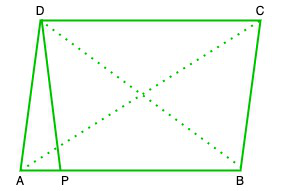
👁 ImageGiven that ABCD is a parallelogram whose vertices are A (1, -2), B (2, 3), C (a, 2), and D (-4, -3)
As we know that, diagonals bisects each other
i.e., mid-point of AC = mid-point of BD
⇒
= 1/2[x1(y2 - y3) + (y3 - y1)x2 + x3(y1 - y2)]
⇒1 + a = -2
⇒a = -3
So, the required value of a is -3
Given that, AB as base of a ||gm and drawn a perpendicular from A to AB
which meet AB at P. So, DP is a height of a ||gm.
Now, equation of base AB, passing through the points (1, -2) and (2, 3) is
⇒
⇒(y + 2)=
⇒(y + 2) = 5(x - 1)
⇒5x - y = 7 ------------(i)
So, the slope of AB, say
Let the slope of DP be m2.
Since, DP is perpendicular to AB.
By condition of perpendicularity
m1 * m2 = -1 ⇒ 5 * m2 = -1
⇒m2 = -1/5
Now, eq. of DP, having slope (-1/5)
and passing the point (-4,-3) is (y - y1) = m2(x - x1)
⇒
⇒5y + 15 = -x - 4
⇒x + 5y = -19 -------------(ii)
On adding eq (i) and (ii), then we get the intersection point P.
Now put the value of y from eq. (i) in eq. (ii), we get
x + 5(5x - 7) = -19 [using Eq. (i)]
⇒x + 25x - 35 = -19
⇒26x = 16
x = 8/13
Now put the value of x in Eq.(i), we get
So, the coordinates of point P
And, the length of the height of a parallelogram,
Now, by using distance formula, we get
Hence, the required length of height of a parallelogram is 12√26/13
Solution:
Given that, ABCD is a parallelogram, whose vertices are A (6,1), B (8,2) and C (9,4)
Let us assume that the fourth vertex of parallelogram be D(x, y).
Now as we know that, the diagonal of a parallelogram bisect each other.
so, Mid point of BD = Mid point of AC
⇒
⇒
⇒8+x=15⇒x=7
and
⇒2 + y = 5 ⇒ y = 3
So, fourth vertex of ||gm is D(7, 3)
Now, mid-point of side DC
E = (8, 7/2)
Now we find the area of ∆ADE
= 1/2[6(3 - 7/2) + 7(7/2 - 1) + 8(1 - 3)]
= 1/2 [6 * (-1/2 + 7(5/2 + 8(-2)]
= 1/2 (-3 + 35/2 - 16)
= 1/2 ( 35/2 - 19)
= 1/2 (-3/2)
= -3/4 [As we know that area cannot be negative]
Hence, the required area ∆ADE is 3/4sq. units
Solution:
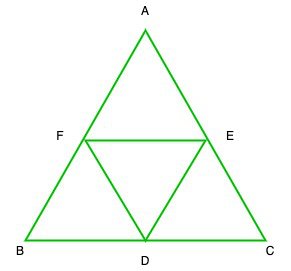
👁 ImageGiven that ABC is a triangle, so let us assume that the vertices of triangle ABC are A(x1, y1), B(x2, y2) and C(x3, y3)
And the mid points of side BC, CA, and AB are D(-1/2, 5/2), E(7, 3), and F(7/2, 7/2)
Since, D(-1/2, 5/2) is the mid-point of BC.
So,
and
⇒x2 + x3 = -1 ------------(i)
and y2 + y3 = 5
As we know that E(7, 3) is the mid-point of CA.
So, and
⇒x3 + x1 = 14 -----------(iii)
and y3 + y1 = 6 ------------(iv)
Also, F(7/2, 7/2) is the mid-point of AB
and
⇒x1 + x2 = 7 --------------(v)
and y1 + y2 = 7 ----------------(vi)
Now on adding Eq.(i), (ii) and (v), we get
2(x1 + x2 + x3) = 20
x1 + x2 + x3 = 10 ---------------(vii)
On subtracting Eq. (i) (iii) and (v) from Eq. (vii), we get
x1 = 11, x2 = -4, x3 = 3
On adding Eq.(ii), (iv) and (vi), we get
2(y1 + y2 + y3) = 18
⇒y1 + y2 + y3 = 9 -------------(viii)
On subtracting Eq. (ii), (iv) and (vi) from Eq. (viii), we get
y1 = 4, y2 = 3, y3 = 9
Hence, the vertices of ∆ABC are A(11, 4), B(-4, 3) and C(3, 2)
Area of ∆ABC = 1/2[x1(y2 - y3) + (y3 - y1)x2 + x3(y1 - y2)]
= 1/2[11(3 - 2) + (-4)(2 - 4) + 3(4 - 3)]
= 1/2[11 * 1 + (-4)(-2) + 3(1)]
= 1/2(11 + 8 + 3)
= 22/2 = 11
Hence, the required area of ∆ABC is 11 sq.unit
Read More: