|
VOOZH | about |
|
VOOZH | about |
Solution:
According to the question
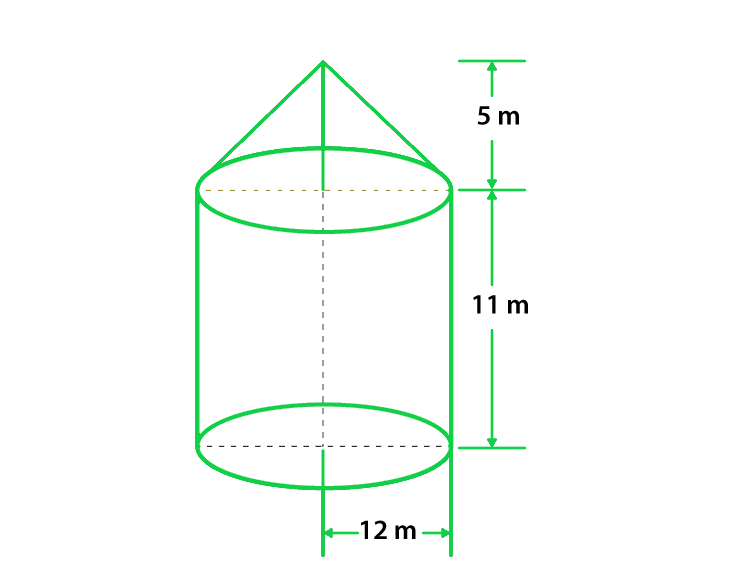
Diameter of the cylinder = 24 m,
So the radius(r) = 24/2 = 12 m,
Height of the cylindrical part (H1) = 11m
and the total height of the shape = 16 m
So, the height of the cone (h)= 16 - 11 = 5m
👁 ImageNow, first we find the slant height of the cone
So, according to the formula of slant height
l = √r2 + h2
l = √122 + 52 = 13m
Now, we find the curved surface area of the cone
A1 = πrl
= 22/7 × 6 × 13 ......(1)
Now, we find the curved surface area of the cylinder
A2 = 2πrH1
= 2π(12)(11) ......(2)
Now we find the total area of canvas required for tent,
So,
A = A1 + A2
= 22/7 × 12 × 13 + 2 × 22/7 × 12 × 11
= 490 + 829.38 = 1319.8 = 1320 m2
Hence, the total canvas required for tent is 1320 m2
Solution:
According to the question
Radius of the cylindrical part of the rocket(r) = 2.5 m,
Height of the cylindrical part of the rocket (h) = 21 m,
Slant Height of the conical surface of the rocket(l) = 8 m,
Now, we find the curved surface area of the cone
A1 = πrl
= π(2.5)(8)
= π x 20 ......(1)
Now, we find the curved surface area of the cone
A2 = 2πrh + πr2
= (2π × 2.5 × 21) + π (2.5)2
= (π × 10.5) + (π × 6.25) ......(2)
Now we find the total curved surface area
A = A1 + A2
= (π x 20) + (π x 10.5) + (π x 6.25)
= 62.83 + 329.86 + 19.63 = 412.3 m2
Hence, the total curved surface area of the conical surface is 412.3 m2
Let us considered H be the height of the conical portion in the rocket,
So, l2 = r2 + H2
H2 = l2 - r2
h = √82 - 2.52 = 23.685 m
Now we find the volume of the conical surface of the rocket
V1 = 1/3πr2H
= 1/3 × 22/7 × (2.5)2 × 23.685 ......(3)
Now we find the volume of the cylindrical part
V2 = πr2h
V2 = 22/7 × 2.52 × 21
Therefore, the total volume of the rocket
V = V1 + V2
V = 461.84 m2
Hence, the total volume of the Rocket is 461.84 m2
Solution:
According to the question
Height of the tent = 77 dm,
Height of a surmounted cone = 44 dm,
Diameter of the cylinder = 36 m,
So, the radius of the cylinder(r) = 36/2 = 18 m
Therefore, the height of the cylindrical Portion(h) = 77 - 44 = 33 dm = 3.3 m
Let us considered l be the slant height of the cone,
So,l2 = r2 + h2
l2 = 182 + 3.32
l2 = 324 + 10.89 = 334.89 = 18.3 m
Now we find the curved surface area of the cylinder
A1 = 2πrh
= 2π184.4 m2 ......(1)
Now we find the curved surface area of the cone
A2 = πrh
= π × 18 × 18.3 ......(2)
Hence, the total curved surface of the tent
A = A1 + A2
Put all the values from eq(1) and (2)
A = (2π x 18 × 4.4) + (π x 18 × 18.3) = 1532. 46 m2
Hence, the total Curved Surface Area is 1532.46 m2
Solution:
According to the question
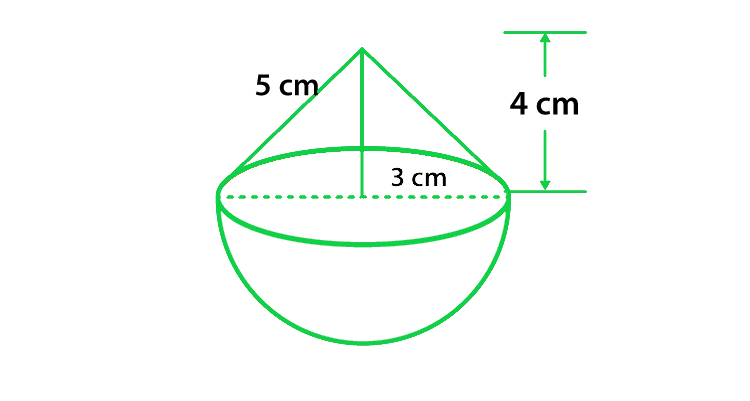
The height of the cone (h) = 4 cm
Diameter of the cone (d) = 6 cm,
So, radius of the cone (r) = 3
Also radius of the cone = radius of the hemisphere.
👁 ImageLet us considered l be the slant height of the cone,
l = √r2 + h2
l = √32 + 42 = 5 cm
Now we find the curved surface area of the cone
A1 = πrl
= π(3)(5) = 47.1 cm2
Now we find the curved surface area of the hemisphere
A1 = 2πr2
= 2π(3)2 = 56.23 cm2
Hence, the total surface area of toy
A = A1 + A2
= 47.1 + 56.23 = 103.62 cm2
Hence, the curved surface area of the toy is 103.62 cm2
Solution:
According to the question
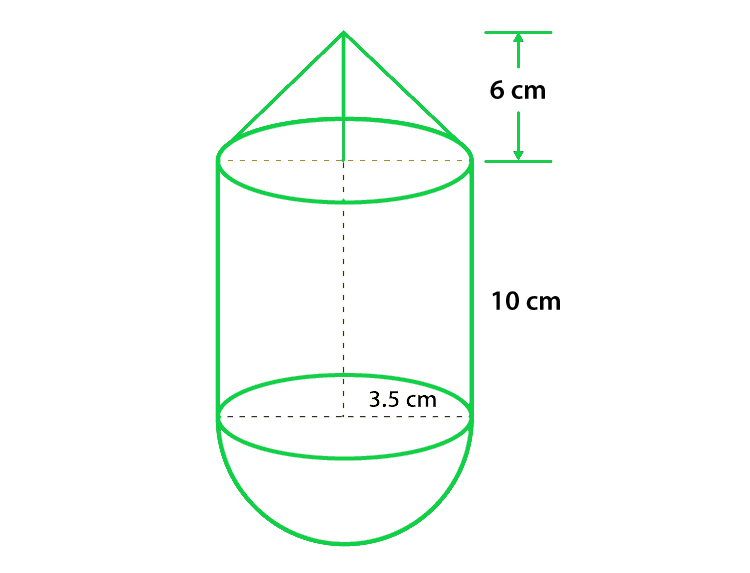
The radius of the common base (r) = 3.5 cm,
Height of the cylindrical part (h) = 10 cm,
Height of the conical part (h1) = 6 cm
👁 ImageLet us considered l be the slant height of the cone,
So,
l = √r2 + h2 = √3.52 + 62 = 48.25 cm
Now we find the curved surface area of the cone
A1 = πrl
= π(3.5)(48.25) = 76.408 cm2
Now we find the curved surface area of the hemisphere
A2 = 2πrh
= 2π(3.5) (10) = 220 cm2
Therefore, the total surface area of the solid
A = A1 + A2
= 76.408 + 220 = 373.408 cm2
Hence, total surface area of the solid is 373.408 cm2.
Solution:
According to the question
The height of the cylindrical part(h1) = 13 cm,
Radius of the cylindrical part(r) = 5 cm,
Height of the whole solid(H) = 30 cm,
The height of the conical part,
h2 = 30 - 13 - 5 = 12 cm
Now we find the slant height of the cone
l = √r2 + h22 = √52 + 122 = 13 cm
Now we find the curved surface area of the cylinder
A1 = 2πrh1
= 2π(5)(13) = 408.2 cm2
Now we find the curved surface area of the cone
A2 = πrl
= π(5)(13) cm2 = 204.1 cm2
Now we find the curved surface area of the hemisphere
A3 = 2πr2
= 2π(5)2 = 157 cm2
Hence, the total curved surface area of the toy
A = A1 + A2 + A3
= (408.2 + 204.1 + 157) = 769.3 cm2
Hence, the surface area of the toy is 769.3 cm2
Solution:
According to the question
Radius of the Cylindrical tub(r) = 5 cm,
Height of the Cylindrical tub(h1) = 9.8 cm,
Height of the cone outside the hemisphere (h2) = 5 cm,
Radius of the hemisphere = 5 cm.
Now we find the volume of the cylindrical tub
V1 = πr2h1
= π(5)2 9.8 = 770 cm3
Now we find the volume of the Hemisphere
V2 = 2/3 × π × r3
= 2/3 × 22/7 × 3.53 = 89.79 cm3
Now we find the volume of the cone
V3= 1/3 × π × r2 × h2
= 1/3 × 22/7 × 3.52 × 5 = 64.14 cm3
Hence, The total volume
V = V2 + V3
V = 89.79 + 64.14 = 154 cm3
Hence, the total volume of the solid = 154 cm3
Hence, the volume of water left in the tube V = V1 - V2
V = 770 - 154 = 616 cm3
Hence, the volume of water left in the tube is 616 cm3.
Solution:
According to the question
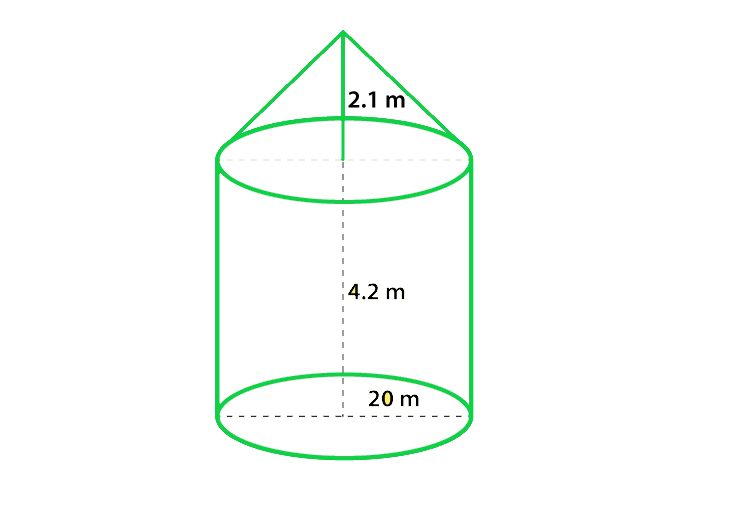
Radius of the cylindrical part(R) = 20 m,
Height of the cylindrical part(h1) = 4.2 m,
Height of the conical part(h2) = 2.1 m,
👁 ImageNow we find the volume of the cylindrical part
V1 = πr2 h1
= π(20)2 4.2 = 5280 m3
Now we find the volume of the conical part
V2 = 1/3 × π × r2 × h2
= 1/3 × 22/7 × r2 × h2
= 13 × 22/7 × 202 × 2.1 = 880 m3
Hence, the total volume of the circus tent
V = V1 + V2 = 6160 m3
Hence, the volume of the circus tent is 6160 m3
Solution:
According to the question
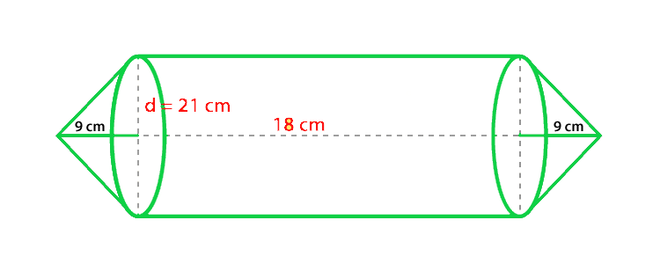
Base diameter of the cylinder = 21 cm,
Radius (r) = diameter/2 = 25/2 = 11.5 cm,
Height of the cylindrical part of the tank (h1) = 18 cm,
Height of the conical part of the tank (h2) = 9 cm.
👁 ImageNow we find the volume of the cylindrical portion
V1 = πr2 h1
= π(11.5)2 18 = 7474.77 cm3
Now we find the volume of the conical portion
V2 = 1/3 × 22/7 × r2 × h2
= 1/3 × 22/7 × 11.52 × 9 = 1245.795 cm3
Hence, the total the capacity of the tank
V = V1 + V2
= 7474.77 + 1245.795
= 8316 cm3
Hence, the capacity of the tank is 8316 cm3
Solution:
According to the question
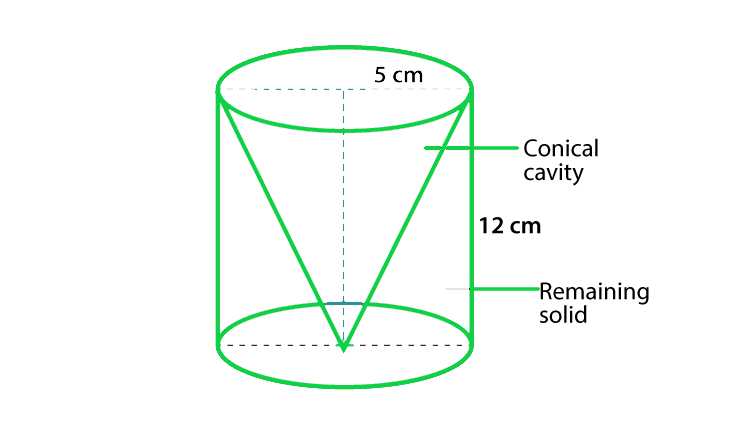
Height of the cone = Height of the cylinder = h = 12 cm,
Radius of the cone = Radius of the cylinder = r = 5 cm.
👁 ImageLet us considered l be the slant height of the cone
So,
l = √r2 + h2 = √52 + 122 = 13 cm
Now we find the total surface area of the remaining part in the circular cylinder
A= πr2 + 2πrh + πrl
= π(5)2 + 2π(5)(12) + π(5)(13) = 210 π cm2
Now we find the volume of the remaining part of the circular cylinder
V = πr2h - 1/3 πr2h
= πr2h - 1/3 × 22/7 × r2 × h
= π(5)2(12) - 1/3 × 22/7 × 52 × 12 = 200 π cm2
Hence, the area of the remaining part is 210 π cm2 and the volume is 200 π cm2
Solution:
According to the question
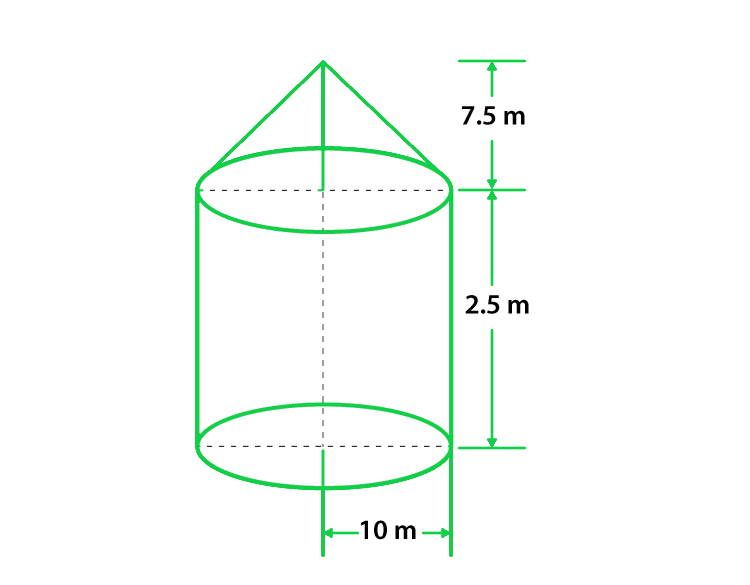
Diameter of the cylinder = 20 m,
So, the radius of the cylinder = 10 m,
Height of the cylinder (h1) = 2.5 m,
Radius of the cone = Radius of the cylinder = r = 15 m,
Height of the Cone (h2) = 7.5 m.
👁 ImageLet us considered l be the slant height of the cone
So,
l = √r2 + h22 = √152 + 7.52 = 12.5 m
Now we find the volume of the cylinder
V1 = πr2h1
= π(10)2 2.5 = 250π m3
Now we find the volume of the Cone
V2 = 1/3πr2h2
= 1/3 × 22/7 × 102 × 7.5 = 250π m3
Hence, the total capacity of the tent
V = V1 + V2
= 250 π + 250 π = 500π m3
Hence, the total capacity of the tent = V = 4478.5714 m3
Now we find the total area of the canvas required for the tent is
S = 2πrh1 + πrl
= 2(π)(10)(2.5) + π(10)(12.5) = 550 m2
Hence, the total cost of the canvas is (100 x 550) = Rs. 55000
Solution:
According to the question
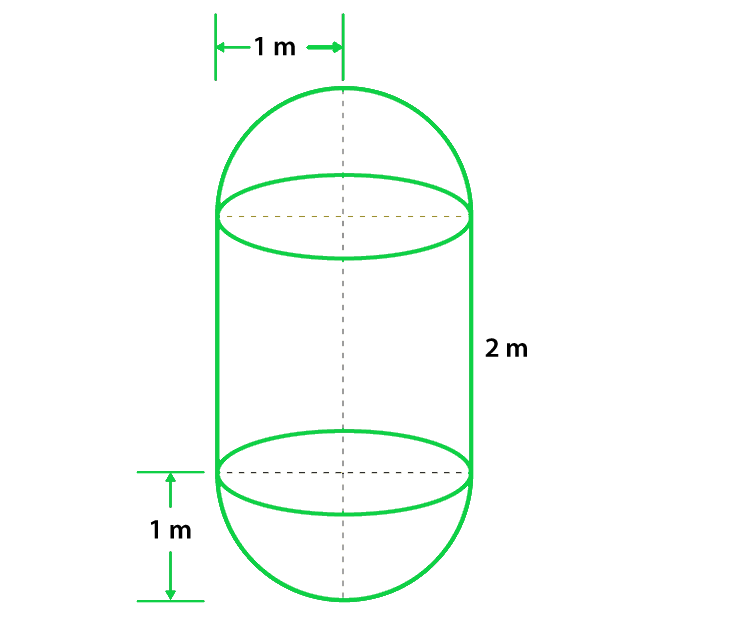
Diameter of the hemisphere = 2 m,
So, the radius of the hemisphere (r) = 1 m,
Height of the cylinder (h) = 2 m,
👁 ImageNow we find the volume of the cylinder
V1 = πr2h
= π(1)2 x 2 = 22/7 × 2 = 44/7m3
Since, at each of the ends of the cylinder, two hemispheres are attached.
so, the volume of two hemispheres
V2 = 2 × 2/3πr3
= 2 × 2/3 × 22/7 × 13 = 22/7 × 4/3 = 88/21 m3
Hence, the volume of the boiler is
V = V1 + V2
V = 44/7 + 88/21 = 220/21 m3
Hence, the volume of the boiler Is 21.3
Exercise 16.2 Set 1 focuses on problems related to cylinders. It covers calculations involving the curved surface area, total surface area, and volume of cylinders. The questions range from direct application of formulas to more complex problem-solving scenarios. Students are required to work with various dimensions of cylinders, including radius and height, and understand the relationships between these measurements and the cylinder's properties.