|
VOOZH | about |
|
VOOZH | about |
Chapter 2 of RD Sharma's Class 10 Mathematics book delves into the polynomials a fundamental algebraic concept. This chapter introduces polynomials, their types and their properties laying the groundwork for the solving polynomial equations. Exercise 2.3 focuses on the solving polynomial equations using the various techniques.
A polynomial is an algebraic expression consisting of the variables and coefficients combined using the addition, subtraction and multiplication, and non-negative integer exponents of the variables. For example: 3x2+2x−5 is a polynomial. The degree of a polynomial is the highest power of the variable in the expression. The Polynomials are classified based on their degree and the number of terms they contain such as the linear, quadratic and cubic polynomials.
(i) f(x) = x3 – 6x2 + 11x – 6, g(x) = x2 + x + 1
(ii) f(x) = 10x4 + 17x3 – 62x2 + 30x – 105, g(x) = 2x2 + 7x + 1
(iii) f(x) = 4x3 + 8x2 + 8x + 7, g(x) = 2x2 – x + 1
(iv) f(x) = 15x3 – 20x2 + 13x – 12, g(x) = x2 – 2x + 2
Solution:
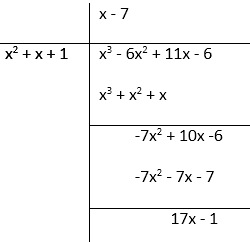
(i) Here we have to divide f(x) = x3 – 6x2 + 11x – 6 by g(x) = x2 + x + 1
So, to get quotient q(x) and remainder r(x), we use division algorithm
👁 ImageTherefore,
Remainder r(x) = 17x - 1
Quotient q(x) = x - 7
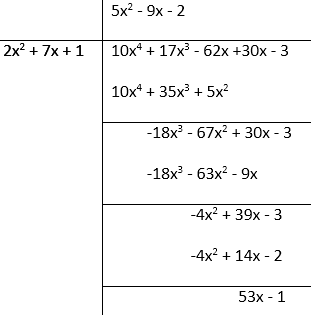
(ii) Here we have to divide f(x) = 10x4 + 17x3 – 62x2 + 30x – 105 by g(x) = 2x2 + 7x + 1
So, to get quotient q(x) and remainder r(x), we use division algorithm
👁 ImageTherefore,
Remainder r(x) = 53x - 1
Quotient q(x) = 5x2 - 9x - 2
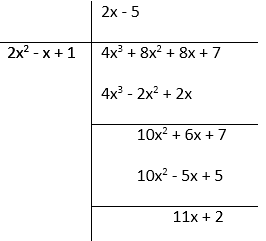
(iii) Here we have to divide f(x) = 4x3 + 8x2 + 8x + 7 by g(x) =2x2 – x + 1
So, to get quotient q(x) and remainder r(x), we use division algorithm
👁 ImageTherefore,
Remainder r(x) = 11x + 2
Quotient q(x) = 2x - 5
(iv) f(x) = 15x3 – 20x2 + 13x – 12, g(x) = x2 – 2x + 2
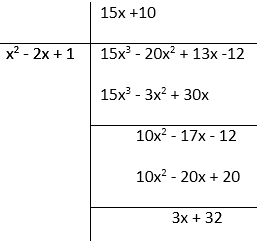
Here we have to divide f(x) = 15x3 – 20x2 + 13x – 12 by g(x) = x2 – 2x + 2
So, to get quotient q(x) and remainder r(x), we use division algorithm
👁 ImageTherefore,
Remainder r(x) = 3x + 32
Quotient q(x) = 15x + 10
(i) g(t) = t2 – 3; f(t) = 2t4 + 3t3 – 2t2 – 9t – 12
(ii) g(x) = x2 – 3x + 1; f(x) = x5 – 4x3 + x2 + 3x + 1
(iii) g(x) = 2x2 – x + 3; f(x) = 6x5 − x4 + 4x3 – 5x2 – x – 15
Solution:
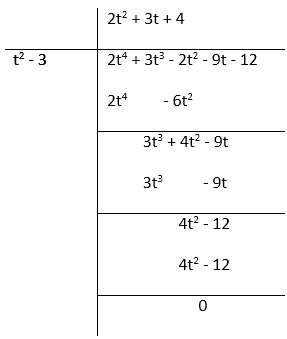
(i) Here, we have to check whether g(t) = t2 – 3 is a factor of f(t) = 2t4 + 3t3 – 2t2 – 9t – 12
So, by using division algorithm, we get
👁 ImageAs the remainder left is 0.
Therefore,
g(t) = t2 – 3 is a factor of f(t) = 2t4 + 3t3 – 2t2 – 9t – 12
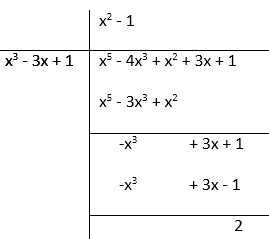
(ii) Here, we have to check whether g(x) = x2 – 3x + 1 is a factor off(x) = x5 – 4x3 + x2 + 3x + 1
So, by using division algorithm, we get
👁 ImageAs the remainder left is 2.
Therefore,
g(x) = x2 – 3x + 1 is not a factor of f(x) = x5 – 4x3 + x2 + 3x + 1
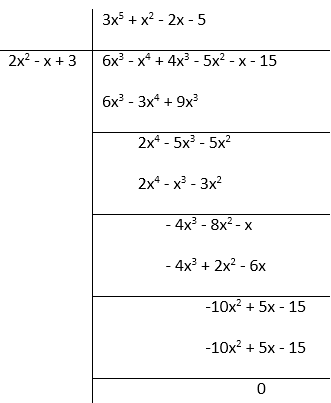
(iii) Here, we have to check whether g(x) = 2x2 – x + 3 is a factor of f(x) = 6x5 − x4 + 4x3 – 5x2 – x – 15
So, by using division algorithm, we get
👁 ImageAs the remainder left is 0.
Therefore,
g(x) = 2x2 – x + 3 is a factor of f(x) = 6x5 − x4 + 4x3 – 5x2 – x – 15
Solution:
Given: f(x) = 2x4 + x3 – 14x2 – 19x – 6
Here we have given the two zeroes of the polynomial that are -2 and -1,
Hence, its factors will be (x + 2) and (x + 1)
Further,
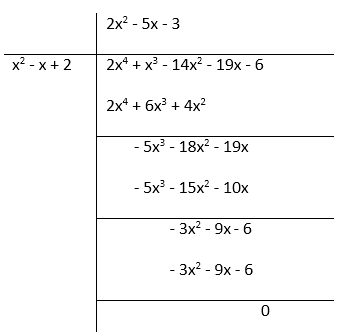
(x + 2)(x + 1) = x2 + x + 2x + 2 = x2 + 3x + 2
So, by using division algorithm, we get
👁 Imagef(x) = 2x4 + x3 – 14x2 – 19x – 6 = (2x2 – 5x – 3)(x2 + 3x + 2)
= (2x + 1)(x – 3)(x + 2)(x + 1)
Hence, the factors of f(x) = 2x4 + x3 – 14x2 – 19x – 6 are (2x + 1), (x – 3), (x + 2), (x + 1)
Therefore, the zeroes of the polynomial are -1/2, 3, -2, -1
Solution:
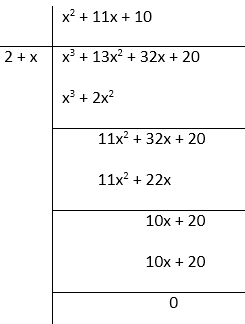
We have been given the zero of the polynomial f(x) = x3 + 13x2 + 32x + 20 is -2.
Hence, its factor is (x + 2).
So, by using division algorithm, we get
👁 ImageThus,
f(x) = x3 + 13x2 + 32x + 20
= (x2 + 11x + 10)(x + 2)
= (x2 + 10x + x + 10)(x + 2)
= (x + 10)(x + 1)(x + 2)
Hence, the factors of f(x) = x3 + 13x2 + 32x + 20 are (x + 10), (x + 1), (x + 2)
Thus, the zeroes of the polynomial are -1, -10, -2.
Solution:
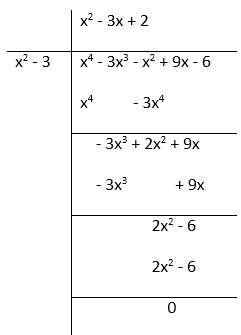
Here, we are given two zeros of the polynomial f(x) = x4 – 3x3 – x2 + 9x – 6 that are -√3 and √3.
Thus, the factors are (x + √3)(x − √3) ⇒ x2 - 3.
So, by using division algorithm, we get
👁 ImageHence,
f(x) = x4 – 3x2 – x2 + 9x – 6 = (x2 – 3)(x2 – 3x + 2)
(x + √3)(x – √3)(x2 – 2x – 2 + 2)
= (x + √3)(x – √3)(x – 1)(x – 2)
Thus, the factors of f(x) = x4 – 3x3 – x2 + 9x – 6 are (x + √3)(x – √3)(x – 1)(x – 2).
Therefore, the zeroes of the polynomial are -√3, √3, 1, 2.
Solution:
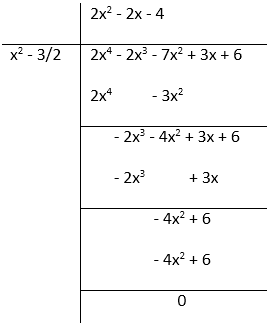
Here, we are given two zeros of the polynomial f(x) = 2x4 – 2x3 – 7x2 + x – 1 that are -√3/2 and √3/2.
Thus, the factors are ⇒ x2 - 3/2.
So, by using division algorithm, we get
👁 ImageHence,
Factors of f(x) = 2x4 – 2x3 – 7x2 + x – 1 are .
Thus, the zeroes of the polynomial are -1, 2, -√3/2 and √3/2.
Solution:
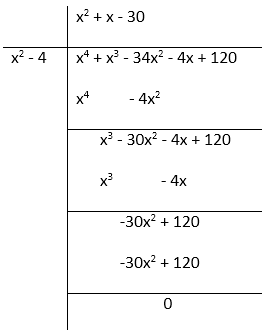
Here, we are given two zeros of the polynomial x4 + x3 – 34x2 – 4x + 120 that are 2 and -2.
Thus, the factors are (x + 2)(x - 2)⇒ x2 - 4.
So, by using division algorithm, we get
👁 ImageHence,
x4 + x3 – 34x2 – 4x + 120 = (x2 – 4)(x2 + x – 30)
= (x – 2)(x + 2)(x2 + 6x – 5x – 30)
= (x – 2)(x + 2)(x + 6)(x – 5)
So, the factors of x4 + x3 – 34x2 – 4x + 120 are (x – 2), (x + 2), (x + 6), (x – 5)
Thus, the zeroes of the polynomial = x = 2, – 2, – 6, 5
Solution:
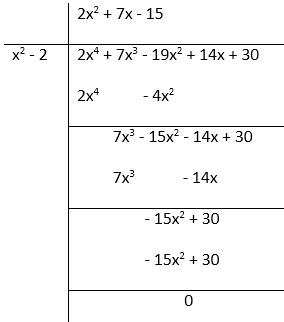
Here, we are given two zeros of the polynomial 2x4 + 7x3 – 19x2 – 14x + 302 that are √2 and -√2.
Thus, the factors are (x + √2)(x - √2) ⇒ x2 - 2.
So, by using division algorithm, we get
👁 ImageHence,
2x4 + 7x3 – 19x2 – 14x + 30 = (x2 – 2)(2x2 + 7x – 15)
= (2x2 + 10x – 3x – 15)(x + √2)(x – √2)
= (2x – 3)(x + 5)(x + √2)(x – √2)
So, the factors of 2x4 + 7x3 – 19x2 – 14x + 30 are (2x – 3), (x + 5), (x + √2), (x – √2)
Thus, the zeroes of the polynomial is √2, -√2, -5, 3/2.
Solution:
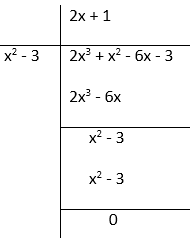
Here, we are given two zeros of the polynomial f(x) = 2x3 + x2 – 6x – 3 that are -√3 and √3.
Thus, the factors are (x + √3)(x - √3) ⇒ x2 - 3.
So, by using division algorithm, we get
👁 ImageHence,
f(x) = 2x3 + x2 – 6x – 3
= (x2 – 3)(2x + 1)
= (x + √3)(x - √3)(2x + 1)
Factors of f(x) = 2x3 + x2 – 6x – 3 are (x + √3), (x - √3), 2x + 1
Thus, the zeroes for the given polynomial are √3, -√3, -1/2
Solution:
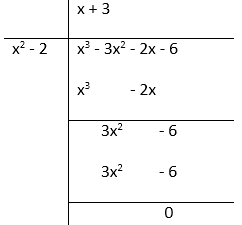
Here, we are given two zeros of the polynomial f(x) = x3 + 3x2 – 2x – 6 that are √2 and -√2.
Thus, the factors are (x + √2)(x - √2)⇒ x2 - 2.
So, by using division algorithm, we get
👁 ImageHence,
f(x) = x3 + 3x2 – 2x – 6
= (x2 – 2)(x + 3)
= (x + √2)(x - √2)(x + 3)
Factors of f(x) = x3 + 3x2 – 2x – 6 are (x + √2), (x - √2), (x + 3)
Thus, the zeroes of the given polynomial is -√2, √2, and – 3.
Solution:
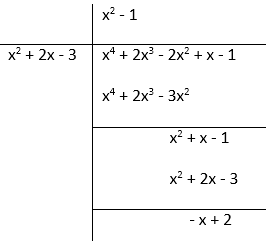
Here we have to add to the polynomial f(x) = x4 + 2x3 – 2x2 + x − 1 so that the
resulting polynomial is exactly divisible by g(x) = x2 + 2x − 3.
So, divide f(x) = x4 + 2x3 – 2x2 + x − 1 by g(x) = x2 + 2x − 3 to get the answer.
👁 ImageAs the remainder left is (x – 2) to get the resulting polynomial exactly divisible by
g(x) = x2 + 2x − 3 we must add (x - 2) to f(x) = x4 + 2x3 – 2x2 + x − 1.
Solution:
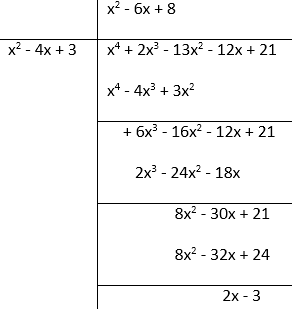
Here we have to subtract to the polynomial f(x) = x4 + 2x3 – 13x2 – 12x + 21
so that the resulting polynomial is exactly divisible by g(x) = x2 - 4x + 3.
So, divide f(x) = x4 + 2x3 – 13x2 – 12x + 21 by g(x) = x2 - 4x + 3 to get the answer.
👁 ImageAs the remainder left is (2x - 3) to get the resulting polynomial exactly divisible by
g(x) = x2 - 4x + 3 we must add (2x - 3) to f(x) = x4 + 2x3 – 13x2 – 12x + 21.
Solution:
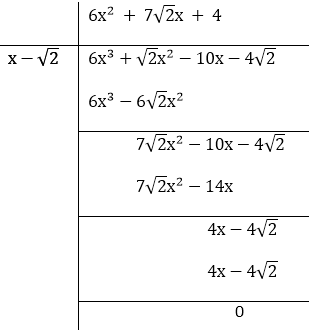
Here, we are given that √2 is the zero of the cubic polynomial
f(x) = 6x3 + √2x2– 10x – 4√2, thus, factor of the polynomial is (x - √2)
So, by using division algorithm, we get
👁 ImageHence,
f(x) = 6x3 + √2x2 – 10x – 4√2
= (x - √2)(6x2 + 7√2x + 4)
= (x - √2)(6x2 + 4√2x + 3√2x + 4)
= (x - √2)(3x + 2√2)(2x + √2)
The factors of f(x) = 6x3 + √2x2– 10x – 4√2 are (x - √2), (3x + 2√2), (2x + √2)
Therefore, the zeros of the polynomial are -2√2/3, -√2/2, √2
Solution:
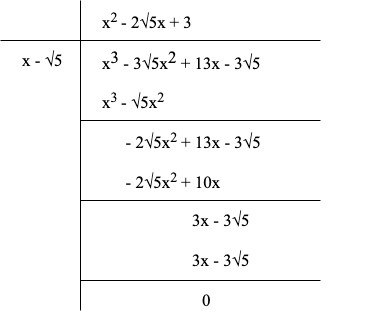
Here, we have x - √5 as factor of the cubic polynomial x3 - 3√5x2 + 13x - 3√5
To find all the zeros of the polynomial, we have to divide the polynomial x3 - 3√5x2 + 13x - 3√5 by the factor x - √5
👁 ImageHence,
x3 - 3√5x2 + 13x - 3√5
= (x - √5)(x2 - 2√5 + 3)
= (x - √5)(x - (√5 + √2))(x - (√5 - √2))
So, the factors of the cubic polynomial x3 - 3√5x2 + 13x - 3√5 are (x - √5), (x - (√5 + √2)), (x - (√5 - √2))
Therefore, the zero of the polynomial are √5, (√5 - √2), (√5 + √2)
Read More: