|
VOOZH | about |
|
VOOZH | about |
Solution:
According to the question
The sides of triangle are:
AB = 3 cm
BC = 4 cm
AC = 6 cm
According to Pythagoras Theorem:
AB2 = 32 = 9
BC2 = 42 = 16
AC2 = 62 = 36
Since, AB2 + BC2 ≠ AC2
Hence, by converse of Pythagoras theorem, triangle is not a right triangle
(i) a = 7 cm, b = 24 cm and c = 25 cm
(ii) a = 9 cm, b = 16 cm and c = 18 cm
(iii) a = 1.6 cm, b = 3.8 cm and c = 4 cm
(iv) a = 8 cm, b = 10 cm and c = 6 cm
Solution:
(i) According to the question
The sides of triangle are:
a = 7 cm, b = 24 cm and c = 25 cm
According to Pythagoras Theorem:
The hypotenuse or longest side of a right angle triangle is equal to the sum of
squares of other two sides of the triangle
∴ a2 = 49, b2 = 576 and c2 = 625
(Longest side)2 = c2 = 625
Sum of squares of shorter sides = (a)2 + (b)2= 49 + 576 = 625
∴ 625 = 625
Hence, by converse of Pythagoras theorem, given triangle is a right triangle.
(ii) According to the question
The sides of triangle are: a = 9 cm, b = 16 cm and c = 18 cm
According to Pythagoras Theorem:
The hypotenuse or longest side of a right angle triangle is equal to the sum of
squares of other two sides of the triangle
∴ a2 = 81, b2 = 256 and c2 = 324
(Longest side)2 = c2 = 324
Sum of squares of shorter sides = (a)2 + (b)2 = 81 + 256 = 337
∴324 ≠ 337
Hence, by converse of Pythagoras theorem, given triangle is not a right triangle.
(iii) According to the question
The sides of triangle are: a = 1.6 cm, b = 3.8 cm and C = 4 cm
According to Pythagoras Theorem:
The hypotenuse or longest side of a right angle triangle is equal to the sum of
squares of other two sides of the triangle
(Longest side)2 = 16
Sum of squares of shorter sides = (1.6)2 + (3.8)2 = 2.56 + 14.44 = 17
∴ 16 ≠ 17
Hence, by converse of Pythagoras theorem, given triangle is not a light triangle.
(iv) According to the question
The sides of triangle are: a = 8 cm, b = 10 cm, c = 6 cm
According to Pythagoras Theorem:
The hypotenuse or longest side of a right angle triangle is equal to the sum of
squares of other two sides of the triangle
(Longest side)2 = (10)2 = 100
Sum of squares of shorter sides = (8)2 + (6)2 = 64 + 36 = 100
∴ 100 = 100
Hence, by converse of Pythagoras theorem, given triangle is a light triangle.
Solution:
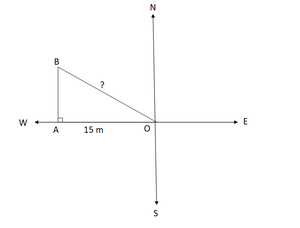
👁 ImageLet the starting point of the man be O and final point be A.
So, In ∆ABO,
By using Pythagoras theorem
AO2 = AB2 + BO2
⟹ AO2 = 82 + 152
⟹ AO2 = 64 + 225 = 289
⟹ AO = √289 = 17m
Hence, the man is 17m far from the starting point.
Solution:
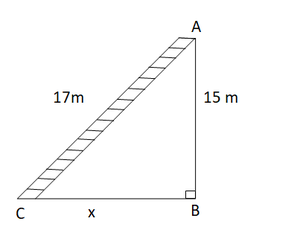
👁 ImageIn ∆ABC,
By using Pythagoras theorem
AB2 + BC2 = AC2
⟹ 152 + BC2 = 172
⟹ 225 + BC2 = 172
⟹ BC2 = 289 – 225
⟹ BC2 = 64
⟹ BC = 8 m
Hence, the distance of the foot of the ladder from building = 8 m
Solution:
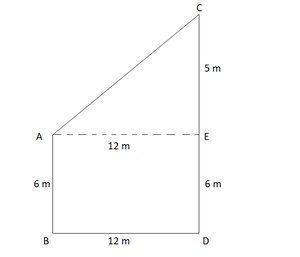
👁 ImageLet us considered CD and AB be the poles of height 11 and 6 in.
Therefore, CP = 11 - 6 = 5 m
From the figure we may observe that AP = 12m
In ∆APC,
By using Pythagoras theorem
AP2 + PC2 = AC2
122 + 52 = AC2
AC2 = 144 + 25 = 169 m
AC = 13 m
Hence, the distance between their tops = 13 m.
Solution:
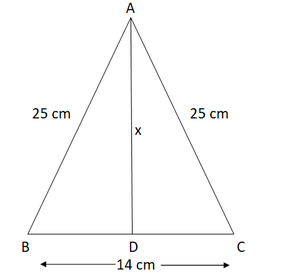
👁 ImageAccording to the question
AB = AC = 25 cm and BC = 14
In ∆ABD and ∆ACD
∠ADB = ∠ADC [Each = 90°]
AB = AC [Each = 25 cm]
AD = AD [Common]
So, by RHS condition
∆ABD ≅ ∆ACD
Hence, by corresponding parts of congruent triangles
∴ BD = CD = 7 cm
In ∆ADB,
By using Pythagoras theorem
AD2 + BD2 = AB2
⟹ AD2 + 72 = 252
⟹ AD2 = 625 – 49 = 576
⟹ AD = √576 = 24 cm
Solution:
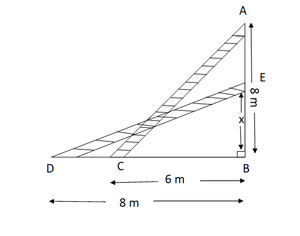
👁 ImageLet length of ladder be AD = BE = l m
In ∆ACD,
By using Pythagoras theorem
AD2 = AC2 + CD2
⟹ l2 = 82 + 62 ... (i)
In ∆BCE,
By using Pythagoras theorem
BE2 = BC2 + CE2
⟹ l2 = BC2 + 82 ... (ii)
From eq(i) and (ii), we get
BC2 + 82 = 82 + 62
⟹ BC2 + 62
⟹ BC = 6 m
Solution:
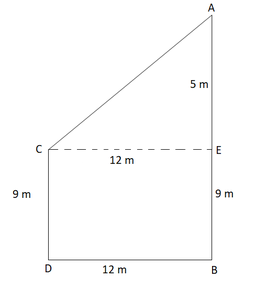
👁 ImageWe have,
AC = 14 m. DC = 12m and ED = BC = 9 m
Construction: Draw EB ⊥ AC
AB = AC – BC = 14 — 9 = 5 m
And, EB = DC = 12m
In ∆ABE,
By using Pythagoras theorem
AE2 = AB2 + BE2
⟹ AE2 = 52 + 122
⟹ AE2 = 25 + 144 = 169
⟹ AE= √169 = 13 m
Hence, the distance between their tops = 13 m
Solution:
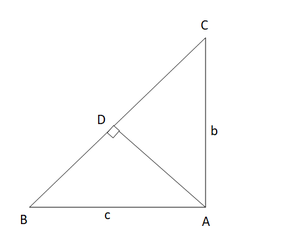
We have,
In ∆BAC,
By using Pythagoras theorem
BC2 = AB2 + AC2
⟹ BC2 = c2 + b2
....(1)
In ∆ABD and ∆CBA
∠B = ∠B [Common]
∠ADB = ∠BAC [Each 90°]
So, by AA both the triangles are similar
∆ABD ͏~ ∆CBA
Hence, by corresponding parts of similar ∆ are proportional
Hence, the length of AD in terms of b and c is
Solution:
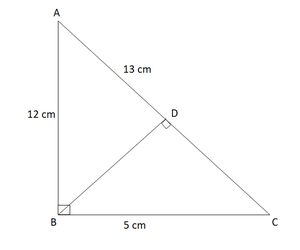
👁 ImageLet, AB = 5cm, BC = 12 cm and AC = 13 cm. Then, AC2 = AB2 + BC2.
This proves that ∆ABC is a fight triangle. right angles at B.
Let BD be the length of perpendicular from B on AC.
Now, Area of ∆ABC = 1/2(BC x BA)
= 1/2(12 x 5)
= 30 cm
Also, Area of ∆ABC = 1/2(AC x BD) = 1/2(13 x BD) = 1/2(13 x 2)
BD = 60/13 cm
Solution:
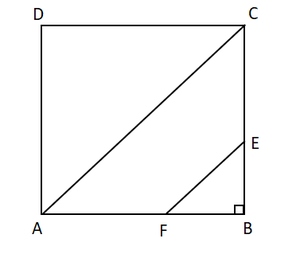
👁 ImageGiven,
ABCD is a square.
F is the mid-point of AB.
BE is one third of BC.
Area of ∆ FBE = 108cm2
To find: length of AC
Let’s the sides of the square to be y.
AB = BC = CD = DA = y cm
So, AF = FB = x/2 cm
and, BE = x/3 cm
Now,
Area of ∆ FBE = 1/2 x BE x FB
⇒ 108 = (1/2) x (x/3) x (x/2)
⇒ x2 = 108 x 2 x 3 x 2 = 1296
⇒ x = √(1296)
x = 36cm
In ∆ ABC,
By using Pythagoras theorem
AC2 = AB2 + BC2
⇒ AC2 = x2 + x2 = 2x2
⇒ AC2 = 2 x (36)2
⇒ AC = 36√2 = 36 x 1.414 = 50.904 cm
Hence, the length of AC is 50.904 cm.
Solution:
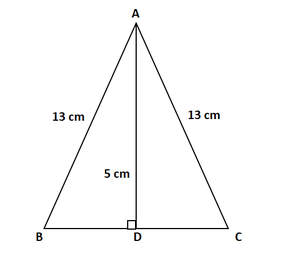
👁 ImageGiven that,
An isosceles triangle ABC, AB = AC = 13cm, AD = 5cm
To find: BC
Now In ∆ ADB,
By using Pythagoras theorem
AD2 + BD2 = 132
52 + BD2 = 169
BD2 = 169 – 25 = 144
BD = √144 = 12 cm
Similarly, In ∆ADC,
By using Pythagoras theorem
AC2 = AD2 + DC2
132 = 52 + DC2
169 - 25 = DC2
DC = √144 = 12 cm
So, BC = BD + DC = 12 + 12 = 24 cm
Hence, in isosceles triangle ABC side BC is 24 cm
(i) AD = a √3
(ii) area (∆ABC) = √3 a2
Solution:
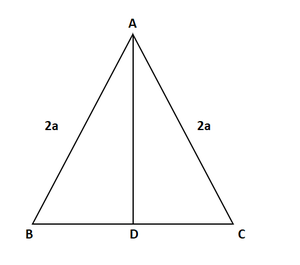
👁 Image(i) In ∆ABD and ∆ACD,
∠ADB = ∠ADC = 90° [Given]
AB = AC [Given]
AD = AD [Common]
So, By RHS condition
∆ABD ≅ ∆ACD
Hence, by corresponding parts of congruent triangles
∴ BD = CD = a
Now In ∆ABD,
By using Pythagoras theorem
AD2 + BD2 = AB2
AD2 + a2 = 2a2
AD2 = 4a2 – a2 = 3a2
AD = a√3
(ii) Area (∆ABC) = 1/2 x BC x AD
= 1/2 x (2a) x (a√3)
= √3 a2
Hence Proved
Solution:
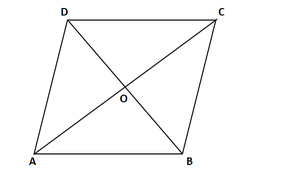
👁 ImageTo find: Each side of the rhombus.
Let ABCD be a rhombus with diagonals AC and BD.
∴ AC = 24cm and BD = 10cm
We know that,
AO = OC = 12cm and BO = OD = 3cm [Diagonals of a rhombus bisect each other at right angle]
Now In ∆AOB,
By using Pythagoras theorem
AB2 = AO2 + BO2
= 122 + 52
= 144 + 25
= 169
∴ AB = √(169) = 13cm
∴ AB = BC = CD = AD = 13cm. [The sides of rhombus are all equal.]
Hence, the sides of the rhombus are as follows AB = BC = CD = AD = 13cm.