|
VOOZH | about |
|
VOOZH | about |
Solution:
Let us considered the length of piece of cloth = x m
Given: The total cost = ₹ 35
So, the cost of 1 m cloth = ₹ 35/x
According to the question,
(x + 4)(35/x - 1) = 35
⇒ 35 - x + (140/x) - 4 = 35
⇒ -x + (140/x) + 31 - 35 = 0
⇒ -x + (140/x) - 4 = 0
⇒ -x2 + 140 - 4x = 0
⇒ x2 + 4x - 140 = 0
⇒ x2 + 14x - 10x - 140 = 0
⇒ x (x + 14) -10 (x + 14) = 0
⇒ (x + 14) (x - 10) = 0
x = 10 or x = -14
Here the value of x = -14 is negative which is not possible
So, the length of piece of cloth = 10 m.
Solution:
Let us considered the number of students = x
Given: The total budget = ₹ 480
So, the share of each student = ₹ 480/x
According to the question,
(480/x - 8) - (480/x) = 10
⇒
⇒
⇒ 10x2 - 80x - 3840 = 0
⇒ x2 - 8x - 384 = 0
⇒ x2 + 16x - 24x - 384 = 0
⇒ x (x + 16) - 24 (x + 16) = 0
⇒ (x + 16) (x - 24) = 0
x = 24, or x = -16
Here the value of x = -16 is negative which is not possible
So, the number of students = 24.
The total number of students attend the picnic = 24 - 8 = 16
Solution:
Let cost price of the article = ₹ x
Selling price = ₹ 24
Gain = x %
According to the Question,
S.P.= C.P. × (100 + Gain%)/100
24 = x(100 + x)/100
⇒ 2400 = 100x + x2
⇒ x2 + 100x - 2400 = 0
⇒ x2 - 20x +120x - 2400 = 0
⇒ x(x - 20) + 120(x - 20) = 0
⇒ (x - 20)(x + 120) = 0
x = 20 or x = -120
Here the value of x = -120 is negative which is not possible
Therefore, the cost price of the article = ₹20
Solution:
Let us considered the total number of swans = x
According to the question,
7/2(√x) + 2 = x
⇒ 7√x = 2x - 4
On squaring both sides, we get
⇒ 49x = 4x + 16 - 16x
⇒ 4x2 - 65x + 16 = 0
⇒ 4x2 - 64x - x + 16 = 0
⇒ 4x(x - 16) - (x – 16) = 0
⇒ (4x - 1)(x - 16) = 0
⇒ x =1/4 or x = 16
Since, number of swans is a natural number we can neglect the solution of a = 1/4
Hence, the total number of swans is 16.
Solution:
Let the original price of the toy = x
The number of toys he can buy at the original price for ₹ 360 = 360/x
According to the question,
⇒ 360x = (x - 2)(360 + 2x)
⇒ 360x = 360x + 2x2 - 720 - 4x
⇒ x2 - 2x - 360 = 0
⇒ x2 - 20x + 18x - 360 = 0
⇒ x(x - 20) + 18(x - 20) = 0
⇒ (x + 18)(x - 20) = 0
⇒ x + 18 = 0 or x - 20 = 0
⇒ x = -18 or x = 20
As, the price can’t be negative, x = -18 is neglected.
Thus, the original price of the toy is ₹ 20.
Solution:
Let’s consider the original number of people = a
Amount which each receives when a person are present = 9000/a
According to the question,
⇒ 9000a = (9000 – 160a)(a + 20)
⇒ 9000a = 9000a + 180000 – 160a2 – 3200a
⇒ a2 + 20a – 1125 = 0
⇒ a2 + 45a – 25a – 1125 = 0
⇒ a(a + 45) – 25(a + 45) = 0
⇒ (a – 25)(a + 45) = 0
⇒ a = 25 or a = -45 (Number of people can never be negative,
so we can neglect this value)
Therefore, the original number of people = 25.
Solution:
Let us considered the number of students = x
Given: The total budget = ₹ 500
So, the share of each student = ₹ 500/x
The number of students failed to go = 5
According to the question,
⇒ 5x2 - 25x - 2500 = 0
⇒ x2 - 5x - 500 = 0
⇒ x2 - 25x + 20x - 500 = 0
⇒ x(x - 25) + 20(x - 25) = 0
⇒ (x - 25)(x + 20) = 0
⇒ x - 25 = 0 or x + 20 = 0
⇒ x = 25 or x = -20
Here the value of x = -20 is negative which is not possible
So, the number of students = 25
Solution:
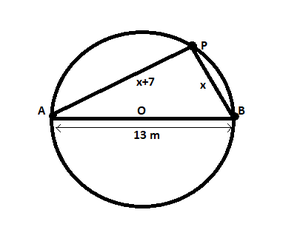
In the given circle, AB(Diameter) = 13 m
👁 Image
Let us considered P be the pole in the circle.
So, PB = x m and PA= (x + 7) m
In the triangle APB
AB2 = AP2 + PB2
⇒ 132 = (x + 7)2 + (x)2
⇒ 169 = x2 + 49 +14x + x2
⇒ 2x2 + 14x -120 = 0
⇒ x2 +7x - 60 = 0
⇒ x2 +12x - 5x - 60 = 0
⇒ x(x + 12) - 5(x + 12) = 0
⇒ (x + 12)(x - 5) = 0
x = -12 or x = 5
Here the value of x = -12 is negative which is not possible
So the value valid of x = 5
Hence, PB = 5 m and PA = 5 + 7 = 12 m.
Solution:
Given: The sum of marks obtained by P in Mathematics and Science = 28
So let us considered the marks in Mathematics = x
and the marks in Science = 28 – x
According to the question
(x + 3) (28 – x – 4) = 180
⇒ (x + 3) (24 – x) = 180
⇒ 24x – x² + 72 – 3x = 180
⇒ 21x – x² + 72 – 180 = 0
⇒ – x² + 21x – 108 = 0
⇒ x² – 21x + 108 = 0
⇒ x² – 9x – 12x + 108 = 0
⇒ x (x – 9) – 12 (x – 9) – 0
⇒ (x – 9)(x – 12) = 0
x = 9 or x = 12
So, if we take x = 9 then the marks in
Mathematics = 9 and marks in Science = 19
So, if we take x = 12 then the marks in
Mathematics = 12 and marks in English = 16
Solution:
Given: Sum of Shefali's marks in Mathematics and English = 30
So let us considered the marks in Mathematics = x
and the marks in English = 30 – x
According to the question
(x + 2) (30 – x – 3) = 210
⇒ (x + 2) (27 – x) = 210
⇒ 27x – x² + 54 – 2x – 210 = 0
⇒ – x² + 25x – 156 = 0
⇒ x² – 25x + 156 = 0
⇒ x² – 12x – 13x +156 = 0
⇒ x (x – 12) – 13 (x – 12) = 0
⇒ (x – 12) (x – 13) = 0
x = 13 or x = 12
So, if we take x = 13 then the marks in
Mathematics = 12 and marks in English = 18
So, if we take x = 12 then the marks in
Mathematics = 13 and marks in English = 17
Solution:
Given: Total cost of production on that day = ₹90
So, Let us considered the number of articles = x
Hence the price of each article = 2x + 3
According to the question,
x (2x + 3) = 90
⇒ 2x² + 3x - 90 = 0
⇒ 2x² -12x + 15x - 90 = 0
⇒ 2x (x - 6) + 15 (x - 6) = 0
⇒ (x - 6) (2x + 15) = 0
If x - 6 = 0
So, x = 6
If 2x + 15 = 0
So x = -15/2
Here the value of x is negative which is not possible
So the value valid of x = 6
Hence the number of articles = 6
And price of each article = 2x + 3 = 2 x 6 + 3 = 12 + 3 = 15
Solution:
As we already know that, the time between 2 pm to 3 pm = 1 h = 60 minutes
Given: At t minutes past 2 pm, the time needed by the minutes hand of a clock
to show 3 pm was found to be 3 minutes less than t2/4 minutes.
Find: the value of t
So,
⇒ 4t + t² - 12 = 240
⇒ t² + 4t - 252 = 0
⇒ t² + 18t - 14t - 252 = 0
⇒ t (t + 18) - 14 (t + 18) = 0
⇒ (t + 18) (t - 14) = 0
As we know that time cannot be negative, so t ≠ -18
Hence, t = 14 min