|
VOOZH | about |
|
VOOZH | about |
Chapter 2 of RD Sharma's Class 11 Mathematics textbook focuses on Relations. Exercise 2.1 specifically deals with the basic concepts of relations, including their definition, representation, and properties. This exercise helps students understand how relations are used to describe connections between elements of sets.
Solution:
According to the definition of equality of ordered pairs
(a/3 + 1, b - 2/3) = (5/3, 1/3)
⇒ a/3 + 1 = 5/3 and b - 2/3 =1/3
⇒ a/3 = (5 - 3)/3 and b = (1/3 + 2/3)
⇒ a/3 = 2/3 and b = 3/3
⇒ a = 2 and b = 1
Solution:
According to the definition of equality of ordered pairs
(x + 1, 1) = (3, y - 2)
⇒ x + 1 = 3 and 1 = y - 2
⇒ x = 3 - 1 and 1 + 2 = y
⇒ x = 2 and 3 = y
⇒ x = 2 and y = 3
Solution:
Given:
(x, -1) ∈ {(a, b) : b = 2a - 3}
and, (5, y) ∈ {(a, b) : b = 2a - 3}
⇒ -1 = 2 × x - 3 and y = 2 × 5 - 3
⇒ -1 = 2x - 3 and y = 10 - 3
⇒ 3 - 1 = 2x and y = 7
⇒ 2 = 2x and y = 7
⇒ x = 1 and y = 7
Solution:
Given: a ∈ {- 1, 2, 3, 4, 5} and b ∈ {0, 3, 6},
Now, we have to find the ordered pair (a, b) such that a + b = 5
So, the ordered pair (a, b) such that a + b = 5 are as follows
(a, b) ∈ {(- 1, 6), (2, 3), (5, 0)}
Solution:
Given: a ∈ {2, 4, 6, 9} and b ∈ {4, 6, 18, 27}
Here,
2 divides 4, 6, 18 and is also less than all of them
4 divides 4 and is also less than none of them
6 divides 6, 18 and is less than 18 only
9 divides 18, 27 and is less than all of them
∴ Ordered pairs (a, b) are (2, 4), (2, 6), (2, 18), (6, 18), (9, 18) and (9, 27)
Solution:
Given: A = {1, 2} and B = {1, 3}
Now we have to find A x B, and B x A
A × B = {1, 2} × {1, 3}
= {(1, 1), (1, 3), (2, 1), (2, 3)}
B × A = {1, 3} × {1, 2}
= {(1, 1), (1, 2), (3, 1), (3, 2)}
Solution:
Given: A = {1, 2, 3} and B = {3, 4}
Now we have to find A x B
A x B = {1, 2, 3} × {3, 4}
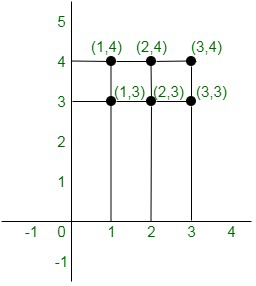
= {(1, 3), (1, 4), (2, 3), (2, 4), (3, 3), (3, 4)}
To draw A x B graphically follow the following steps:
Step 1: Draw horizontal and vertical axis.
Step 2: The horizontal axis represents set A and the vertical axis represents set B.
Step 3: Now, draw dotted lines perpendicular to horizontal and vertical axes through the elements of set A and B
Step 4: Point of intersection of these perpendicular represents A × B
👁 Image
Solution:
Given:
A = {1, 2, 3} and B = {2, 4}
Now we have to find A × B, B × A, A × A, and (A × B) ∩ (B × A)
A × B = {1, 2, 3} × {2, 4}
= {(1, 2), (1, 4), (2, 2), (2, 4), (3, 2), (3, 4)}
B × A = {2, 4} × {1, 2, 3}
= {(2, 1), (2, 2), (2, 3), (4, 1), (4, 2), (4, 3)}
A × A = {1, 2, 3} × {1, 2, 3}
= {(1, 1), (1, 2), (1, 3), (2, 1), (2, 2), (2, 3), (3, 1), (3, 2), (3, 3)}
B × B = {2, 4} × {2, 4}
= {(2, 2), (2, 4), (4, 2), (4, 4)}
Intersection of two sets represents common elements of both the sets
So,
(A × B) ∩ (B × A) = {(2, 2)}
Solution:
Given: n(A) = 5 and n(B) = 4
We know that if A and B are two finite sets, then n(A × B) = n(A) × n(B)
Therefore,
n(A × B) = 5 × 4 = 20
Now,
n[(A × B) ∩ (B × A)] = 3 × 3 = 9 -(∵ A and B have 3 common elements)
Solution:
Let us considered(a, b) be an arbitrary elements of (A × B) ∩ (B × A). Then,
(a, b) ∈ (A × B) ∩ (B × A)
= (a, b) ∈ A × B and (a, b) ∈ B × A
= (a ∈ A and b ∈ B) and (a ∈ B and b ∈ A)
= (a ∈ A and a ∈ B) and (b ∈ A and b ∈ B)
= a ∈ A ∩ B and b ∈ A ∩ B
Hence, the sets A × B and B × A have an element in
common have an element in common.
Solution:
Since (x, 1), (y, 2), (z, 1) are elements of A × B. Therefore, x, y, z ∈ A and 1, 2 ∈ B
Given: n(A) = 3 and n(B) = 2
Therefore, x, y, z ∈ A and n(A) = 3
⇒ A = (x, y, z)
1, 2 ∈ B and n(B) = 2
⇒ B = (1, 2)
Solution:
Given: A = (1, 2, 3, 4) and, R = {(a, b) : a ∈ A, b ∈ A, a divides b}
Now, a/b stands for 'a divides b'.
So, for the elements of the given sets, we find that 1/1, 1/2, 1/3, 1/4, 2/2, 3/3 and 4/4
Therefore,
R = {(1, 1), (1, 2), (1, 3), (1, 4), (2, 2), (2, 4), (3, 3), (4, 4)}
Solution:
Given: A = {-1, 1}
So, A × A = {-1, 1} × {-1, 1}
= {(-1, -1), (-1, 1), (1, -1), (1, 1)}
Therefore, A × A × A = {-1, 1} × {(-1, -1), (-1, 1), (1, -1)(1, 1)}
= {(-1, -1, -1), (-1, -1, 1), (-1, 1, -1), (-1, 1, 1), (1, -1, -1), (1, -1, 1), (1, 1, -1), (1, 1, 1)}
(i) If P = {m, n} and Q = {n, m}, then P × Q = {(m, n), (n, m)}
(ii) If A and B are non-empty sets, then A × B is a non-empty set of ordered pairs (x, y) such that x ∈ B and y ∈ A.
(iii) If A = {1, 2} and B = {3, 4}, then A ∩ (B ∩ ∅) = ∅
Solution:
(i) False,
If P = {m, n} and Q = {n, m},
Then,
P × Q = {(m, n), (m, m), (n, n), (n, m)}
(ii) False,
If A and B are non-empty sets, then AB is a non-empty set of ordered pairs (x, y) such that x ∈ A and y ∈ B
(iii) True
Solution:
Given: A = {1, 2}
So, A × A = {1, 2} × {1, 2}
= {(1, 1), (1, 2), (2, 1), (2, 2)}
Therefore,
A × A × A = {1, 2} × {(1, 1), (1, 2), (2, 1), (2, 2)}
= {(1, 1, 1), (1, 1, 2), (1, 2, 1), (1, 2, 2), (2, 1, 1), (2, 1, 2), (2, 2, 1), (2, 2, 2)}
Solution:
Given: A = {1, 2, 4} and B = {1, 2, 3}
So, A × B = {1, 2, 4} × {1, 2, 3}
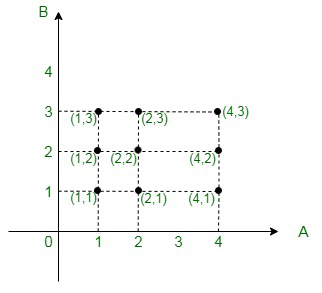
= {(1, 1), (1, 2), (1, 3), (2, 1), (2, 2), (2, 3), (4, 1), (4, 2), (4, 3)}
Hence, we represent A on the horizontal line and B on vertical line.
So, the graphical representation of A × B is as shown below:
👁 Image
Solution:
Given: A = {1, 2, 4} and B = {1, 2, 3}
So, B × A = {1, 2, 3} × {1, 2, 4}
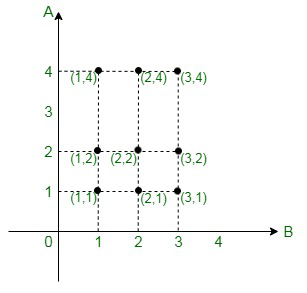
= {(1, 1), (1, 2), (1, 4), (2, 1), (2, 2), (2, 4), (3, 1), (3, 2), (3, 4)}
Hence, we represent B on the horizontal line and A on vertical line.
So, the graphical representation of B × A:
👁 Image
Solution:
Given: A = {1, 2, 4}, B = {1, 2, 3}
So, A × A = {1, 2, 4} × {1, 2, 4}
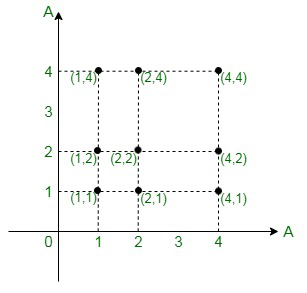
= {(1, 1), (1, 2), (1, 4), (2, 1), (2, 2), (2, 4), (4, 1), (4, 2), (4, 4)}
Graphical representation of A × A:
👁 Image
Solution:
Given: A = {1, 2, 4}, B = {1, 2, 3}
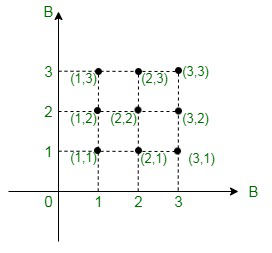
So, B × B = {1, 2, 3} × {1, 2, 3}
= {(1, 1), (1, 2), (1, 4), (2, 1), (2, 2), (2, 3), (3, 1), (3, 2), (3, 3)}
Graphical representation of B × B:
👁 ImageChapter 2 Exercise 2.1 in RD Sharma's Class 11 Mathematics textbook focuses on the fundamental concepts of relations. It introduces students to the definition of relations and various methods of representing them, including set notation, arrow diagrams, and graphs. The exercise covers key topics such as identifying the domain and range of a relation, understanding different types of relations (empty, universal, identity), and analyzing properties like reflexivity, symmetry, and transitivity. Students learn to work with operations on relations, including union, intersection, and composition. This foundational knowledge is crucial for understanding more advanced topics in relations and functions, which play a significant role in higher mathematics and its real-world applications. The exercise provides a mix of theoretical understanding and practical problem-solving, preparing students for more complex mathematical concepts.