|
VOOZH | about |
|
VOOZH | about |
Solution:
If the given points lie on a line then we can say that these points have same slope
∴ Slope of AP = Slope of PB = Slope of AB
⇒ [b - 0] / [a - h] = [k - b] / [0 - a] = [k - 0] / [0 - h]
⇒ [b - 0] / [a - h] = [k - b] / [0 - a]
⇒ -ab = (k - b)(a - h)
⇒ -ab = ka- kh - ab + bh
⇒ ka + bh = kh
Dividing both side by kh we get
⇒ a/h + b/k = 1
Hence Proved
Solution:
Let the slope of given lines be m1 and m2
According to question m1 = m and m2 = 2m
tan θ = (m1 - m2)/(1 + m1m2)
Case I:
⇒ 1/3 = (m - 2m)/(1 + 2m2)
⇒ 1/3 = (-m)/(1 + 2m2)
⇒ 1 + 2m2 = -3m
⇒ 2m2 + 3m + 1 = 0
⇒ 2m2 + 2m + m + 1 = 0
⇒ 2m(m + 1) + (m + 1) = 0
⇒ (2m + 1)(m + 1) = 0
m = -1, -1/2
Case II:
⇒ 1/3 = (2m - m)/(1 + 2m2)
⇒ 1/3 = (m)/(1 + 2m2)
⇒ 1 + 2m2 = 3m
⇒ 2m2 - 3m + 1 = 0
⇒ 2m2 - 2m - m + 1 = 0
⇒ 2m(m - 1) - (m - 1) = 0
⇒ (2m - 1)(m - 1) = 0
m = 1, 1/2
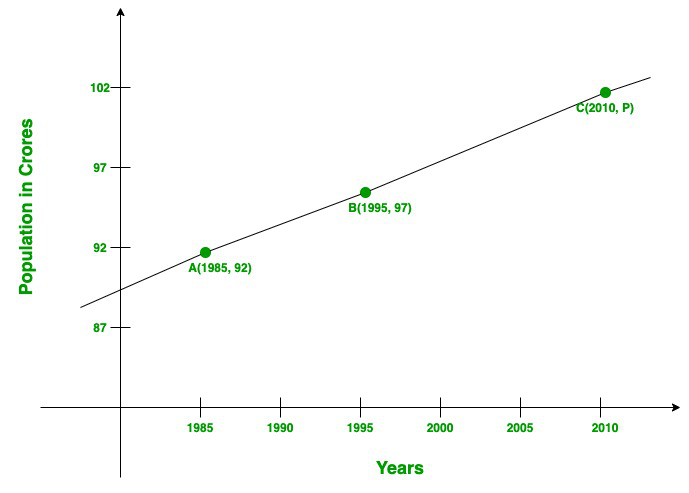
Solution:
Using the formula,
Slope of the line = [y2 - y1] / [x2 - x1]
Slope of the line AB = [97 - 92] / [1995 - 1985]
= 5/10 = 1/2
So, the population (P) in 2010 can be find using the slope of AC
Slope of the line AC = [P - 92] / [2010 - 1985]
= (P - 92) / 25
According to question :
⇒ (P - 92) / 25 = 1/2 = Slope of AB
⇒(P - 92) =25/2
⇒ 2P - 184 = 25
∴ P = 209/2 = 104.50
Solution:
Let P (-2,-1), Q (4,0), R (3,3) and S (-3,2) be the vertices of a quadrilateral
Using the formula,
Slope of the line = [y2 - y1] / [x2 - x1]
Slope of the line PQ = [0 - (-1)] / [4 - (-2)]
= 1/6
Slope of the line QR = [3 - 0] / [3 - 4]
= -3
Slope of the line RS = [2 - 3] / [-3 - 3]
= 1/6
Slope of the line RP = [2 - (-1)] / [-3 - (-2)]
= -3
We see that the slope of opposite side of the quadrilateral PQRS are equal.
Hence, the quadrilateral PQRS is a parallelogram.
Solution:
Slope of the line segment joining the points (3,-1) and (4,-2) is
m1 = [y2 - y1] / [x2 - x1]
= [-2 - (-1)] / [4 - 3]
= -1
Slope of x-axis is 0
m2 = 0
If θ is the angle between x-axis and the line segment then
tanθ = [m1 - m2] / [1 + m1m2]
= [-1 - 0] / [1 + (-1)(0)]
= -1
∴ θ = 135°
Solution:
We have,
Slope of the line = [y2 - y1] / [x2 - x1]
The slope of the line joining the points (-2,6) and (4,8) is
m1 = [8 - 6] / [4 - (-2)]
= 2/6 = 1/3
The slope of the line joining the points (8,12) and (x,24) is
m2 = [24 - 12] / [x - 8]
= 12/(x - 8)
The lines are perpendicular to each other
m1 × m2 = -1
⇒ (1/3) × 12/(x - 8) = -1
⇒ 4/(x-8) =-1
⇒ 4 = 8 - x
⇒ x = 4
Solution:
Let the given points are P (x,-1), Q (2,1) and R (4,5)
Also, given that the points P, q, and R are collinear, therefore
the area of the triangle that they form must be zero.
Hence,
x1 (y2 - y3) + x2 (y3 - y1) + x3 (y1 - y2) = 0
⇒ x(1 - 5) + 2(5 - (-1)) + 4(-1 - 1) = 0
⇒ -4x + 2(5 + 1) + (-2) = 0
⇒ -4x + 12 -8 = 0
⇒ -4x = -4
⇒ x = 1
Solution:
Slope of x axis m1 = 0
Slope of the line = [y2 - y1] / [x2 - x1]
m2 = [-2 - (-1)] / [4 - 3]
m2 = -1/1 = -1
Let us considered θ be the angle between x-axis and
the line joining the points (3,-1) and (4,-2).
tanθ = [m1 - m2] / [1 + m1m2]
= [0 - (-1)] / [1 + (0)(-1)]
= -1
∴ θ = 3π/4
Solution:
Let P (-2,-1), Q (4,0), R (3,3) and S (-3,2) be the vertices of the quadrilateral
We know
Slope of the line = [y2 - y1] / [x2 - x1]
Slope of the line PQ = [0 - (-1)] / [4 - (-2)]
= 1/6
Slope of the line QR = [3 - 0] / [3 - 4]
= -3
Slope of the line RS = [2 - 3] / [-3 - 3]
= 1/6
Slope of the line RP = [2 - (-1)] / [-3 - (-2)]
= -3
We see that the slope of opposite side of the quadrilateral PQRS are equal.
Hence, the quadrilateral PQRS is a parallelogram.
Solution:
Let P (4,1), Q (1, 7), R (-6, 0) and S (-1, -9) be the vertices of the quadrilateral
Let W, X, Y and Z be the mid points of PQ, QR, RS, and SP respectively
Using the mid point formula
[(x1 + x2)/2, (y1 + y2)/2]
Mid point of PQ,
W = [(4 + 1)/2, (1 + 7)/2] = (5/2, 4)
Mid point of QR,
X = [(1 - 6)/2, (7 + 0)/2] = (-5/2, 7/2)
Mid point of RS,
Y = [(-6 - 1)/2, (0 - 9)/2] = (-7/2, -9/2)
Mid point of SP,
Z = [(-1 + 4)/2, (-9 + 1)/2] = (3/2, -4)
We know that diagonals of a parallelogram intersect at their mid points
Mid point of diagonal WY
= [{(5 - 7)/2}/2, {(4 - 9/2)/2}] = (-2/4, -1/4) = (-1/2, -1/4)
Mid point of diagonal XZ
= [{(-5 + 3)/2}/2, {(7 - 8/2)/2}] = (-2/4, -1/4) = (-1/2, -1/4)
Thus, the mid-points of the sides of this quadrilateral form a parallelogram.