|
VOOZH | about |
|
VOOZH | about |
Solution:
As we know that the general equation of circles is
x2 + y2 + 2gx + 2fy + c = 0 .....(i)
Centre = (-g, -f)
Radius =
Given equation of circle is x2 + y2 + 6x - 8y - 24 = 0
On comparing with eq(i), we get
Hence, g = 3, f = -4, c = -24
So,
Centre = (-3, 4)
Radius =
Radius = 7
Solution:
As we know that the general equation of circles is
x2 + y2 + 2gx + 2fy + c = 0 .....(i)
Centre = (-g, -f)
Radius =
Given equation of circle is 2x2 + 2y2 - 3x + 5y - 7 = 0
x2 + y2 - 3/2x + 5/2y - 7/2 = 0
On comparing with eq(i), we get
Hence, g = -3/4, f = 5/4, c = -7/2
So, center = (3/4, -5/4)
Radius =
Radius = 3√10/4
Solution:
As we know that the general equation of circles is
x2 + y2 + 2gx + 2fy + c = 0 .....(i)
Centre = (-g, -f)
Radius =
Given equation of circle is 1/2(x2 + y2) + x cosθ + y sinθ - 4 = 0
⇒ x2 + y2 + 2x cosθ + 2sin θ - 8 = 0
On comparing with eq(i), we get
Hence, g = cos θ, f = sin θ, c = -8
So, centre = (-cos θ, -sinθ)
Radius =
Radius = 3
Solution:
As we know that the general equation of circles is
x2 + y2 + 2gx + 2fy + c = 0 .....(i)
Centre = (-g, -f)
Radius =
Given equation of circle is x2 + y2 - ax - by = 0
On comparing with eq(i), we get
Hence, g = -a/2, f = -b/2, c = 0
So, centre = (a/2, b/2)
Radius =
Radius =
Solution:
Given that, the circle pass through points P(5, 7), Q(8, 1), and R(1, 3)
As we know that the general equation of circles is
x2 + y2 + 2gx + 2fy + c = 0 .....(i)
Since, P, Q, and R lies on eq(i)
So,
25 + 49 + 10g + 14f + c = 0 .......(ii)
64 + 1 + 16g + 2f + c = 0 .......(iii)
1 + 9 + 2g + 6f + c = 0 ......(iv)
Now on solving eq (ii), (iii), and (iv), we get,
g = -29/6, f = -19/6, c = 56/3
Now put all these values in eq(i), we get
The equation of circle is
x2 + y2 - 29/3x - 19/6y + 56/3 = 0
3(x2 + y2) - 29x - 19y + 56 = 0
Solution:
Given that, the circle pass through points P(1, 2), Q(3, -4), and R(5, -6)
As we know that the general equation of circles is
x2 + y2 + 2gx + 2fy + c = 0 .....(i)
Since, P, Q, and R lies on eq(i)
So,
1 + 4 + 2g + 4f + c = 0 .....(ii)
9 + 16 + 6g - 8f + c = 0 .....(iii)
25 + 36 + 10g - 12f + c = 0 .....(iv)
Now on solving eq (ii), (iii), and (iv), we get,
g = -11, f = -2, and c = 25
Now put all these values in eq(i), we get
The equation of circle is
x2 + y2 - 22x - 4y + 25 = 0
Solution:
Given that, the circle pass through points P(5, -8), Q(-2, 9), and R(2, 1)
As we know that the general equation of circles is
x2 + y2 + 2gx + 2fy + c = 0 .....(i)
Since, P, Q, and R lies on eq(i)
So,
25 + 64 + 10g - 16f + c = 0 .....(ii)
4 + 81 - 4g + 18f + c = 0 .....(iii)
4 + 1 + 4g + 2f + c = 0 .....(iv)
Now on solving eq (ii), (iii), and (iv), we get,
g = 58, f = 24, and c = -285
Now put all these values in eq(i), we get
The equation of circle is
x2 + y2 + 116x + 48y - 285 = 0
Given that, the circle pass through points P(0, 0), Q(-2, 1), and R(-3, 2)
As we know that the general equation of circles is
x2 + y2 + 2gx + 2fy + c = 0 .....(i)
Since, P, Q, and R lies on eq(i)
So,
0 + 00 + 0 + c = 0 .....(ii)
4 + 1 - 4x + 2y + c = 0 .....(iii)
9 + 4 - 6x + 4y + c = 0 .....(iv)
Now on solving eq (ii), (iii), and (iv), we get,
g = -3/2, f = -11/2, and c = 0
Now put all these values in eq(i), we get
The equation of circle is
x2 + y2 - 3x - 11y = 0
Solution:
It is given that, the circle passing through P(3, -2) and Q(-2, 0) and having its centre on 2x - y = 3.
As we know that the general equation of circles is
x2 + y2 + 2gx + 2fy + c = 0 .....(i)
Since the circle passes through (3, -2) and also (-2, 0)
So,
9 + 4 + 6g - 4f + c = 0 .....(ii)
4 + 0 - 4g + 0 + c = 0 .....(iii)
Also, the centre of the circle lies on 2x - y = 3
-2g + f = 3 .....(iv)
Now on solving eq (ii), (iii), and (iv), we get,
g = 3/2, f = 6, and c = 2
Now put all these values in eq(i), we get
The equation of circle is
x2 + y2 + 3x + 12y + 2 = 0
Solution:
It is given that, the circle passing through P(3, 7) and Q(5, 5) and having its centre on x - 4y = 1
As we know that the general equation of circles is
x2 + y2 + 2gx + 2fy + c = 0 .....(i)
Since the circle passes through P and Q
so,
9 + 49 + 7g + 14f + c = 0 .....(ii)
25 + 25 + 10g + 10f + c = 0 .....(iii)
Also, the centre of the circle lies on x - 4y = 1
so, -g + 4f = 1 .....(iv)
Now on solving eq (ii), (iii), and (iv), we get,
g = 3, f = 1, and c = -90
Now put all these values in eq(i), we get
The equation of circle is
x2 + y2+ 6x + 2y - 90 = 0
Solution:
Given that P (3, -2), Q(1, 0), R(-1, -2), and S(1,-4)
As we know that the general equation of circles is
x2 + y2 + 2gx + 2fy + c = 0 .....(i)
Since the circle passes through P, Q and R
So,
9 + 4 + 6g - 4f + c = 0 .....(ii)
1 + 0 + 2g - 0 + c = 0 .....(iii)
1 + 4 - 2g - 4f + c = 0 .....(iv)
Now on solving eq (ii), (iii), and (iv), we get,
g = -1, f = 2 and c = 1
Now put all these values in eq(i), we get
The equation of circle is
x2 + y2 - 2x + 4y + 1 = 0 .....(v)
Here, we clearly see that point S(1,-4) satisfy eq(v)
Hence, points P, Q, R, and S are concyclic
Solution:
As we know that the general equation of circles is
x2 + y2 + 2gx + 2fy + c = 0 .....(i)
Centre = (-g, -f)
Radius =
Therefore, P(5, 5), Q(6, 4), and R(-2, 4) lie on eq(i),
So,
25 + 25 + 10g + 10f + c = 0 .....(ii)
36 + 16 + 12g + 8f + c = 0 .....(iii)
4 + 16 + 4g + 8f + c = 0 .....(iv)
Now on solving eq (ii), (iii), and (iv), we get,
g = -2, f = -1, c = -20
Now put all these values in eq(i), we get
The equation of circle is
x2 + y2 - 4x - 2y - 20 = 0 .....(v)
Here, we clearly see that point S(7, 1)
Hence, points P, Q, R, and S are concyclic
Now, the centre = (-g, -f) = (2, 1)
Radius =
Solution:
The equations of lines are
x + y = -3 .....(i)
x - y = -1 .....(ii)
x = 3 .....(iii)
Let us considered A, B, and C are the point of intersection of lines (i), (ii), and (iii)
So, Point A(-2,-1), B(3, 4), and C(3,-6)
As we know that the general equation of circles is
x2 + y2 + 2gx + 2fy + c = 0 .....(iv)
So, the circle circumscribing the ∆ABC
4 + 1 - 4g - 2f + c = 0 .....(v)
9 + 16 + 6g + Bf + c = 0 .....(vi)
9 + 36 + 6g - 12f + c = 0 .....(vii)
Now on solving eq (v), (vi), and (vii), we get,
g = -3, f = 1, c = -15
Now put all these values in eq(iv), we get
The equation of circle is
x2 + y2 - 6x + 2y - 15 = 0
Solution:
The equations of lines are
2x + y = 3 .....(i)
x + y = 1 .....(ii)
3x + 3y = 5 .....(iii)
Let us considered A, B, and C are the point of intersection of lines (i), (ii), and (iii)
So, A = (2, -1)
B = (3, -2)
C = (1, 1)
As we know that the general equation of circles is
x2 + y2 + 2gx + 2fy + c = 0 .....(iv)
So, the circle circumscribing the ∆ABC
4 + 1 + 4g - 2f + c = 0 .....(v)
9 + 4 + 6g - 4f + c = 0 .....(vi)
1 + 1 + 2g + 2f + c = 0 .....(vii)
Now on solving eq (v), (vi), and (vii), we get,
g = -13/2, f = -5/2, and c = 16
Now put all these values in eq(iv), we get
The equation of circle is
x2 + y2 - 13x - 5y + 16 = 0
Solution:
The equations of lines are
x + y = 2 .....(i)
3x - 4y = 6 .....(ii)
x - y = 0 .....(iii)
Let us considered A, B, and C are the point of intersection of lines (i), (ii), and (iii)
So, A = (2, 0)
B = (-6, -6)
C = (1, 1)
As we know that the general equation of circles is
x2 + y2 + 2gx + 2fy + c = 0 .....(iv)
So, the circle circumscribing the ∆ABC
4 + 4g + c = 0 .....(v)
36 + 36 - 12g - 12f + c = 0 .....(vi)
1 + 1 + 2g + 2f + c = 0 .....(vii)
Now on solving eq (v), (vi), and (vii), we get,
g = 2, f = 3, and c = -12
Now put all these values in eq(iv), we get
The equation of circle is
x2 + y2 + 4x + 6y - 12 = 0
Solution:
The equations of lines are
y = x + 2 .....(i)
3y = 4x .....(ii)
2y = 3x .....(iii)
Let us considered A, B, and C are the point of intersection of lines (i), (ii), and (iii)
So, A = (6, 8)
B = (4, 6)
C = (0, 0)
As we know that the general equation of circles is
x2 + y2 + 2gx + 2fy + c = 0 .....(iv)
So, the circle circumscribing the ∆ABC
12g + 16f + c = -100 .....(v)
8g + 12f + c = -52 .....(vi)
c = 0 .....(vii)
Now on solving eq (v), (vi), and (vii), we get,
f = 11 and g = -23
Now put all these values in eq(iv), we get
The equation of circle is
x2 + y2 - 46x + 22y = 0.
Solution:
The given equation of circles are,
x2 + y2 - 4x - 6y - 12 = 0 .......(i)
x2 + y2 + 2x + 4y - 10 = 0 .......(ii)
x2 + y2 - 10x - 16y - 1 = 0 .......(iii)
Let O1, O2 and O3 are the centres of (i), (ii), and (iii)
O1 = (-g, -f) = (2, 3)
O2 = (-g, -f) = (-1, -2)
O3 = (-g, -f) = (5, 8)
O1, O2 and O3 will be collinear if ar(∆ O1O2O3) = 0
R2 ⇒ R2 ⇒ -R1
R3 ⇒ R3 ⇒ -R1
O1, O2, and O3 are collinear
Solution:
The given equation of circles are,
x2 + y2 = 1 -----------(i)
x2 + y2 - 2x - 6y - 6 = 0 ----------(ii)
x2 + y2 - 4x - 12y - 9 = 0 ----------(iii)
Let us considered R1, R2, and R3 are the radii of (i), (ii), and (iii)
So, R1 = 1
R2 =
R3 =
As we know that if a, b, c are in AP, then b = a + b/2
so, a = 1, b = 4, c = 7, b = 1 + 7/2 = 4
Therefore 1, 4, 7 are in AP.
Hence, the radius of the three circles lie in AP.
Solution:
It is given that a circle that passes through origin O(0, 0) and
cut off on intercepts of length 4 on x-axis and 6 on y-axis.
So, OA = 4
OB = 6
Let us assume C be the centre of the circle and
CM and CN are perpendicular line drawn on OA and OB
so, the coordinate of A = (4, 0) and B = (0, 6)
The coordinates of M = (2, 0) and N = (0, 3)
And the coordinates of C = (2, 3)
Now in ∆OCM,
Using Pythagoras theorem
OC2 = OM2 + CM2
= 22 + 32
= 4 + 9
OC = √13
Hence, the required circle is
(x - 2)2 + (y - 3)2 = 13
x2 + y2 - 4x - 6y = 0
Solution:
The given equation of circle is
x2 + y2 - 6x + 12y + 15 = 0 .......(i)
so, centre = (-g, -f) = (3, 6)
radius =
Now, the required equation of circle in concentric with (i)
that means both have same centre (3,-6)
The area of required circle = 2 * Area of (i)
πR2 = 2 * π(√30)2
R2 = 60
R = 2√15
Hence, the required circle is
(x - 3)2 + (y + 6)2 = 60
x2 + y2 - 6x + 12y - 15 = 0
Solution:
As we know that the general equation of circles is
x2 + y2 + 2gx + 2fy + c = 0 .....(i)
It is given that the points P(1, 1) and Q(2, 2) passes through it eq(1)
So,
1 + 1 + 2g + 2f + c = 0 .....(ii)
4 + 4 + 4g + 4f + c = 0 .....(iii)
It is given that the radius = 1
⇒
⇒ g2 + f2 - c = 1 ......(iv)
Now from eq(ii) and (iii), we get
g + f + c/2 = -1
g + f + c/4 = -2
Now on subtracting both the equations, we get
c = 4
g + f = -3 .......(v)
Now on solving eq(v) and (vi), we get
g = -1 or -2 and f = -2 or -1
Hence, the required circle is
x2 + y2 - 2x - 4y + 4 = 0
or
x2 + y2 - 4x - 2y + 4 = 0
Solution:
The given equation of circle is
x2 + y2 - 4x - 6y - 3 = 0 .....(i)
so, centre = (-g, -f) = (2, 3)
The required circle is concentric with eq(i)
so, both have centre(2, 3)
Also, the required circle touches y-axis at A.
So, CA = radius = 2
Hence, the required circle is
(x - 2)2 + (y - 3)2 = 4
x2 + y2 - 4x - 6y + 9 = 0
Solution:
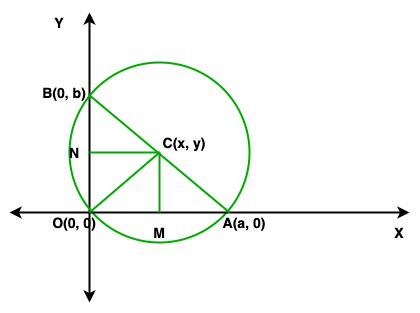
From the given figure, CA, CO, and AB are the equal radii of the circle
So,
CA = CO = CB = r
Also, OCA is an isosceles triangle, and CM is the perpendicular bisector to the OA.
Hence OM = a/2
Similarly, CN is the perpendicular bisector to the OB
So, ON = b/2
from the above figure, it is clear that
OM = x = a/2
ON = y = b/2
Hence the centre of the circle is c(a/2, b/2)
Solution:
It is given that a circle which passes through the point P(2, 3) and Q(4, 5) and
the centre lies on the straight line y - 4x + 3 = 0.
As we know that the general equation of circles is
x2 + y2 + 2gx + 2fy + c = 0 .....(i)
Since the circle passes through P, and Q
So,
13 + 14g + 6f + c = 0 .....(ii)
41 + 8g + 10f + c = 0 .....(iii)
Centre (-g, -f) lies on y - 4x + 3 = 0
So, -f + 4g = -3 .....(iv)
Now on subtracting eq(ii) from (iii), we get
28 + 4g + 4f = 0 .....(v)
On solving eq(iv) and (v) we get,
f = -5 and g = -2
Now put all these values in eq(i), we get
The equation of circle is
41 - 16 - 50 + c = 0
c = 25
Hence, the required equation of the circle is,
x2 + y2 - 4x - 10y + 25 = 0