|
VOOZH | about |
|
VOOZH | about |
Chapter 28 of RD Sharma's Class 11 mathematics textbook introduces students to the fascinating world of 3D Coordinate Geometry, with Exercise 28.1 serving as the foundational entry point into this three-dimensional mathematical landscape. This exercise extends the familiar concepts of 2D coordinate geometry into the third dimension, introducing the z-axis alongside the x and y axes.
The exercise covers fundamental concepts such as distance between points in 3D, section formulas, and the equations of lines and planes. By working through these problems, students develop spatial reasoning skills and learn to translate between algebraic expressions and geometric representations in three dimensions.
(i) (5, 2, 3)
(ii) (-5, 4, 3)
(iii) (4, -3, 5)
(iv) (7, 4, -3)
(v) (-5, -4, 7)
(vi) (-5, -3, -2)
(vii) (2, -5, -7)
(viii) (-7, 2, -5)
Solution:
(i) (5, 2, 3)
Here, since x, y and z all three are positive then octant will be XOYZ
(ii) (-5, 4, 3)
Here, since x is negative and y and z are positive then the octant will be X′OYZ
(iii) (4, -3, 5)
In this case, since y is negative and x and z are positive then the octant will be XOY′Z
(iv) (7, 4, -3)
Here, since z is negative and x and y are positive then the octant will be XOYZ′
(v) (-5, -4, 7)
Here, since x and y are negative and z is positive then the octant will be X′OY′Z
(vi) (-5, -3, -2)
Here, since x, y and z all three are negative then octant will be X′OY′Z′
(vii) (2, -5, -7)
Here, since z and y are negative and x is positive then the octant will be XOY′Z′
(viii) (-7, 2, -5)
Here, since x and z are negative and x is positive then the octant will be X′OYZ′
(i) (-2, 3, 4) in the yz-plane
(ii) (-5, 4, -3) in the xz-plane
(iii) (5, 2, -7) in the xy-plane
(iv) (-5, 0, 3) in the xz-plane
(v) (-4, 0, 0) in the xy-plane
Solution:
(i) (-2, 3, 4)
We can change the x-coordinate in order to find the corresponding image in the yz plane.
Hence, Image of point (-2, 3, 4) is (2, 3, 4)
(ii) (-5, 4, -3)
We can change the y-coordinate in order to find the corresponding image in the xz plane.
Here, Image of point (-5, 4, -3) is (-5, -4, -3)
(iii) (5, 2, -7)
We can change the z-coordinate in order to find the corresponding image in the xy plane.
Here, Image of point (5, 2, -7) is (5, 2, 7)
(iv) (-5, 0, 3)
We can change the y-coordinate in order to find the corresponding image in the xz plane.
Here, Image of point (-5, 0, 3) is (-5, 0, 3)
(v) (-4, 0, 0)
We can change the z-coordinate in order to find the corresponding image in the xy plane.
Here, Image of point (-4, 0, 0) is (-4, 0, 0)
Solution:
Given:
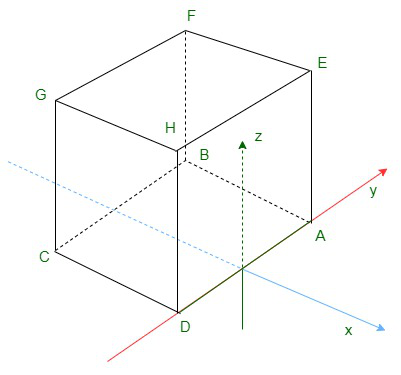
👁 ImageA cube has side 4 having one vertex at (1, 0, 1)
Side of cube = 5
We have to find the coordinates of the other vertices of the cube.
So,
Let the Point A(1, 0, 1) and AB, AD and AE is parallel to –ve x-axis, -ve y-axis and +ve z-axis respectively.
Since side of cube = 5
Point B is (-4, 0, 1)
Point D is (1, -5, 1)
Point E is (1, 0, 6)
Now, EH is parallel to –ve y-axis
Point H is (1, -5, 6)
HG is parallel to –ve x-axis
Point G is (-4, -5, 6)
Now, again GC and GF is parallel to –ve z-axis and +ve y-axis respectively
Point C is (-4, -5, 1)
Point F is (-4, 0, 6)
Solution:
Given:
Points are (3, 0, -1) and (-2, 5, 4)
We have to find the lengths of the edges of the parallelepiped formed.
For point (3, 0, -1)
x1 = 3, y1 = 0 and z1 = -1
For point (-2, 5, 4)
x2 = -2, y2 = 5 and z2 = 4
Plane parallel to coordinate planes of x1 and x2 is yz-plane
Plane parallel to coordinate planes of y1 and y2 is xz-plane
Plane parallel to coordinate planes of z1 and z2 is xy-plane
Distance between planes x1 = 3 and x2 = -2 is 3 – (-2) = 3 + 2 = 5
Distance between planes x1 = 0 and y2 = 5 is 5 – 0 = 5
Distance between planes z1 = -1 and z2 = 4 is 4 – (-1) = 4 + 1 = 5
Therefore,
The edges of parallelepiped is 5, 5, 5
Solution:
Given:
Points are (5, 0, 2) and (3, -2, 5)
We have to find the lengths of the edges of the parallelepiped formed
For point (5, 0, 2)
x1 = 5, y1 = 0 and z1 = 2
For point (3, -2, 5)
x2 = 3, y2 = -2 and z2 = 5
Plane parallel to coordinate planes of x1 and x2 is yz-plane
Plane parallel to coordinate planes of y1 and y2 is xz-plane
Plane parallel to coordinate planes of z1 and z2 is xy-plane
Distance between planes x1 = 5 and x2 = 3 is 5 – 3 = 2
Distance between planes y1 = 0 and y2 = -2 is 0 – (-2) = 0 + 2 = 2
Distance between planes z1 = 2 and z2 = 5 is 5 – 2 = 3
Therefore,
The edges of parallelepiped is 2, 2, 3
Solution:
Given:
The point P (-4, 3, 5)
The distance of the point from x-axis is given as:
The distance of the point from y-axis is given as:
The distance of the point from z-axis is given as:
Solution:
Given:
Point (3, -2, 5)
The Absolute value of any point(x, y, z) is shown by,
√(x2 + y2 + z2)
We need to make sure that absolute value to be the same for all points.
So let the point A(3, -2, 5)
Remaining 7 points are:
Point B(3, 2, 5) (By changing the sign of y coordinate)
Point C(-3, -2, 5) (By changing the sign of x coordinate)
Point D(3, -2, -5) (By changing the sign of z coordinate)
Point E(-3, 2, 5) (By changing the sign of x and y coordinate)
Point F(3, 2, -5) (By changing the sign of y and z coordinate)
Point G(-3, -2, -5) (By changing the sign of x and z coordinate)
Point H(-3, 2, -5) (By changing the sign of x, y and z coordinate)
Exercise 28.1 in RD Sharma's Class 11 textbook provides a comprehensive introduction to 3D Coordinate Geometry, laying the groundwork for students to understand and manipulate geometric entities in three-dimensional space. Through a diverse set of problems, students learn to calculate distances, find midpoints and section points, determine equations of lines and planes, and analyze the relationships between points, lines, and planes in 3D. The exercise emphasizes the importance of spatial visualization and analytical problem-solving, encouraging students to think beyond the two-dimensional plane. By mastering these concepts, students develop a strong foundation for more advanced topics in multivariable calculus, vector algebra, and analytical geometry. The practical applications of 3D geometry in fields such as computer graphics, robotics, and engineering design are also highlighted, demonstrating the real-world relevance of these mathematical concepts. This exercise not only enhances students' mathematical skills but also prepares them for future studies and careers in STEM fields where three-dimensional spatial reasoning is crucial.