|
VOOZH | about |
|
VOOZH | about |
Solution:
We have
Taking LHS
=
=
=
=
=
=
= sin2θcos2θ
Hence, LHS = RHS (Proved)
Solution:
We Have
Taking LHS
=
=
=
=
=
= cosθ/sinθ
= cotθ
Hence, LHS = RHS(Proved)
Solution:
We have
cosθ(tanθ + 2)(2tanθ + 1) = 2secθ + 5sinθ
Taking LHS
= cosθ(tanθ + 2)(2tanθ + 1)
=
=
=
=
=
=
= 2secθ + 5sinθ
Hence, LHS = RHS(Proved)
Solution:
We have
x =
Taking LHS
=
=
=
=
=
Solution:
We have
As we know that
cosθ = √1 - sin2θ -(1)
Now put the value of sinθ in eq(1)
cosθ =
=
=
=
=
So the value of cosθ =
Now,
tanθ =
secθ =
cosecθ =
Alternative Method:
We have
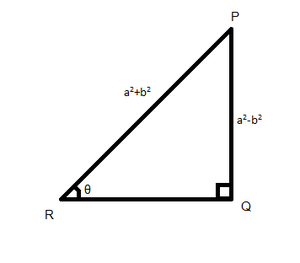
We draw a △PQR right-angled at Q PR = a2 + b2 and PQ = a2 - b2
👁 Image
By Pythagoras theorem, we have
PR2 = PQ2 + QR2
QR2 = (a2 + b2)2 - (a2 - b2)2
QR2 = (a4 + b4 + 2a2b2) − (a4 + b4 − 2a2b2)
QR2 = 4a2b2
QR = 2ab
cosθ =
Now,
tanθ =
secθ =
cosecθ =
Solution:
We have
=
=
Now put tanθ = a/b
=
=
=
=
=
Solution:
We have
Taking LHS
=
Dividing denominator and Numerator by cosθ
=
=
=
=
=
=
Hence, LHS = RHS(Proved)
Solution:
Given: cosecθ - sinθ = a3
1/sinθ − sinθ = a3
= a3
cos2θ/sinθ = a3
a = (cos2θ/sinθ)1/3
Similarly, b = (sin2θ/cosθ)1/3
Now putting the values of a and b in the following equation
Taking LHS
= a2b2(a2 + b2)
= a4b2 + a2b4
=
= cos6/3θ + sin6/3θ
= cos2θ + sin2θ
= 1
Hence, LHS = RHS (Proved)
Solution:
Given: cotθ(1 + sinθ) = 4m and cotθ(1 − sinθ) = 4n
Multiplying both the equations
16mn = cot2θ(1 - sin2θ)
16mn =
16mn = cos4θ/sin2θ
mn = cos4θ/16sin2θ -(1)
Now squaring the given equations
16m2 = cot2θ(1 + sinθ)2 and 16n2 = cot2θ(1 - sinθ)2
On subtracting both the equation, we get
16m2 - 16n2 = cot2θ(1 + sinθ)2 - cot2θ(1 - sinθ)2
16(m2 - n2) = cot2θ((1 + sinθ)2 - (1 - sinθ)2)
16(m2 - n2) =
(m2 - n2) = cos2θ/4sinθ
On squaring both side, we get
(m2 - n2)2 = cos4θ/16sinθ -(2)
From equation(1) and (2)
(m2 - n2)2 = mn
Hence proved
Solution:
Given: sinθ + cosθ = m
On squaring both side, we get
(sinθ + cosθ)2 = m2
= sin2θ + cos2θ + 2sinθcosθ = m2
= 2sinθcosθ = m2 − 1
Now,
Taking LHS
= sin6θ + cos6θ
Using a3 + b3 = (a + b)(a2 + b2 − ab)
= (sin2θ)3 + (cos2θ)3
= (sin2θ + cos2θ)(sin4θ + cos4θ − sin2θcos2θ)
= (1)((sin2θ)2 + (cos2θ)2 − sin2θcos2θ)
= (sin2θ + cos2θ)2 − 2sin2θcos2θ − sin2θcos2θ
= (1 − 3sin2θcos2θ)
=
=
=
Hence, Proved.
Solution:
We have
a = secθ - tanθ and b = cosecθ + cotθ
and we have to proof that
ab + a - b + 1 = 0
So, taking LHS
ab + a - b + 1
Now put the values of a and b, we get
= (secθ - tanθ)(cosecθ + cotθ) - (secθ - tanθ) + (cosecθ + cotθ) + 1
= (1/cosθ - sinθ/cosθ)(1/sinθ + cosθ/sinθ) - (1/cosθ - sinθ/cosθ) + (1/sinθ + cosθ/sinθ) + 1
= 1/cosθsinθ + 1/cosθ x cosθ/sinθ - sinθ/cosθ x 1/sinθ - (sinθ/cosθ) x (cosθ/sinθ) + 1/cosθ - sinθ/cosθ - 1/sinθ - cosθ/sinθ + 1
= 1/cosθsinθ + 1/sinθ - 1/cosθ - 1 + 1/cosθ - sinθ/cosθ - 1/sinθ - cosθ/sinθ + 1
= 1/cosθsinθ - sinθ/cosθ - cosθ/sinθ
= 1 - sin2θ - cos2θ/sinθcosθ
= 1 - (sin2θ + cos2θ)/sinθcosθ
= 1 - 1/sinθcosθ
= 0
Hence, LHS = RHS (Proved)
Solution:
We have
Taking LHS
=
=
=
=
=
=
=
= 2/cosθ
Since π/2 < θ < π ,where cosθ is negative
So, -2/cosθ
Hence, LHS = RHS (Proved)
Solution:
LHS =
= sin2θcos2θ
RHS =
=
= sin2θcos2θ
Solution:
LHS = 2(sin6θ + cos6θ) - 3(sin4θ + cos4θ) + 1
Using (a3 + b3) = (a + b)(a2 + b2 - ab)
= 2(sin2θ + cos2θ)(sin4θ + cos4θ - sin2θcos2θ) - 3(sin4θ + cos4θ) + 1
= 2(1)(sin4θ + cos4θ - sin2θcos2θ) - 3(sin4θ + cos4θ) + 1
= 2sin4θ + 2cos4θ - 2sin2θcos2θ - 3sin4θ - 3cos4θ + 1
= -sin4θ - cos4θ - 2sin2θcos2θ + 1
= -(sin2θ + cos2θ)2 + 1
= -1 + 1 = 0 = RHS (Hence Proved)
Solution:
T6 = sin6θ + cos6θ
Using a3 + b3 = (a + b)(a2 + b2 − ab)
= (sin2x)3 + (cos2x)3
= (sin2x + cos2x)(sin4x + cos4x − sin2xcos2x)
Using a2 + b2 = (a + b)2 − 2ab
= (1)(sin4x + cos4x − sin2xcos2x)
= (sin2x)2 + (cos2x)2 − sin2xcos2x
= (sin2x + cos2x)2 − 3sin2xcos2
= 1 − 3sin2xcos2x
Similarly, we get the values of T8 & T10
T8 = (sin6x + cos6x)(sin2x + cos2x) − sin2xcos2x(sin4x + cos4x)
= 1 − 3sin2xcos2x − sin2xcos2x(1 − 2sin2xcos2x)
= 1 − 4sin2xcos2x + 2sin4xcos4x
T10 = sin10θ + cos10θ
= (sin6θ + cos6θ)(sin4θ + cos4θ) − sin4θcos4θ(sin2θ + cos2θ)
= (1 − 3sin2xcos2x)(1 − 2sin2xcos2x) − sin4xcos4x
= 1 − 5sin2xcos2x + 5sin4xcos4x
On putting the values of T6, T8 and T10 in the following equation
6T10 - 15T8 + 10T6 - 1
We get the value 0.
Hence Proved