|
VOOZH | about |
|
VOOZH | about |
Solution:
According to the question
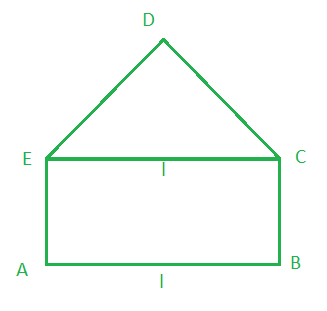
Let us assume l be the length of the rectangle and b be the breadth of the rectangle
The perimeter of the window = 12 m
⇒ (l + 2b) + (l + l) = 12
⇒ 3l + 2b = 12 ......(i)
Mow we find the area of the window (A) = Area of the rectangle + Area of the equilateral △
A = l (12 - 3l / 2) + √3/4 l2
On differentiating w.r.t. l, we get
dA/dl = 6 - 3l + (√3/2)l = 6 - √3(√3 - 1/2)l
For maxima and minima,
Put dA/dl = 0
⇒ 6 - √3(√3 - 1/2)l = 0
⇒ l = 6/{√3(√3 - 1/2) } = 12- (6 - √3)
Now, d2A/dl2 = -√3(√3 - 1/2) = -3 + √3/2
So, l = 12/(6 - √3) is the point of local maxima
So, When l = 12/(6 - √3), the area of the window is maximum
From eq(i), we get
b = (12 - 3l)/2 = [12 - 3{12/(6 - √3)}]/2 = (24 - 6√3)/(6 - √3)
Solution:
According to the question
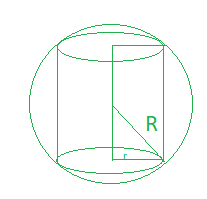
R be the radius of the sphere
So, let us assume that r and h be the radius and the height of the cylinder
So, according to the image
h = 2 √(R2 - r2)
Now we find the volume of the cylinder is
V = πr2h = 2πr2√(R2 - r2)
On differentiating w.r.t. r, we get
dV/dr = 4πr √(R2 - r2) +
= 4πr √(R2 - r2) -
=
=
For maxima and minima,
Put dV/dr = 0
4πrR2 - 6πr3 = 0
r2 = 2R2/3
Now, again differentiating w.r.t. r, we get
d2V/dr2 =
=
=
So, at r2 = 2R2/3, d2V/dr2 < 0
Hence, the volume is the maximum when r2 = 2R2/3
so, the height of the cylinder = 2√(R2 - 2R2/3) = 2√(R2/3) = 2R/√3
Hence proved
Solution:
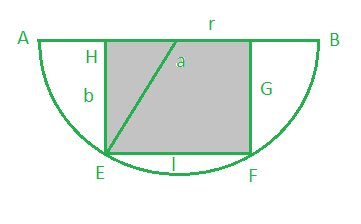
Let us assume EFGH be a rectangle inscribed in a semi-circle. So, r be the radius of the semicircle.
And l and b are the length and width of rectangle.
Now In △OHE,
HE2 = OE2 - OH2
HE = b = .....(i)
Now we find the area of the EFGH rectangle
A = lb = l ×
A = 1/2 l √(4r2 - l2)
On differentiating w.r.t. l, we get
dA/dl = 1/2 []
= 1/2 []
=
For maxima and minima,
Put dA/dl = 0
⇒
⇒ l = ±√2r
As we know that l can't be negative so l ≠ -√2r
So, when l = √2r, d2A/dl2 < 0
Hence, the area of the rectangle is maximum when l = √2r
Now put the value of l = √2r in eq(i), we get
Now we find the area of rectangle = lb
= √2r × r/√2
= r2
Solution:
Let us assume that the radius and height of the cone is r and h.
So, the volume of the cone is
V = 1/3 πr2h
h = 3V/r2 ......(i)
And the surface area of the cone is
A = πrl
Here, l is the slant height = √(r2 + h2)
= πr√(r2 + h2)
=
On differentiating w.r.t. r, we get
dA/dr =
=
For maxima and minima,
Put dA/dr = 0
2π2r6 = 9V2
r6 = 9V2/2π2
When, r6 = 9V2/2π2, d2S/dr2 > 0
Hence, the surface area of the cone is the least when r6 = 6V2/2π2
Now put r6 = 9V2/2π2 in eq(i), we get
h = 3V/πr2 = 3/πr2(2π2r6/9)1/2 = (3/πr2)(√2πr3/3) = √2r
Hence Proved
Solution:
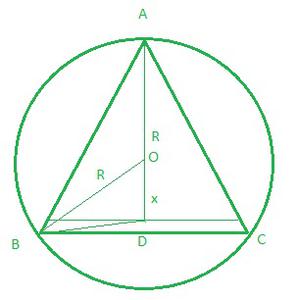
Let us assume R be the radius of the sphere
So, from the figure, we get OD = x and AO = OB = R
BD = √(R2 - x2) and AD = (R + x)
Now,
The volume of the cone is
V = 1/3 πr2h
= 1/3 πBD2 × AD
= 1/3 π (R2 - x2) × (R + x)
On differentiating w.r.t. x, we get
dV/dx = π/3 [-2x (R + x) + R2 - x2]
= π/3 [R2 - 2xR - 3x2]
For maximum and minimum
Put dv/dx = 0
⇒ π/3 [R2- 2xR - 3x2] = 0
⇒ π/3 [(R - 3x) (R + x)] = 0
⇒ R - 3x = 0 or x = -R
Here, x = -R is not possible because -r will make the altitude 0
⇒ x = R/3
Now,
d2V/dx2 = π/3[-2R - 6x]
So, when x = R/3, d2v/dx2 = π/3[-2R - 2R] = -4πR/3 < 0
So, x = R/3 is the point of local maxima.
Hence, the volume is maximum when x = R/3
So, the altitude AD = (R + x) = (R + R/3) = 4R/3 = 2/3d
Here, d is the diameter of sphere.
Solution:
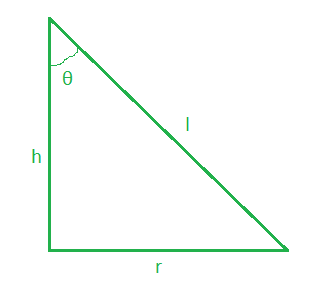
Let us assume h, r and θ be the height, radius and semi vertical angle of the right-angled triangle.
So, the volume of the cone (V) = 1/3 πr2h
⇒ h = 3V/πr2
Slant height of the cone (l) = √(r2 + h2)
l =
And the curved surface area of the cone is
A = πrl
A = πr
A =
On differentiating w.r.t. r, we get
dA/dr =
=
For maximum and minimum
Put dA/dr = 0
= 0
⇒ 2π2r6 - 9V2 = 0
⇒ V2 = 2π2r6/9
⇒ V = √2π2r6/9
⇒ V = πr3√2/3
or
r = (3V/π√2)1/3
h/r = √2
cotθ = √2
Semi-vertical angle, θ = cot-1√2
Also, when r < (3V/π√2)1/3, dA/dr < 0
When r > (3V/π√2)1/3, dA/dr > 0
Hence, the curved surface for r = (3V/π√2)1/3 is least.
Solution:
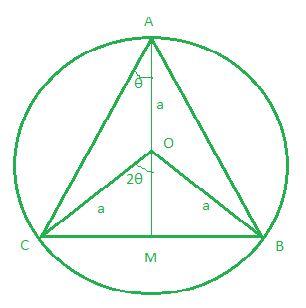
Let us considered ABC is an isosceles triangle such that AB = AC
and the vertical angle∠BAC = 2θ
Radius of the circle = a
Now, draw AM perpendicular to BC.
From the figure we conclude that in △ABC is an isosceles triangle
the circumcenter of the circle lies on the perpendicular from A to BC and
O be the circumcenter of the circle
So, ∠BOC = 2 × 2θ = 4θ
and ∠COM = 2θ [Since △OMB and △OMC are congruent triangles]
OA = OB = OC =a [Radius of the circle]
In △OMC,
CM = asin2θ and OM = acos2θ
BC = 2CM [Perpendicular from the centre bisects the chord]
BC = 2asin2θ .....(i)
In △ABC,
AM = AO + OM
AM = a + acos2θ .....(ii)
Now the area of △ABC is,
A = 1/2 × BC × AM
= 1/2 × 2asin2θ × (a + acos2θ) ......(iii)
On differentiating w.r.t. θ, we get
dA/dθ = a2(2cos2θ + 1/2 × 4cos4θ)
dA/dθ = 2a2 (cos2θ + cos4θ)
Again differentiating w.r.t. θ, we get
d2A/dθ2 = 2a2(-2sin2θ - 4sin4θ)
For maximum and minimum
Put dA/dθ = 0
2a2(cos2θ + cos4θ) = 0
cos2θ + cos4θ = 0
cos2θ + 2cos22θ - 1 = 0
(2cos2θ - 1)(2cos2θ + 1) = 0
cos2θ = 1/2 or cos2θ = -1
2θ = π/3 or 2θ = π
θ = π/6 or θ = π/2
When θ = π/2, it will not form a triangle.
When θ = π/6, d2A/dθ2 < 0
Hence, the area of the triangle is maximum when θ = π/6
Solution:
Let us assume l, b, and V be the length, breadth, and volume of the rectangle.
The perimeter of the rectangle is 36cm
2(l + b) = 36
l + b = 18
l = 18 - b ......(i)
The volume of the cylinder that revolve about the breadth,
V = πl2b
V = π(18 - b )2b
V = π(324 + b2 - 36b)b
V = π(324b + b3 - 36b2)
On differentiating w.r.t. b, we get
dV/db = π(324 + 3b2 - 72b)
Again differentiating w.r.t. b, we get
d2V/db2 = π(6b - 72)
For maximum and minimum
Put dV/db = 0
π(324b + b3 - 36b2) = 0
(b - 6)(b - 18) = 0
b = 6, 18
When b = 6, d2V/db2 = -36π < 0
When b = 18, d2V/db2 = 36π > 0
So, at b = 6 is the maxima
Hence, the volume is maximum when b = 6
Now put the value of b in eq(i), we get
l = 18 - 6
l = 12
Hence, the dimension of rectangle are 12 cm and 6 cm.
Solution:
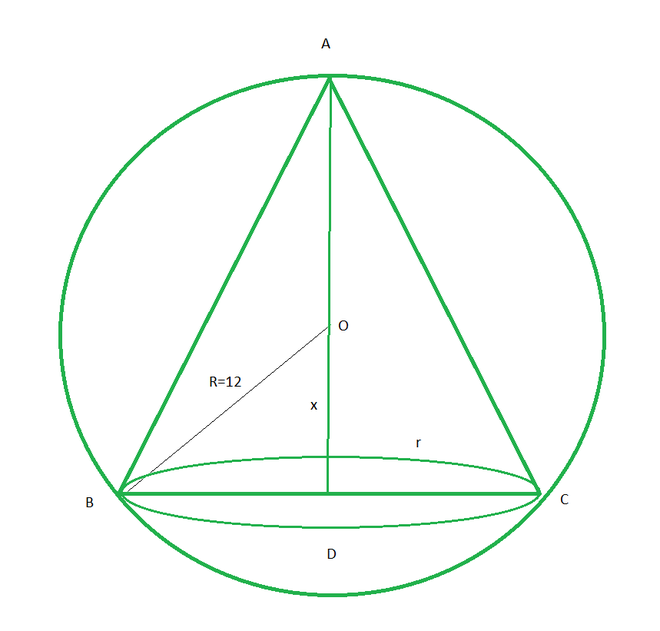
Let us assume r and h be the radius of the base of cone and height of the cone.
From the figure OD = x, and R = 12, BD = r
In △BOD,
BD = √(R2 - x2)
= √(144 - x2)
= (144 - x2)
and AD = AO + OD
= R + x = 12 + x
The volume of cone is
V = 1/3 πr2h
= 1/3 π BD2 × AD
= 1/3 π(144 - x2)(12 + x)
= 1/3 π(1728 + 144x - 12x2 - x3)
On differentiating w.r.t. x, we get
dV/dx = 1/3π (144 - 24x - 3x2)
For maximum and minimum
Put dV/dx = 0
⇒ 1/3 π(144 - 24x - 3x2) = 0
⇒ x = -12, 4
Here x = -12 is not possible
So, x = 4
Now,
d2V/dx2 = π/3(-24 - 6x)
At x = 4, d2v/dx2 = -2π(4 + x) = -2π × 8 = -16π < 0
So, x = 4 is point of local maxima.
Hence, the height of cone of maximum volume = R + x
= 12 + 4 = 16 cm
Solution:
Given that the volume of the closed cylinder (V) = 2156 cm3
Let us assume r and h be the radius and the height of the cylinder.
So, the volume of the cylinder is
V= πr2h = 2156 .....(i)
and the total surface area is
A = 2πrh + 2πr2
A = 2πr (h + r) .....(ii)
So, from eq (i) and (ii)
A = (2156 × 2)/r + 2πr2
On differentiating w.r.t. r, we get
dA/dr = - 4312/4π + 4πr
For maximum and minimum
Put dA/dr = 0
⇒ (-4312 + 4πr3)/r2 = 0
⇒ r3 = 4312/4π
⇒ r = 7
At r = 7, d2s/dr2 = (8624/r3 + 4π) > 0
So, r = 7 is the point of local minima
Hence, the total surf surface area of closed cylinder will be minimum when r = 7 cm.
Solution:
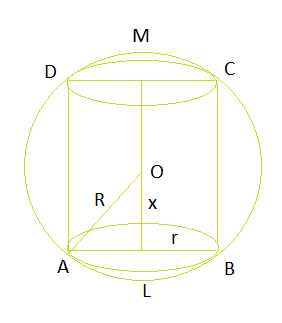
Let r and h be the radius and height of the cylinder.
Given that R be the radius of the sphere = 5√3
So, from the figure LM = h, OL = x
So, h = 2x
Now, In △AOL,
AL = √(AO2 - OL2)
= √(75 - x2)
As we know that the volume of cylinder is
V = πr2h
= πAL2 × ML
= π(75 - x2) × 2x
On differentiating w.r.t. x, we get
dV/dx = π[150 - 6x2]
For maximum and minimum
Put dV/dx = 0
⇒ π[150 - 6x2] = 0
⇒ x = 5 cm
Also, d2v/dx2 = -12πx
At x = 5, d2v/dx2 = -60πx < 0
So, x = 5 is point of local maxima.
Hence, the volume is maximum when x = 5
So, the maximum volume of cylinder is
= π(75 - 25) × 10 = 500π cm3
Solution:
Let us considered the two positive numbers are x and y with
x2+y2 = r2 ......(i)
Let S be the sum of two positive numbers
S = x + y .....(ii)
= x + √(r2 - x2) [From eq(ii)]
On differentiating w.r.t. x, we get
dS/dx = 1 - x/√(r2 - x2)
For maximum and minimum
Put dS/dx = 0
⇒ 1 - x/√(r2 - x2) = 0
⇒ x = √(r2 - x2)
⇒ 2x2 = r2
⇒ x = r/√2, -r/√2
According to the question x and y are the positive numbers
So, x ≠ -r/√2
Now, d2S/dx2 =
At, x = r/√2, d2S/dx2= < 0
So, x = r/√2 is point of local maxima.
Hence, the sum is largest when x = y = r/√2
Solution:
The given equation of parabola is
x2 = 4y .......(i)
Let us considered P(x, y) be the nearest point of the given parabola from the point A (0, 5)
Let Q be the square of the distance of P from A
Q = x2 + (y - 5)2 .....(ii)
Q = 4y + (y - 5)2
On differentiating w.r.t. y, we get
⇒ dQ/dy = 4 + 2(y - 5)
For maximum and minimum
Put dQ/dy = 0
⇒ 4 + 2(y - 5) = 0
⇒ 2y = 6
⇒ y = 3
From eq(i), we get
x2 = 12
x = 2√3
⇒ P = (2√3, 3) and p' = (-2√3, 3)
Now,
d2Q/dy2 = 2 > 0
So, P and P' are the point of local minima.
Hence, the nearest points are P(2√3, 3) and P"(2√3, 3).
Solution:
The given equation of the curve is
y2 = 4x ....(1)
Let us assume P(x, y) be a point on the given curve and
Q be the square of the distance between A(2,-8) and P.
So, Q = (x - 2)2 + (y + 8)2 .......(ii)
= (y2/4 - 2)2 + (y + 8)2
On differentiating w.r.t. y, we get
dQ/dy = 2(y2/4 - 2) × y/2 + 2(y + 8)
= (y3 - 8y)/4 + 2y + 16
= y3/4 + 16
For maximum and minimum
Put dQ/dy = 0
⇒ y3/4 + 16 = 0
⇒ y = -4
Now,
d2Q/dy2 = 3y2/4
At y = -4, d2S/dy2 = 12 > 0
Ao, y = -4 is the point of local minima
Now put the value of y in eq(i), we get
x = y2/4 = 4
Hence, the point is(4, -4) which is nearest to (2, -8).
Solution:
The given equation of the curve is
x2 = 8y ....(1)
Let P(x, y) be a point on the given curve, and
Q be the square of the distance between P and A(2, 4).
Q = (x - 2)2 + (y - 4)2 ........(ii)
= (x - 2)2 + (x2/8 - 4)2
On differentiating w.r.t. x, we get
dQ/dx = 2(x - 2) + 2(x2/8 - 4) × 2x/8
= 2(x - 2) + (x2 - 32)x/16
Also, d2Q/dx2 = 2 + 1/16[x2 - 32 + 2x2]
= 2 + 1/16[3x2 - 32]
For maxima and minima,
dQ/dx = 0
⇒ 2(x - 2) + x(x2 - 32)/16 = 0
⇒ 32x - 64 + x3 -32x = 0
⇒ x3 - 64 = 0
⇒ x = 4
At x = 4, d2Q/dx2 = 2 + 1/16[16 × 3 - 32] = 2 + 1 = 3 > 0
So, x = 4 is point of local minima
Now put the value of x in eq(1), we get
y = x2/8 = 2
So, the P(4, 2) is the nearest point to (2, 4)