|
VOOZH | about |
|
VOOZH | about |
Chapter 30 of RD Sharma's Class 12 Mathematics textbook focuses on Linear Programming an essential topic that involves optimizing a linear objective function subject to a set of the linear inequalities or constraints. This chapter is particularly useful in various fields such as economics, engineering and operational research where decision-making involves allocating limited resources efficiently.
The Linear Programming (LP) is a mathematical technique used to the determine the best possible outcome in a given situation such as maximum profit or minimum cost within a set of given constraints. The primary components of the linear programming problem are the objective function, constraints and non-negativity restrictions. The LP problems are typically solved using the graphical methods or the simplex method.
| Gadget | Foundry | Machine-shop |
| A | 10 | 5 |
| B | 6 | 4 |
| The firm'sand capacity per week | 1000 | 60 |
Answer:
The given data may be put in the following tabular form:
Gadget Foundry Machine-shop Profit A 10 5 Rs. 30 B 6 4 Rs. 20 Firm's capacity per week 1000 600 Let the required weekly production of gadgets A and B be x and y respectively.
Given that, profit on each gadget A is Rs 30 and gadget B is Rs 20.
Profit on x gadget of type A = 30x
Profit on y gadget of Type B = 20y
Let Z denote the total profit, so
Z = 30x + 20y
Given, production of one gadget A requires 10 hours per week for foundry and gadget B requires 6 hours per week for foundry.
So, x units of gadget A requires 10x hours per week and y units of gadget B requires 6y hours per week. But the maximum capacity of foundry per week is 1000 hours. So,
10x + 6y <= 1000 (First constraint.)
Given, production of one unit gadget A requires 5 hours per week of machine shop and production off one unit of gadget B requires 4 hours per week of machine shop.
So, x units of gadget A requires 5x hours per week and y units of gadget B requires 4y hours per week, but the maximum capacity of machine shop is 600 hours per week.
So, 5x + 4y <= 600 (Second constraint.)
Hence, mathematical formulation of LPP is:
Find x and y which maximize Z = 30x + 20y
Subject to constraints,
10x + 6y <= 1000
5x + 4y <=600
And, x, y >=0 (Since production cannot be less than 0.)
Answer:
The given information can be written in tabular form as follows :
Product Machine hours Labour hours Profit A 1 1 Rs 60 B - 1 Rs 80 Total Capacity 400 for A 500 Minimum supply of product B is 200 units.
Let the production of product A be x units and production of product B be y units.
Profit on one unit of product A = Rs 60
Profit on x units of product A = Rs 60y
Profit on one unit of product B = Rs 80
Profit on y units of product B = Rs 80y
Let Z denote the total profit. So,
Z = 60x + 80y
Given, minimum supply of product B is 200.
So, y >= 200 (First constraint)
Given that the production of one unit of product A requires 1 hour of machine hours, so x units of product A requires x hours , but given total machine hours available for product A is 400 hours. So,
x <= 400 (Second constraint)
Given, each unit of product A and B requires one hour of labour hour, so x units of product A require x hour and y unit of product B require y hour of labour hours, but total labour hours available are 500. So,
x + y <= 500 (Third constraint)
Hence, mathematical formulation of LPP is,
Find x and y which minimize Z = 60x + 80y
Subject to constraints,
y >= 200,
x <= 400,
x + y <= 500
x, y >=0 (Since production cannot be less than 0.)
| Machine | Products | ||
| A | B | C | |
| M1 | 4 | 3 | 5 |
| M2 | 2 | 2 | 4 |
Answer:
The given information can be written in tabular form as follows :
Product Machine(M1) Machine(M2) Profit A 4 2 3 B 3 2 2 C 5 4 4 Maximum capacity 2000 2500 Let required production of product A, B and C be x, y and z units respectively.
Given, profit on one unit of product A, B and C are Rs 3, Rs. 2 and Rs 4 respectively
So, profit on x unit of A, y unit of B and z unit of C are given by Rs 3x, Rs. 2y and Rs 4z respectively.
Let U be the total profit, so
U = 3x + 2y + 4z
Given, one unit of product A, B and C requires 4, 3 and 5 minutes on machine M1. So, x units of product A, y units of product B and z units of product C requires 4x, 3y and 5z minutes on machine M1. Therefore,
4x + 3y + 5z <= 2000 (First constraint)
Given, one unit of product A, B and C requires 2, 2 and 4 minutes on machine M1. So, x units of product A, y units of product B and z units of product C requires 2x, 2y and 4z minutes on machine M2. Therefore,
2x + 2y + 4z <= 2500 (Second constraint)
Also, given that the firm must manufacture 100 A's, 200 B's and 50 C's but not more than 150 A's. So,
100 <= x <= 150
y >=200
z >=50
Hence the mathematical formulation of LPP is:
Find x, y and z which minimize U = 3x + 2y + 4z
Subject to constraints,
4x + 3y + 5z <= 2000
2x + 2y + 4z <= 2500
100 <= x <= 150
y >=200
z >=50
x, y, z >=0
Answer:
The given information can be written in tabular form as follows :
Product M1 M2 Profit A 1 2 2 B 1 1 3 Capacity 6 hours 40 min. = 400 min 10 hours = 600 min. Let the required production of product A be x units and product B be y units.
Profit on one unit of product A = Rs 2
Profit on x units of product A = Rs 2x
Profit on one unit of product B = Rs 3
Profit on y units of product A = Rs 3y
Let the total profit be Z, so
Z = 2x + 3y
On machine M1,
Production of one unit of product A requires 1 minute.
Production of x units of product A requires x minute.
Production of one unit of product B requires 1 minute.
Production of y units of product B requires y minute.
But total time available on machine M1 is 600 minutes.
So, x + y <=400 (First constraint)
On machine M2,
Production of one unit of product A requires 2 minute.
Production of x units of product A requires 2x minute.
Production of one unit of product B requires 1 minute.
Production of y units of product B requires y minute.
But total time available on machine M2 is 600 minutes.
So, 2x + y <=600 (Second constraint)
Hence the mathematical formulation of LPP is:
Find x, y and z which maximize Z = 2x + 3y
Subject to constraints,
x + y <=400
2x + y <=600
x, y >=0 (Production cannot be less than zero.)
| Plant | A | B | C |
| 1 | 50 | 100 | 100 |
| 2 | 60 | 60 | 200 |
Answer:
The given information can be written in tabular form as follows :
Plant A B C Cost 1 50 100 100 2500 2 60 60 200 3500 Monthly demand 2500 3000 7000 Let plant 1 requires x days and plant 2 requires y days per month to minimize cost.
Given, plant 1 and plant 2 requires Rs 2500 per day and Rs 3500 per day respectively.
So, cost to run plant 1 and 2 is Rs 2500x and Rs 3500y per month.
Let Z be the total cost per month, so
Z = 2500x + 3500y
Given production of tyre A from plant 1 and 2 per day is 50 and 60 respectively. So, production of tyre A from plant 1 and 2 per month will be 50x and 60y respectively. But the maximum demand of tyre A is 2500 per month. So,
50x + 60y >= 2500 (First constraint)
Given production of tyre B from plant 1 and 2 per day is 100 and 60 respectively. So, production of tyre B from plant 1 and 2 per month will be 100x and 60y respectively. But the maximum demand of tyre B is 3000 per month. So,
100x + 60y >= 3000 (Second constraint)
Given production of tyre C from plant 1 and 2 per day is 100 and 200 respectively. So, production of tyre C from plant 1 and 2 per month will be 100x and 200y respectively. But the maximum demand of tyre A is 7000 per month. So,
100x + 200y >= 7000 (Third constraint)
Hence the mathematical formulation of LPP is:
Find x and y which minimize Z = 2500x + 3500y
Subject to constraints,
50x + 60y >= 2500
100x + 60y >= 3000
100x + 200y >= 7000
x, y >= 0 (Since number of days cannot be less than zero)
Answer:
Product Man Hours Maximum demand Profit A 5 7000 60 B 3 10000 40 Total Capacity 45000 Let the required production of product A be x units and product B be y units.
Profit on one unit of product A = Rs 60
Profit on x units of product A = Rs 60x
Profit on one unit of product B = Rs 40
Profit on y units of product A = Rs 40y
Let the total profit be Z, so
Z = 60x + 40y
Production of one unit of product A requires 5 hours.
Production of x units of product A requires 5x hours.
Production of one unit of product B requires 3 hours.
Production of y units of product B requires 3y hours.
But the total man hours available are 45000 hours, so
5x + 3y <= 450000 (First constraint)
Given, maximum demand for product A is 7000, so
x <= 7000 (Second constraint)
Given, maximum demand for product B is 10000, so
y <= 10000 (Third constraint)
Hence the mathematical formulation of LPP is:
Find x and y which minimize Z = 2500x + 3500y
Subject to constraints,
5x + 3y <= 450000
x <= 7000
y <= 10000
x, y >= 0 (Since production cannot be less than zero)
| Food 1 (per lb) | Food 2 (per lb) | Minimum daily requirement for the nutrient | |
| Calcium | 10 | 5 | 20 |
| Protein | 5 | 4 | 20 |
| Calories | 2 | 6 | 13 |
| Price (Rs) | 60 | 100 |
Answer:
Let x and y be the packets of 25 gm of Food 1 and Food 2 purchased. Let Z be the price paid. Obviously we have to minimize the price.
Take a mass balance on the nutrients from Food 1 and 2,
Calcium: 10x + 4y >= 20, i.e., 5x + 2y >= 10 (Equation 1)
Protein: 5x + 5y >= 20, i.e., x + y >= 20 (Equation 2)
Calories: 2x + 6y >=13 (Equation 3)
These become the constraints for the cost function, Z to be minimized , i.e, 0.6x + y = Z, given cost of Food 1 is Rs 0.6 and Rs 1 per lb.
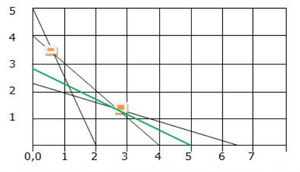
From equation 1, 2 and 3 we get points on the X & Y- axis as (0,5) & (2,0); (0,4) & (4,0); (0,13/6) & (6.5, 0).
Plotting these,
👁 ImageThe smallest value of Z is 2.9 at the point (2.75, 1.25). We cannot say that the minimum value of Z is 2.9 as the feasible region is unbounded.
Therefore, we have to draw the graph of the inequality 0.6x + y < 2.9.
Plotting this to see if the resulting line has any plot common with the feasible region. Since there are no common points, this is the minimum value of the function Z and the mix is
Food 1 = 2.75 lb; Food 2 = 1.25 lb; Price = Rs 2.9
When Z has an optimal value (maximum or minimum), where the variables x and y are subject to constraints described by linear inequalities, this optimal value must occur at a corner point (vertex) of the feasible region.
Here the feasible region is the unbounded region A-B-C-D.
Computing the value of Z a t the corner points of the feasible region ABHG
Point Corner Point Value of Z = 0.6x + y A 2 ,5 6.2 B 0.67, 3.33 3.73 C 2.75, 1.25 2.9 D 6.5, 2.16 6.06
| A | B | |
| Grinding | 1 | 2 |
| Turning | 3 | 1 |
| Assembling | 6 | 3 |
| Testing | 5 | 4 |
Answer:
Product Grinding Turning Assembling Testing Profit A 1 3 6 5 2 B 2 1 3 4 3 Maximum capacity 30 hours 60 hours 200 hours 200 hours Let the required production of product A be x units and product B be y units.
Profit on one unit of product A = Rs 2
Profit on x units of product A = Rs 2x
Profit on one unit of product B = Rs 3
Profit on y units of product A = Rs 3y
Let the total profit be Z, so
Z = 2x + 3y
Production of one unit of product A requires 1 hours of grinding.
Production of x units of product A requires x hours of grinding.
Production of one unit of product B requires 2 hours of grinding.
Production of y units of product B requires 2y hours of grinding.
But the total time available for grinding is 30 hours, so
x + 2y <= 30 (First constraint)
Production of one unit of product A requires 3 hours of turning.
Production of x units of product A requires 3x hours of turning..
Production of one unit of product B requires 1 hours of turning..
Production of y units of product B requires y hours of turning..
But the total time available for turning.is 60 hours, so
3x + y <= 60 (Second constraint)
Production of one unit of product A requires 6 hours of assembling.
Production of x units of product A requires 6x hours of assembling.
Production of one unit of product B requires 3 hours of assembling.
Production of y units of product B requires 3y hours of assembling.
But the total time available for assembling is 200 hours, so
6x + 3y <= 200 (Third constraint)
Production of one unit of product A requires 5 hours of testing.
Production of x units of product A requires 5x hours of testing.
Production of one unit of product B requires 4 hours of testing.
Production of y units of product B requires 4y hours of testing.
But the total time available for testing is 200 hours, so
5x + 4y <= 200 (Fourth constraint)
Hence the mathematical formulation of LPP is:
Find x and y which maximize Z = 2x + 3y
Subject to constraints,
x + 2y <= 30
3x + y <= 60
6x + 3y <= 200
5x + 4y <= 200
x, y >= 0 (Since production cannot be negative)
Answer:
Given information can be tabulated as below:
Foods Vitamin A Vitamin B Cost F1 2 3 5 F2 4 2 2.5 Minimum daily requirement 40 50 Let the required quantity of Food F1 be x units and quantity of food F2 be y units.
Given, cost of one unit of food F1 and F2 are Rs 5 and Rs 2.5 respectively. So, cost of x units of Food F1 and y units of food F2 are Rs 5x and 2.5y respectively.
Let Z be the total cost, so
Z = 5x + 2.5y
Given, one unit of food F1 and F2 contain 2 and 4 units of Vitamin A respectively, so x unit of food F1 and y units of food F2 contain 2x and 4y units of Vitamin A respectively, but minimum requirement of Vitamin A is 40 unit, so
2x + 4y >= 40 (First constraint)
Given, one unit of food F1 and F2 contain 3 and 2 units of Vitamin B respectively, so x unit of food F1 and y units of food F2 contain 3x and 2y units of Vitamin B respectively, but minimum requirement of Vitamin A is 50 unit, so
3x + 2y >= 50 (Second constraint)
Hence the mathematical formulation of LPP is:
Find x and y which maximize Z = 5x + 2.5y
Subject to constraints,
2x + 4y >= 40
3x + 2y >= 50
x, y>= 0 (Since requirement of food F1 and F2 cannot be less than zero)
Answer:
Let the number of automobiles produced be x and let the number of trucks produced be y.
Let Z be the profit function to be maximized.
Z = 2000x + 30000y
The constraints are on the man hours worked
Shop A : 2x + 5y <= 180 (Equation 1)
Shop B : 3x + 3y <= 135 ((Equation 2)
Corner points can be obtained from
2x + 5y = 180 , i.e, x= 0; y = 36 & x = 90; y = 0
3x + 3y = 135 , i.e. , x =0; y = 45 & x = 45; y = 0
Solving Equation 1 and Equation 2 gives x = 15 & y = 30
Corner point Value of Z = 2000x + 30000y 0, 0 0 0, 36 1080000 15, 30 930000 45, 0 90000 0 automobiles and 36 trucks will give maximum profit of Rs.1080000 .
Chapter 30 of RD Sharma's Class 12 Mathematics book focuses on Linear Programming, a crucial topic that plays a significant role in various real-life applications. This exercise provides a solid understanding of how to set up linear inequalities, construct feasible regions, and identify optimal solutions. Exercise 30.1 Set 1 typically deals with formulating linear programming problems from given word problems. This involves: