|
VOOZH | about |
|
VOOZH | about |
Answer:
Taylor A Taylor B Limit Variable x + y Shirts 6x + 10y >=60 Pants 4x + 4y >=32 Earn Rs 150 + 200 Z The above LPP can be represented in the table above.
To minimize labour cost means to assume minimize the earnings, i.e, Min Z = 150x + 200y such that the constraints
x>=0; y >= 0 (at least 1 shirt and pant is required)
6x + 10y >= 60 (require at least 60 shirts)
4x + 4y >= 32 (require at least 32 pants)
Solving the above inequalities as equations we get, x = 5 and y = 3
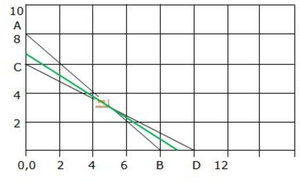
Other corner points obtained are (0, 6) & (10, 0), (0, 8) & (8, 0)
The feasible region is the open unbounded region A-E-D.
Point E(5, 3) may not be the minimal value. So, plot 150x + 200y < 1350 to see if there is a common region with A-E-D.
The green line has no common point, therefore
Corner point Value of Z = 150x + 200y 0, 8 0 10, 0 1500 5, 3 1350 Stitching 5 shirts and 3 pants minimizes labour cost to Rs. 1350.
| Plane | First class | Tourist class | Cost |
| Model 314 | 20 | 30 | 100000 |
| Model 335 | 20 | 60 | 150000 |
| Requirement minimum | 160 seats | 300 seats |
Answer:
Model 314 Model 535 Limit Variable x + y F class 20x + 20y >= 160 T class 30x + 60y >= 300 Cost x lakh + 1.5y lakh Z The above LPP can be represented in the table above.
The flight cost is to be minimized, i.e, Min Z = x +1.5y such that the constraints
x >= 2 (at least 2 planes of model 314 must be used)
y >= 0 (at least 1 planes of model 535 must be used)
20x + 20y >= 160 (require at least 160F class seats)
30x + 60y >= 300 (require at least 300T class seats)
Solving the above inequalities as equations we get,
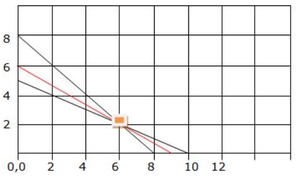
When x = 0, y = 8 and when y = 0, x = 8
When x = 0, y = 5 and when y = 0, x = 10
We get an unbounded region 8-E-10 as a feasible solution. Plotting the corner points and evaluating we have,
Corner point Value of Z = x + 1.5y 10, 0 10 0, 8 12 6, 2 9 Since we obtained an unbounded region as the feasible solution a plot of Z ( x + 1.5y < 9) is plotted.
since there are no common points , point E is the point that gives the minimum value.
Using 6 planes of model 314 & 2 of model 535 gives minimum cost of 9 lakh rupees.
Answer:
Given information can be tabulated as below
Sets Time requirement Points 1 3 5 2 2 3 4 6 Time for all three sets = 3.5 hours
Time for Set 1 ans Set 2 = 2.5 hours
Maximum number of questions = 100Let there be x, y, z questions from set 1, 2 and 3 respectively.
Given, each question from set 1, 2 and 3 earn 5,4 and 6 points respectively. So x questions of set 1, y questions of set 2 and z questions of set 3 earn 5x, 4y and 6z points.
Let total point credit be U
So, U = 5x + 4y + 6z
Given, each questions of set 1, 2 and 3 require 3, 2 and 4 minutes respectively. So, x questions of set 1, y questions of set 2 and z questions of set 3 require 3x, 2y and 4z minutes respectively but given that total time to devote in all three sets is 3.5 hours = 210 minutes and the first two sets is 2.5 hours = 150 minutes.
So,
3x + 2y + 4z <= 210 (First constraint)
3x + 2y < =150 (Second constraint)
Given, total number of questions cannot exceed 100.
So, x + y + z <= 100 (Third constraint)
Hence, mathematical formulation of LPP is
Find x and y which maximize U = 5x + 4y + 6z
Subject to constraint,
3x + 2y + 4z <= 210
3x + 2y < =150
x + y + z <= 100
x, y, z >= 0 (Since number of questions to solve from each set cannot be less than zero)
Answer:
Given information can be tabulated as below:
Product Yield Cultivation Price Fertilizers Tomatoes 2000 kg 5 days 1 100 kg Lettuce 3000 kg 6 days 0.75 100 kg Radishes 1000 kg 5 days 2 50 kg Average 2000 kg/per acre
Total land = 100 Acre
Cost of fertilizers = Rs 0.50 per kg
A total of 400 days of cultivation labour with Rs 20 per day
Let required quantity of field for tomatoes, lettuce and radishes be x, y and z acre respectively.
Given, costs of cultivation and harvesting of tomatoes, lettuce and radishes are 5 * 20 = Rs 100, 6 * 20 = Rs 120, 5 * 20 = Rs 100 respectively per acre. Cost of fertilizers for tomatoes, lettuce and radishes 100 * 0.05 = Rs 50, 100 * 0.50 = Rs 50 ans 50 * 0.50 = Rs 25 respectively per acre.
So, total costs of production of tomatoes, lettuce and radishes are Rs 100 + 50 = Rs 150x, Rs 120 + 50 = Rs 170y and Rs 100 + 25 = Rs 125z respectively. Total selling price of tomatoes, lettuce according to yield are 2000 * 1 = Rs 2000x, 3000 * 0.75 = Rs 2250y and 1000 * 2 = Rs 2000z respectively.
Let U be the total profit,
So,
U = (2000x - 150x) + (2250y - 170y) + (2000z - 125z)
U = 1850x + 2080y + 1875z
Given, farmer has 100 acre from
So, x + y + z <= 100 (First constraint)
Number of cultivation and harvesting days are 400
So, 5x + 6y + 5z <= 400 (Second constraint)
Hence, mathematical formulation of LPP is
Find x, y, z which maximize U = 11850x + 2080y + 1875z
Subject to constraint,
x + y + z <= 100
5x + 6y + 5z <= 400
x, y, z >=0 (Since cultivation cannot be less than zero)
| Product A | Product B | Weekly capacity | |
| Department 1 | 3 | 2 | 130 |
| Department 2 | 4 | 6 | 260 |
| Selling price per unit | Rs 25 | Rs 30 | |
| Labour price per unit | Rs 16 | Rs 20 | |
| Raw material cost per unit | Rs 14 | Rs 4 |
Answer:
Given information can be tabulated as below:
Product Department 1 Department 2 Selling price Labour cost Raw material cost A 3 4 25 16 4 B 2 6 30 20 4 Capacity 130 260 Let the required number of product A and B be x and y units respectively.
Given, labour cost and raw material cost of one unit of product A is Rs 16 and Rs 4, so total cost of product A is Rs 16 + Rs 4 = Rs 20
And given selling price of 1 unit of product A is Rs 25
So, profit on one unit of product A = Rs 25 - Rs 20 = Rs 5
Again, labour cost and raw material cost of one unit of product A is Rs 20 and Rs 4, so total cost of product A is Rs 20 + Rs 4 = Rs 24
And given selling price of 1 unit of product B is Rs 30
So, profit on one unit of product B = Rs 30 - Rs 24 = Rs 6
Hence, profits on x unit of product A and y units of product B are Rs 5x and Rs 6y respectively.
Let Z be the total profit, so Z = 5x + 6y
Given, production of one unit of product A and B need to process for 3 and 4 hours respectively in department 1, so production of x units of product A and y units of product B need to process for 3x and 4y hours respectively in department 1. But total capacity of Department 1 is 130 hours,
So, 3x + 2y <= 130 (First Constraint)
Given, production of one unit of product A and B need to process for 4 and 6 hours respectively in department 2, so production of x units of product A and y units of product B need to process for 4x and 6y hours respectively in department 2. But total capacity of Department 2 is 260 hours,
So, 4x + 6y <= 260 (Second Constraint)
Hence, mathematical formulation of LPP is
Find x, y, z which maximize Z = 5x + 6y
Subject to constraint,
3x + 2y <= 130
4x + 6y <= 260
x, y >= 0 (Since production cannot be less than zero)
Linear Programming is a mathematical technique used to optimize a linear objective function subject to linear equality and inequality constraints. In Class 12, it typically involves solving problems with two variables, often using graphical methods. Key steps include: