|
VOOZH | about |
|
VOOZH | about |
In this chapter, we will explore the concept of area and how to calculate it for various shapes like trapeziums, rhombuses, and quadrilaterals. Understanding these concepts is essential for various real-world applications, from architecture and engineering to everyday problem-solving.
Area of Trapezium
A trapezium is a quadrilateral with one pair of parallel sides.
The formula for the area of a trapezium:
Area = (1/2) × (sum of parallel sides) × height
Solution:
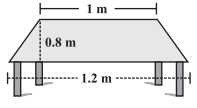
One parallel side of the trapezium (a) = 1 m
And second side (b) = 1.2 m and
height (h) = 0.8 m
Area of top surface of the table = (½) × (a + b)h
= (½) × (1 + 1.2)0.8
= (½) × 2.2 × 0.8
= 0.88
Area of top surface of the table is 0.88 m2 .
Solution:
Let the length of the other parallel side be b.
Length of one parallel side, a = 10 cm
height, (h) = 4 cm and
Area of a trapezium is 34 cm2
Formula for, Area of trapezium = (1/2) × (a + b)h
34 = ½(10 + b) × 4
34 = 2 × (10 + b)
After simplifying, b = 7
Hence another required parallel side is 7 cm.
Solution:
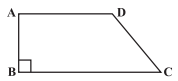
Given: BC = 48 m, CD = 17 m,
AD = 40 m and perimeter = 120 m
∵ Perimeter of trapezium ABCD
= AB + BC + CD + DA
120 = AB + 48 + 17 + 40
120 = AB = 105
AB = 120 – 105 = 15 m
Now, Area of the field = (½) × (BC + AD) × AB
= (½) × (48 + 40) × 15
= (½) × 88 × 15
= 660
Hence, area of the field ABCD is 660m2
Solution:
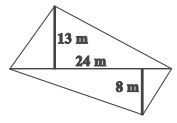
Consider, h1 = 13 m, h2 = 8 m and AC = 24 m
Area of quadrilateral ABCD = Area of triangle ABC + Area of triangle ADC
= ½(bh1) + ½(bh2)
= ½ × b(h1 + h2) = (½) × 24 × (13 + 8)
= (½) × 24 × 21 = 252
Hence, required area of the field is 252 m2
Solution:
Given: d1 = 7.5 cm and d2 = 12 cm
We know that,Area of rhombus = (½) × d1 × d2 = (½) × 7.5 × 12 = 45
Therefore, area of rhombus is 45 cm2 .
Solution:
Since a rhombus is also a kind of a parallelogram.
Formula for Area of rhombus = Base × Altitude
Putting values, we have
Area of rhombus = 6 × 4 = 24
Area of rhombus is 24 cm2
Also, Formula for Area of rhombus = (½) × d1d2
After substituting the values, we get
24 = (½) × 8 × d2
d2 = 6
Hence, the length of the other diagonal is 6 cm.
Solution:
Length of one diagonal, d1 = 45 cm and d2= 30 cm
∵ Area of one tile = (½)d1d2 = (½) × 45 × 30 = 675
Area of one tile is 675 cm2
Area of 3000 tiles is
= 675 × 3000
= 2025000 cm2
= 2025000/10000
= 202.50 m2 [∵ 1m2 = 10000 cm2]
∵ Cost of polishing the floor per sq. meter = 4
Cost of polishing the floor per 202.50 sq. meter = 4 × 202.50 = 810
Hence the total cost of polishing the floor is Rs. 810.
Solution:
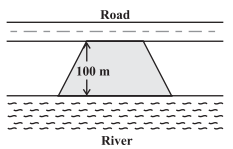
Perpendicular distance (h) = 100 m (Given)
Area of the trapezium shaped field = 10500 m2 (Given)
Let side along the road be ‘x’ m and side along the river = 2x m
Area of the trapezium field = (½) × (a + b) × h
10500 = (½) × (x + 2x) × 100
10500 = 3x × 50
After simplifying, we have x = 70, which means side along the river is 70 m
Hence, the side along the river = 2x = 2(70) = 140 m.
Solution:
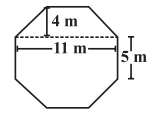
👁 ImageOctagon having eight equal sides, each 5 m. (given)
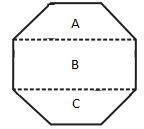
Divide the octagon as show in the below figure, 2 trapeziums whose parallel and perpendicular sides are 11 m and 4 m respectively and 3rd one is rectangle having length and breadth 11 m and 5 m respectively.
Now, Area of two trapeziums = 2 [(½) × (a + b) × h]
= 2 × (½) × (11 + 5 ) × 4
= 4 × 16 = 64
Area of two trapeziums is 64 m2
Also, Area of rectangle = length × breadth
= 11 × 5 = 55
Area of rectangle is 55 m2
Total area of octagon = 64 + 55
= 119 m2
Solution:
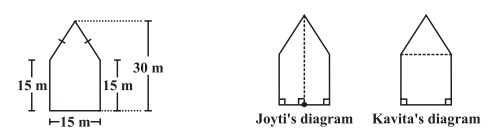
First way: By Jyoti’s diagram,
Area of pentagon = Area of trapezium ABCP + Area of trapezium AEDP
= (½)(AP + BC) × CP + (1/2) × (ED + AP) × DP
= (½)(30 + 15) × CP + (1/2) × (15 + 30) × DP
= (½) × (30 + 15) × (CP + DP)
= (½) × 45 × CD
= (1/2) × 45 × 15
= 337.5 m2
Area of pentagon is 337.5 m2
Second way: By Kavita’s diagram
Here, a perpendicular AM drawn to BE.
AM = 30 – 15 = 15 m
Area of pentagon = Area of triangle ABE + Area of square BCDE (from above figure)
= (½) × 15 × 15 + (15 × 15)
= 112.5 + 225.0
= 337.5
Hence, total area of pentagon shaped park = 337.5 m2
Solution:
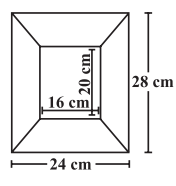
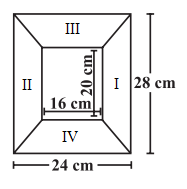
👁 ImageDivide given figure into 4 parts, as shown below:
Here two of given figures (I) and (II) are similar in dimensions.
And also figures (III) and (IV) are similar in dimensions.
Area of figure (I) = Area of trapezium
= (½) × (a + b) × h
= (½) × (28 + 20) × 4
= (½) × 48 × 4 = 96
Area of figure (I) = 96 cm2
Also, Area of figure (II) = 96 cm2
Now, Area of figure (III) = Area of trapezium
= (½) × (a + b) × h
= (½) × (24 + 16)4
= (½) × 40 × 4 = 80
Area of figure (III) is 80 cm2
Also, Area of figure (IV) = 80 cm2