|
VOOZH | about |
|
VOOZH | about |
Mensuration is a branch of mathematics that deals with the measurement of geometric figures and their properties such as length, area, and volume. In Class 8, Chapter 11 of the NCERT textbook focuses on the Mensuration where students learn about the measurements of different shapes and solids. Exercise 11.4 specifically addresses problems related to calculating the surface area and volume of cylinders. This exercise is crucial for building a strong foundation in geometric measurements and applying these concepts to real-world problems.
The Mensuration as covered in Class 8 Chapter 11 involves understanding how to calculate the surface area and volume of the various geometric shapes. This chapter equips students with the tools to solve problems related to measuring three-dimensional objects such as cylinders, cones, and spheres. Exercise 11.4 delves into practical applications of these concepts providing students with a solid grasp of how to handle problems involving the cylinders.
(a) To find how much it can hold.
(b) Number of cement bags required to plaster it.
(c) To find the number of smaller tanks that can be filled with water from it.
Solution:
a) In this condition, we will find the volume of a cylindrical tank.
b) In this condition, we will find the surface area of a cylindrical tank.
c) In this condition, we will find the volume of a cylindrical tank.
Solution:
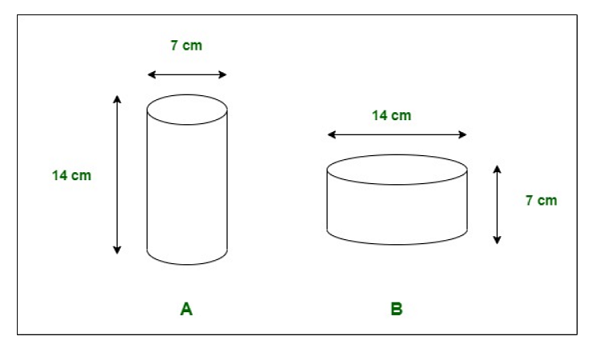
Cylinder A:
Radius of cylinder A = 7/2 cm
Height of cylinder A = 14 cm
Volume of cylinder A = pi.r2h = 22/7 x 7/2 x 7/2 x 14 = 539 cm3
Total Surface area of cylinder A = 2.pi.r(h + r) = 2 x 22/7 x 7/2(14 + 7/2) = 385 cm2
Cylinder B:
Radius of cylinder B = 14/2 or 7 cm
Height of cylinder B = 7 cm
Volume of cylinder B = pi.r2h = 22/7 x 7 x 7 x 7 = 1078 cm3
Total Surface area of cylinder B = 2.pi.r(h + r) = 2 x 22/7 x 7(7 + 7) = 616 cm2
We can clearly see that the Volume of cylinder B is twice that of cylinder A. Hence, verified that the Volume of cylinder B is greater than the volume of cylinder A. Also, Total surface area of cylinder B is greater.
Solution:
Area of Cuboid = length x breadth = 180 cm2
Volume of Cuboid = length x breadth x height = 900 cm3
So, Area x height = Volume
180 cm2 x height = 900 cm3
Hence, height = 5 cm
Hence, height of given cuboid is 5 cm.
Solution:
Volume of Cuboid = length x breadth x height = 60 cm x 54 cm x 30 cm = 97200 cm3
Volume of Cube = (side)3 = (6cm)3 = 216 cm3
Number of small cubes that can be placed inside given cuboid = Volume of given Cuboid/ Volume of one Cube
= 97200/216
= 450
Hence, 450 small cubes can be placed inside given cuboid.
Solution:
Volume of cylinder = 1.54 m3
Diameter of base of cylinder = 140 cm = 1.40 m, Radius = 7.20 m
As we know, Volume of cylinder = pi.r2h
So, 1.54 = 22/7 x 7.2 x 7.2 x height
On doing calculation, we get Height of cylinder = 1 m
Hence, height of given cylinder is 1 m.
Solution:
The radius of the cylindrical tank = 1.5 m
Length/Height of cylindrical = 7 m
The quantity of milk in liters that can be stored in the tank = Volume of the cylindrical tank
So, Volume of cylinder = pi.r2h = 22/7 x 1.5 x 1.5 x 7 = 49.50 m3
Volume = 49.50 m3
As we know, 1 m3 = 1000 liters
So, 49.50 m3 = 49500 L
Hence, the quantity of milk in liters that can be stored in the tank is 49500 L
(i) how many times will it be surface area increase?
(ii) how many times will its volume increase?
Solution:
Let us assume that the original edge of the cube is a cm. If the edge of the cube is doubled, then the new edge will be 2a cm.
i) Original surface area of cube = (edge)2 = (a)2 = a2 cm2
New surface area of cube = (edge)2 = (2a)2 = 4a2 cm2
Ratio to find which cube's surface area is greater = Original surface area : New surface area = a2 : 4a2 = 1 : 4
Hence, surface area of cube is increased by 4 times.
ii) Original volume of cube = (edge)3 = (a)3 = a3 cm3
New volume of cube = (edge)3 = (2a)3 = 8a3 cm3
Ratio to find which cube's volume is greater = Original volume : New volume = a3 : 8a3 = 1 : 8
Hence, volume of cube is increased by 8 times.
Solution:
Given the volume of the reservoir is 108 m3 Or 108000 L [1 m3 = 1000 L]. The volume of water pouring into a cuboidal reservoir = 60 L / minutes.
So, the time is taken to fill the reservoir = Volume of cuboidal reservoir / Volume of water pouring into the reservoir per minute
= 108000/60
= 1800 minutes
= 1800/60
= 30 hours
Hence, it will require 30 hours to fill the reservoir completely.
Read More: