|
VOOZH | about |
|
VOOZH | about |
In this article, we will be going to solve the entire Exercise 3.3 of Chapter 3 of the NCERT textbook for Class 8.
A quadrilateral is a polygon with four sides (edges), four vertices (corners), and four angles. It is one of the simplest types of polygons and can take various shapes depending on the lengths of its sides and the measures of its angles. The topic is easier than most of the topics. Quadrilaterals are fundamental shapes in geometry and come in various types, each with unique properties.
In this section, we will cover the basic properties of quadrilaterals, including the definition and types of quadrilaterals, and the key properties that distinguish each type, with a particular emphasis on parallelograms.
Let's learn about the solution to NCERT Exercise 3.3 for class 8 in the article below:
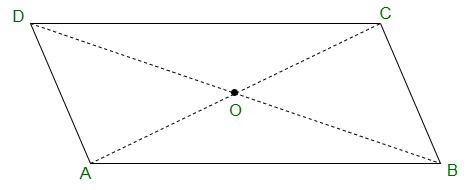
(i) AD = ……
(ii) ∠DCB = ……
(iii) OC = ……
(iv) m ∠DAB + m ∠CDA = ……
Solution:
(i) AD = BC {Opposite sides of a parallelogram are equal}
(ii) ∠DCB = ∠DAB {Opposite angles of a parallelogram are equal}
(iii) OC = OA {Diagonals of a parallelogram are equal}
(iv) m ∠DAB + m ∠CDA = 180°
Solution:
(i)
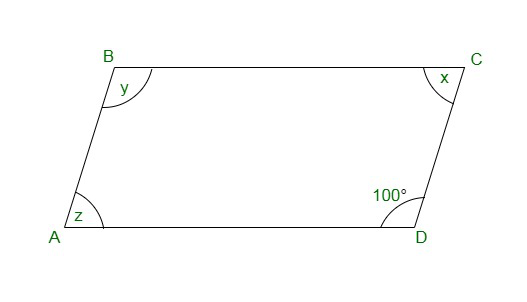
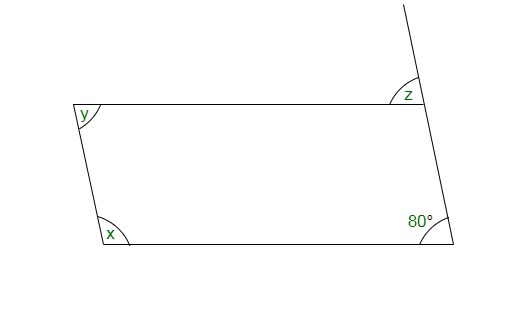
👁 Imagey = 100° {opposite angles of a parallelogram}
x + 100° = 180° {Adjacent angles of a parallelogram}
⇒ x = 180° – 100°
⇒ x = 80°x = z = 80° {opposite angles of a parallelogram}
Therefore,
x = 80°, y = 100° and z = 80°
(ii)
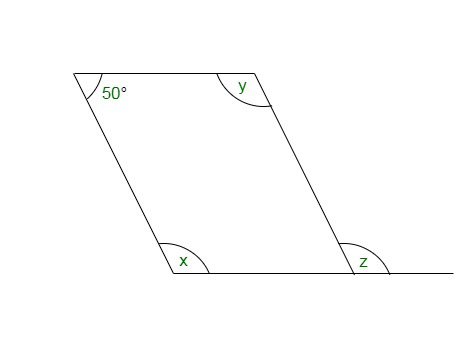
👁 Image50° + x = 180°
⇒ x = 180° – 50° = 130° {Adjacent angles of a parallelogram}
⇒ x = y = 130° {opposite angles of a parallelogram}
⇒ x = z = 130° {corresponding angle}
(iii)
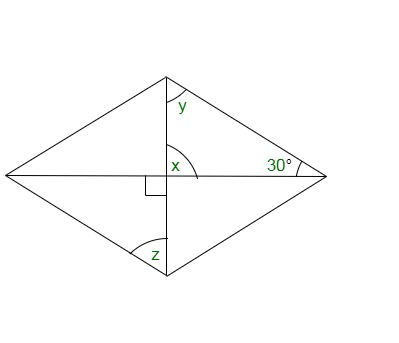
👁 Imagex = 90° {vertical opposite angles}
x + y + 30° = 180° {angle sum property of a triangle}
⇒ 90° + y + 30° = 180°
⇒ y = 180° – 120° = 60°
also, y = z = 60° {alternate angles}
(iv)
👁 Imagez = 80° {corresponding angle}
z = y = 80° {alternate angles}
x + y = 180° {adjacent angles}
⇒ x + 80° = 180°
⇒ x = 180° – 80° = 100°
(v)
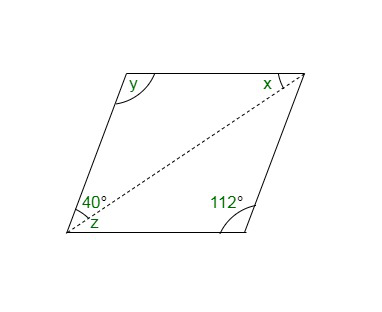
👁 Imagey = 112° {opposite angles of a parallelogram}
x = 180° – (y + 40°) {angle sum property of a triangle}
x = 28°
z = 28° {alternate angles}
(i) ∠D + ∠B = 180°?
(ii) AB = DC = 8 cm, AD = 4 cm and BC = 4.4 cm?
(iii)∠A = 70° and ∠C = 65°?
Solution:
(i) Yes,
The quadrilateral ABCD be a parallelogram if ∠D + ∠B = 180°,
it should also fulfilled some conditions which are:
(a) The sum of the adjacent angles should be 180°.
(b) Opposite angles must be equal.
(ii) No, opposite sides should be of the same length.
Here, AD ≠ BC
(iii) No, opposite angles should be of same measures.
Here, ∠A ≠ ∠C
Solution:
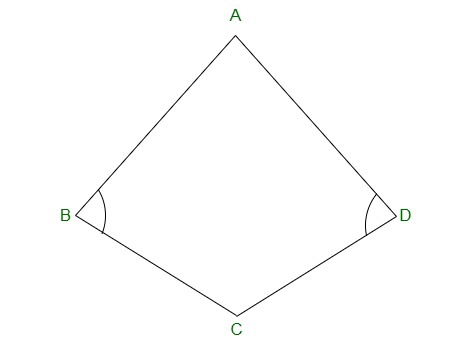
👁 ImageABCD is a figure of quadrilateral which is not a parallelogram but has exactly two opposite angles
that is ∠B = ∠D of equal measure. It is not a parallelogram because ∠A ≠ ∠C.
Solution:
Let the measures of two adjacent angles ∠A and ∠B be 3x and 2x respectively in parallelogram ABCD.
∠A + ∠B = 180°
⇒ 3x + 2x = 180°
⇒ 5x = 180°
⇒ x = 36°
As we know opposite sides of a parallelogram are equal.
∠A = ∠C = 3x = 3 × 36° = 108°
∠B = ∠D = 2x = 2 × 36° = 72°
Solution:
Let ABCD be a parallelogram.
The sum of adjacent angles of a parallelogram = 180°
∠A + ∠B = 180°
⇒ 2∠A = 180°
⇒ ∠A = 90°
also,
90° + ∠B = 180°
⇒ ∠B = 180° – 90° = 90°
∠A = ∠C = 90°
∠B = ∠D = 90°
Solution:
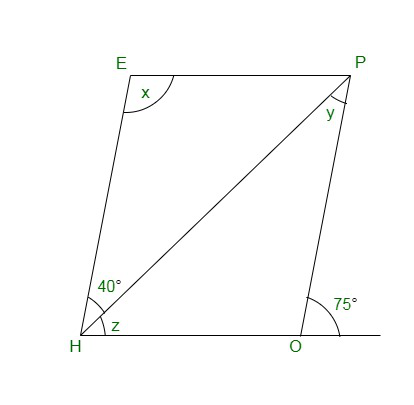
y = 40° {alternate interior angle}
∠P = 70° {alternate interior angle}
∠P = ∠H = 70° {opposite angles of a parallelogram}
z = ∠H – 40°= 70° – 40° = 30°
∠H + x = 180°
⇒ 70° + x = 180°
⇒ x = 180° – 70° = 110°
Solution:
(i)
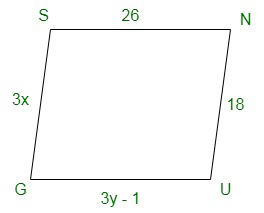
👁 ImageSG = NU and SN = GU {opposite sides of a parallelogram are equal}
3x = 18
x = 18/3
⇒ x =6
3y – 1 = 26 and,
⇒ 3y = 26 + 1
⇒ y = 27/3=9
x = 6 and y = 9
(ii)
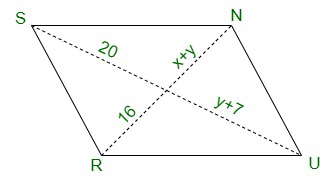
👁 Image20 = y + 7 and 16 = x + y {diagonals of a parallelogram bisect each other}
y + 7 = 20
⇒ y = 20 – 7 = 13 and,
x + y = 16
⇒ x + 13 = 16
⇒ x = 16 – 13 = 3
x = 3 and y = 13
Solution:
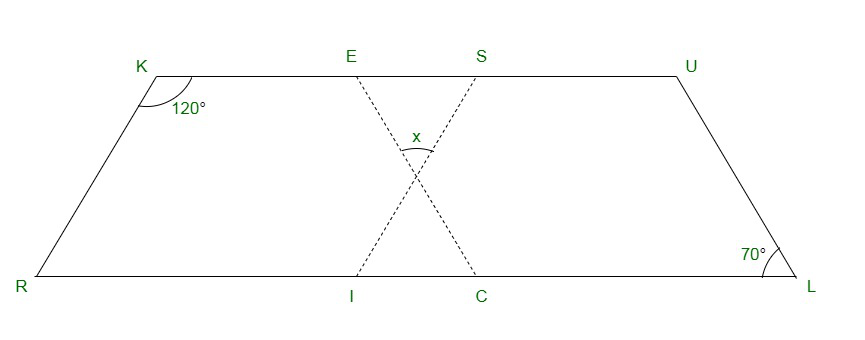
∠K + ∠R = 180° {adjacent angles of a parallelogram are supplementary}
⇒ 120° + ∠R = 180°
⇒ ∠R = 180° – 120° = 60°
also, ∠R = ∠SIL {corresponding angles}
⇒ ∠SIL = 60°
also,
∠ECR = ∠L = 70° {corresponding angles}
x + 60° + 70° = 180° {angle sum of a triangle}
⇒ x + 130° = 180°
⇒ x = 180° – 130° = 50°
Solution:
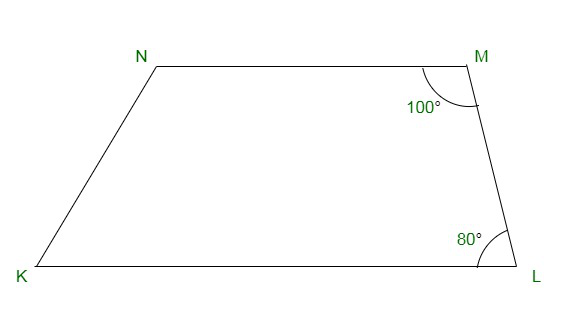
When a transversal line intersects two lines in such a way that the sum of the adjacent angles on the same side of transversal is 180° then, the lines are parallel to each other.
Here we have, ∠M + ∠L = 100° + 80° = 180°
Hence, MN || LK
As the quadrilateral KLMN has one pair of parallel line therefore it is a trapezium.
MN and LK are parallel lines.
Solution:
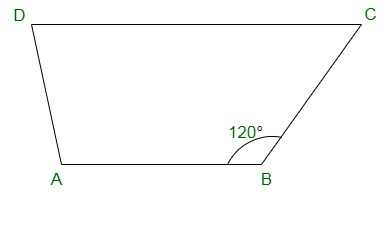
m∠C + m∠B = 180° {angles on the same side of transversal}
⇒ m∠C + 120° = 180°
⇒ m∠C = 180° − 120° = 60°
Solution:
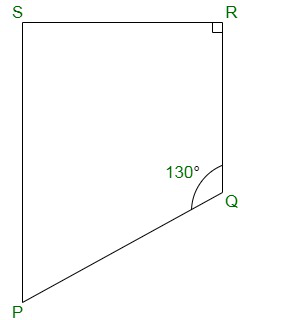
∠P + ∠Q = 180° {angles on the same side of transversal}
⇒ ∠P + 130° = 180°
⇒ ∠P = 180° – 130° = 50°
also,
∠R + ∠S = 180° {angles on the same side of transversal}
⇒ 90° + ∠S = 180°
⇒ ∠S = 180° – 90° = 90°
Hence, ∠P = 50° and ∠S = 90°
Yes, there are more than one method to find m∠P.
PQRS is a quadrilateral. Sum of measures of all angles of a quadrilateral is 360°.
Thus, as we know the measurement of ∠Q, ∠R and ∠S.
∠Q = 130°, ∠R = 90° and ∠S = 90°
∠P + 130° + 90° + 90° = 360°
⇒ ∠P + 310° = 360°
⇒ ∠P = 360° – 310° = 50°
In summary, Exercise 3.3 of Chapter 3 in the NCERT Class 8 textbook focuses on understanding and applying the properties of quadrilaterals, especially parallelograms. Through this article, students will be able to solve problems related to angles, sides, and diagonals of quadrilaterals and understand the logic behind each solution.