|
VOOZH | about |
|
VOOZH | about |
In Chapter 19 of RD Sharma's Class 8 Mathematics, students are introduced to the concept of visualizing shapes. This chapter focuses on enhancing spatial understanding by helping the students visualize various 2D and 3D shapes. Through different exercises including Exercise 19.1 students learn to identify, describe, and draw geometric shapes ultimately improving their ability to perceive and analyze geometric properties.
The Visualizing shapes involves the ability to the mental picture and manipulate different geometric figures both in two and three dimensions. This skill is crucial for understanding concepts in geometry and helps students in solving problems related to the areas, volumes, and properties of the various shapes. By practicing the visualization of the shapes students enhance their spatial reasoning which is fundamental to advanced mathematical learning.
Solution:
The least number of planes that are required to enclose a solid is 4.
The name of the solid is tetrahedron. It is a solid with four planes.
Solution:
No, because we need minimum 4 triangular faces in order to complete a polyhedron.
Solution:
Yes, A tetrahedron has 4 triangles as its faces.
Solution:
Yes, A square pyramid has a square and four triangles as its faces.
Solution:
Yes, if the number of faces is equal to or more than 4. As there is no possible polyhedron with 3 or less faces.
Solution:
Yes, a square prism is same as a cube. Both of them have 6 faces, 8 vertices and 12 edge.
The only difference is that a square prism is a 3-d shape with six rectangular shaped sides, out of which two are squares and
a cube is a rectangular prism having same length, width and height.
Solution:
No.
Reason -
Given,
Number of faces (F) = 10
Number of edges (E) = 20
Number of vertices (V) = 15
We know that, every polyhedron satisfies Euler's formula.
So, By using Euler’s formula -
V + F = E + 2
15 + 10 = 20 + 2
25 ≠ 22
Since, the given polyhedron does not satisfy Euler’s formula. Thus, a polyhedron can not have 10 faces, 20 edges and 15 vertices.
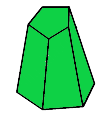
(i)
👁 ImageSolution:
In the given polyhedron -
Number of faces (F) = 7
Number of edges (E) = 15
Number of vertices (V) = 10
Now, By using Euler’s formula -
V + F = E + 2
10 + 7 = 15 + 2
17 = 17
Here, Euler's formula is satisfied.
Hence, verified.
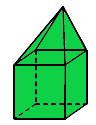
(ii)
👁 ImageSolution:
In the given polyhedron -
Number of faces (F) = 9
Number of edges (E) = 16
Number of vertices (V) = 9
Now, By using Euler’s formula -
V + F = E + 2
9 + 9 = 16 + 2
18 = 18
Here, Euler's formula is satisfied.
Hence, verified.
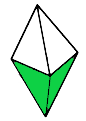
(iii)
Solution:
In the given polyhedron -
Number of faces (F) = 9
Number of edges (E) = 21
Number of vertices (V) = 14
Now, By using Euler’s formula -
V + F = E + 2
14 + 9 = 21 + 2
23 = 23
Here, Euler's formula is satisfied.
Hence, verified.
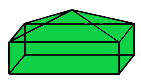
(iv)
Solution:
In the given polyhedron -
Number of faces (F) = 8
Number of edges (E) = 12
Number of vertices (V) = 6
Now, By using Euler’s formula -
V + F = E + 2
6 + 8 = 12 + 2
14 = 14
Here, Euler's formula is satisfied.
Hence, verified.
(v)
Solution:
In the given polyhedron -
Number of faces (F) = 9
Number of edges (E) = 16
Number of vertices (V) = 9
Now, By using Euler’s formula -
V + F = E + 2
9 + 9 = 16 + 2
18 = 18
Here, Euler's formula is satisfied.
Hence, verified.
| Faces | ? | 5 | 20 |
| Vertices | 6 | ? | 12 |
| Edges | 12 | 9 | ? |
Solution:
(i) Given,
Number of vertices (V) = 6
Number of edges (E) = 12
By using Euler’s formula -
V + F = E + 2
6 + F = 12 + 2
F = 14 - 6
F = 8
Thus, the number of faces is 8.
(ii) Given,
Number of faces (F) = 5
Number of edges (E) = 9
By using Euler’s formula -
V + F = E + 2
V + 5 = 9 + 2
V = 11 - 5
V = 6
Thus, the number of vertices is 6.
(iii) Given,
Number of vertices (V) = 12
Number of faces (F) = 20
By using Euler’s formula -
V + F = E + 2
12 + 20 = E + 2
E = 32 - 2
E = 30
Thus, the number of edges is 30.
Chapter 19 of RD Sharma's Class 8 Mathematics book especially Exercise 19.1 plays a vital role in building the strong foundation in geometry by helping the students visualize and understand the properties of shapes. This chapter not only prepares students for the more complex topics in the higher classes but also develops their problem-solving and critical-thinking skills in geometry.