|
VOOZH | about |
|
VOOZH | about |
Exercise 20.2 | Set 2 of Chapter 20 in RD Sharma Solutions for Class 8 further explores advanced concepts related to the area of trapeziums and polygons. This set presents more challenging problems, requiring students to apply their knowledge in complex scenarios and integrate various geometric principles.
This exercise set delves into more sophisticated applications of area calculations for trapeziums and polygons. It may include problems involving irregular shapes, composite figures, and real-world applications that require critical thinking and multi-step problem-solving approaches.
Solution:
Given:
Length of the parallel sides of the trapezium = 10m and 6m,
Area = 72 m2
Assume that the distance between parallel sides of trapezium is x m
As we know that,
Area of trapezium = 1/2 (Sum of lengths of parallel sides) × distance between parallel sides
Now, put all the given values in this formula, and we get,
72 = 1/2 (10 + 6) × x
72 = 8 × x
x = 72/8 = 9
Hence, the depth is 9m.
Solution:
Given:
Assume that the length of one parallel side of trapezium = x m,
then, the length of other parallel side of trapezium = (x+8) m,
Area of trapezium = 91 cm2,
Height = 7 cm.
As we know that,
Area of trapezium = 1/2 (Sum of lengths of parallel sides) × altitude
Now, put all the given values in this formula, and we get,
91 = 1/2 (x+x+8) × 7
91 = 1/2(2x+8) × 7
91 = (x+4) × 7
(x+4) = 91/7
x+4 = 13
x = 13 - 4 = 9
Hence, the length of one parallel side of trapezium = 9 cm
Therefore the length of other parallel side of trapezium = x+8 = 9+8 = 17 cm.
Solution:
Given:
Assume that the length of one parallel side of trapezium = 3x m,
then the length of other parallel side of trapezium will 5x m,
Area of trapezium = 384 cm2,
Distance between the parallel sides of the trapezium = 12 cm.
As we know that,
Area of trapezium = 1/2 (Sum of lengths of parallel sides) × distance between parallel sides
Now, put all the given values in this formula, and we get,
384 = 1/2 (3x + 5x) × 12
384 = 1/2 (8x) × 12
4x = 384/12
4x = 32
x = 8
Hence, the length of one parallel side of trapezium = 3x = 3× 8 = 24 cm
and length of other parallel side of trapezium = 5x = 5× 8 = 40 cm.
Solution:
Given:
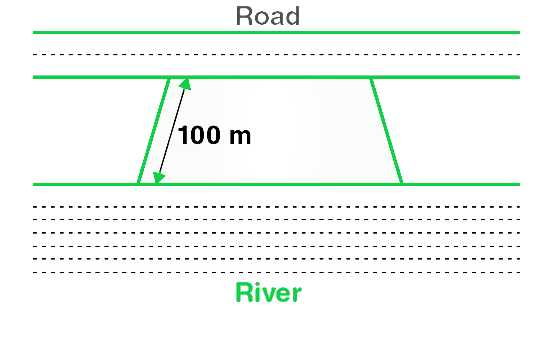
Assume that the length of side of trapezium shaped field along road = x m
and length of the other side of trapezium shaped field along road = 2x m,
Area of trapezium = 10500 cm2,
Distance between the parallel sides of the trapezium = 100 m.
As we know that,
Area of trapezium = 1/2 (Sum of lengths of parallel sides) × distance between parallel sides
Now, put all the given values in this formula, and we get,
10500 = 1/2 (x + 2x) × 100
10500 = 1/2 (3x) × 100
3x = 10500/50
3x = 210
x = 210/3 = 70
x = 70
Hence, the length of side of trapezium shaped field along road is 70 m
and length of other side of trapezium shaped field along road will 2x = 70× 2 = 140 m.
Solution:
Given:
Let us assume that the length of other parallel side of trapezium = x cm
and Length of one parallel side of trapezium = 38 cm,
Area of trapezium = 1586 cm2,
Distance between parallel sides = 26 cm.
As we know that,
Area of trapezium = 1/2 (Sum of lengths of parallel sides) × distance between parallel sides
Now, put all the given values in this formula, and we get,
1586 = 1/2 (x + 38) × 26
1586 = (x + 38) × 13
(x + 38) = 1586/13
x = 122 - 38
x = 84
Hence, the length of the other parallel side of the trapezium is 84 cm.
Solution:
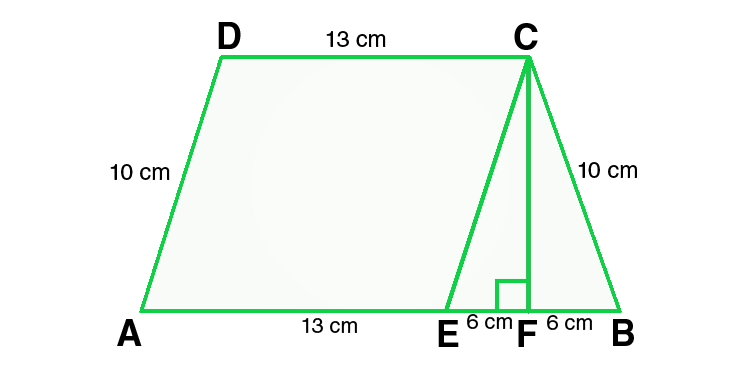
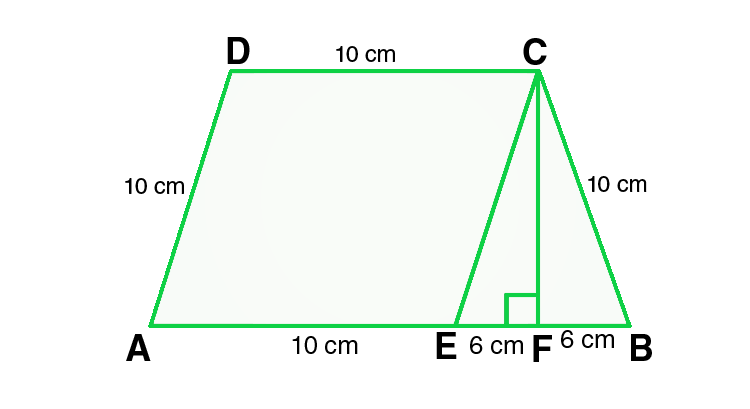
👁 ImageGiven:
In ΔCEF,
CE = 10 cm and EF = 6cm
By using Pythagoras theorem,
CE2 = CF2 + EF2
CF2 = CE2 - EF2
CF2 = 102 - 62
CF2 = 100 - 36
CF2 = 64
CF = 8 cm
From the figure we conclude that,
Area of trapezium = Area of parallelogram AECD + Area of triangle CEF
= base × height + 1/2 (base × height)
= 13 × 8 + 1/2 (12 × 8) = 104 + 48 = 152
Hence, the area of trapezium is 152 cm2.
Solution:
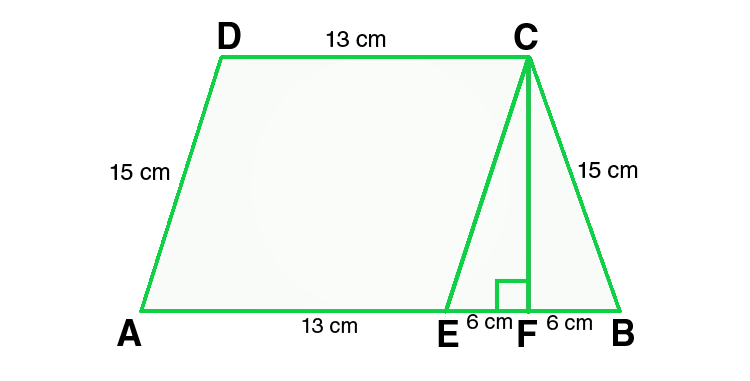
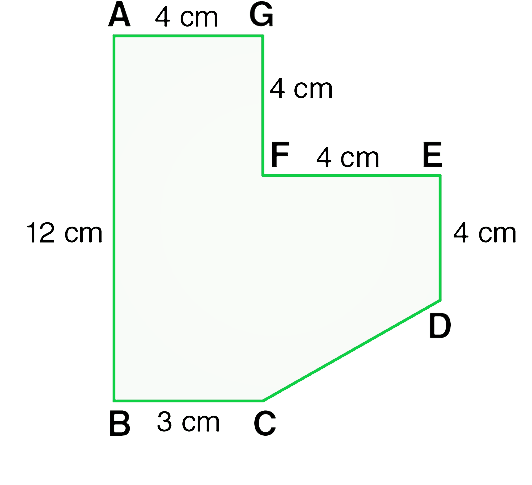
👁 ImageGiven:
In ΔCEF,
CE = 10 cm and EF = 6cm
By using Pythagoras theorem,
CE2 = CF2 + EF2
CF2 = CE2 - EF2
CF2 = 152 - 62
CF2 = 225 - 36
CF2 = 189
CF = √189 = √ (9×21) = 3√21 cm
From the figure we conclude that,
Area of trapezium = Area of parallelogram AECD + Area of triangle CEF
= height + 1/2 (sum of parallel sides)
= 3√21 × 1/2 (25 + 13)
= 3√21 × 19 = 57√21
Hence, the area of trapezium is 57√21 cm2.
Solution:
Given:
Let us assume that the length of other parallel side of trapezium = x cm,
Length of one parallel side of trapezium = 6 cm,
Area of trapezium = 28 cm2,
Length of altitude of trapezium = 4 cm.
As we know that,
Area of trapezium = 1/2 (Sum of lengths of parallel sides) × distance between parallel sides
Now, put all the given values in this formula, and we get,
28 = 1/2 (6 + x) × 4
28 = (6 + x) × 2
(6 + x) = 28/2
(6 + x) = 14
x = 14 - 6 = 8
Hence, the length of the other parallel side of trapezium is 8 cm.
Solution:
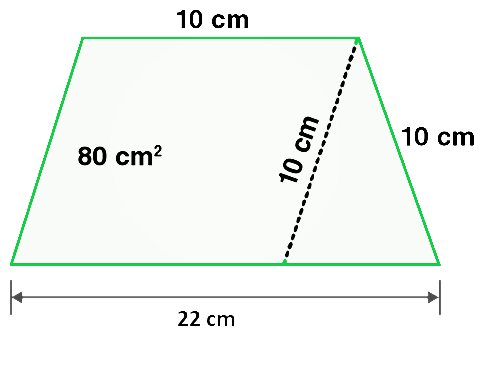
👁 ImageGiven:
In ΔCEF,
CE = 10 cm and EF = 6cm
By using Pythagoras theorem,
CE2 = CF2 + EF2
CF2 = CE2 - EF2
CF2 = 102 - 62
CF2 = 100-36
CF2 = 64
CF = 8 cm
Area of parallelogram = 80 cm^2 - (Given)
From the figure we conclude that,
Area of trapezium = Area of parallelogram AECD + Area of triangle CEF
So, area of trapezium = base × height + 1/2 (base × height)
Now, put all the given values in this formula, and we get,
= 10 × 8 + 1/2 (12 × 8)
= 80 + 48 = 128
Hence, the area of trapezium is 128 cm2.
Solution:
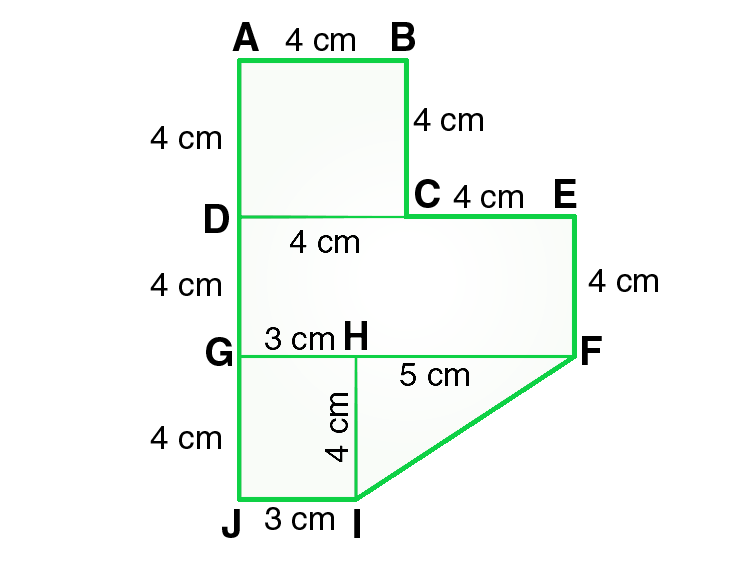
👁 ImageFrom the figure we conclude that,
Area of the given figure = Area of square ABCD + Area of rectangle DEFG +
Area of rectangle GHIJ + Area of triangle FHI
Also,
Area of the given figure = side × side + length × breadth +
length × breadth + 1/2 × base × altitude
Now, put all the given values in this formula, and we get,
= 4×4 + 8×4 + 3×4 + 1/2×5×5
= 16 + 32 + 12 + 10
= 70
Hence, the area of given figure is 70 cm2.
Exercise 20.2 | Set 2 of Chapter 20 in RD Sharma Solutions for Class 8 presents advanced problems on areas of trapeziums and polygons. It incorporates complex geometric scenarios, real-world applications, and multi-step problems. This set challenges students to apply their knowledge creatively, enhancing their problem-solving skills and deepening their understanding of advanced geometric concepts.