|
VOOZH | about |
|
VOOZH | about |
Today in this Article we are going to look at the answer of a renowned book named RD Sharma for class 8 Chapter 25 Data Handling III (Pictorial Representation Of Data As Pie Charts Or Circle Graphs) - Exercise 25.1 | Set 2. So let's first see the question.
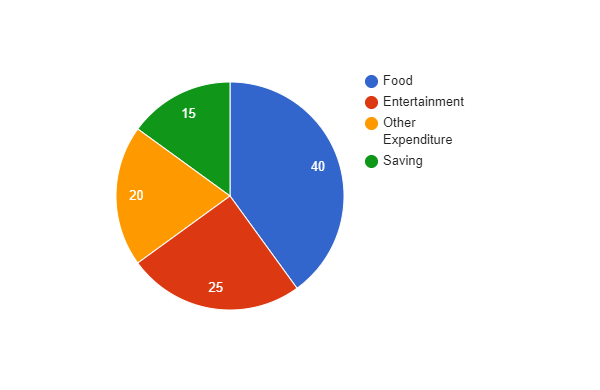
| Items | Food | Entertainment | Other Expenditure | Saving |
| Expenditure (in %) | 40 | 25 | 20 | 15 |
Solution:
Given that, total Expenditure = 100%
Therefore,
Central angle = (component value/100) × 360°
Now the central angle for each activity will be calculated as follows:
Items Expenditure (in %) Central Angle Food 40 40/100 * 360 = 144 Entertainments 25 25/100 * 360 = 90 Other Expenditure 20 20/100 * 360 = 72 Saving 15 15/100 * 360 = 54 Steps to construct pie chart using above data :
Step 1. First draw the circle of an appropriate radius.
Step 2. Now draw a vertical radius anywhere inside the circle.
Step 3. Now choose the largest central angle. Construct a sector of central angle, whose one radius coincides with the radius drawn in step 2 and the other radius is in clockwise direction to the vertical radius.
Step 4. Construct other sectors representing other values in clockwise direction in descending order of values of their central angles.
Step 5. Shade the sectors so obtained by different colors and label them.
👁 Image
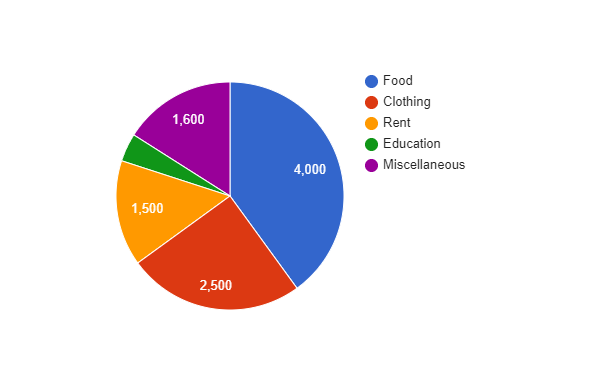
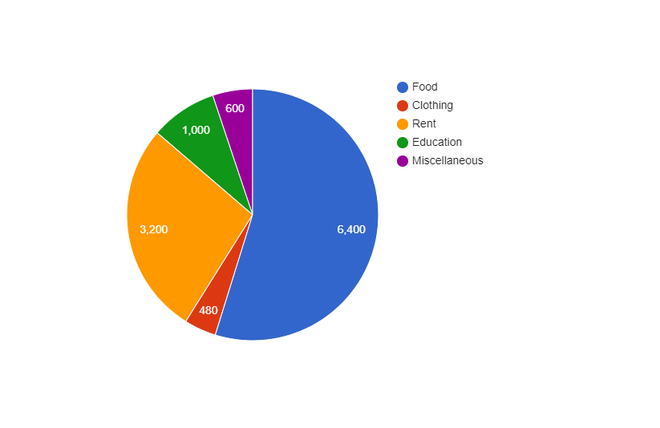
| Items of Expenditure | Expenditure |
| Family A Family B | |
| Food | 4000 6400 |
| Clothing | 2500 480 |
| Rent | 1500 3200 |
| Education | 400 1000 |
| Miscellaneous | 1600 600 |
| Total | 10000 16000 |
Solution:
Given that, the total expenditure of family A = 10000 and family B = 11680
Central angle for family A = (component value/10000) × 360°
Central angle for family B = (component value/11680) × 360°
Now the central angle for each activity will be calculated as follows :
Items of Expenditure Expenditure Family A Expenditure Family B Central Angle of Family A Central Angle of Family B Food 4000 6400 4000/10000 * 360 = 144 6400/11680 * 360 = 197.6 Clothing 2500 480 2500/10000 * 360 = 90 480/11680 * 360 = 14.8 Rent 1500 3200 1500/10000 * 360 = 54 3200/11680 * 360 = 98.6 Education 400 1000 400/10000 * 360 = 14.4 1000/11680 * 360 = 30.8 Miscellaneous 1600 600 1600/10000 * 360 =57.6 600/11680 * 360 = 18.5 Steps to construct pie chart using above data :
Step 1. First draw the circle of an appropriate radius.
Step 2. Now draw a vertical radius anywhere inside the circle.
Step 3. Now choose the largest central angle then construct a sector of central angle, whose one radius coincides with the radius drawn in step 2 and the other radius is in clockwise direction to the vertical radius.
Step 4. Construct other sectors representing other values in clockwise direction in descending order of values of their central angles.
Step 5. Shade the sectors so obtained by different colors and label them.
👁 Image
👁 Image
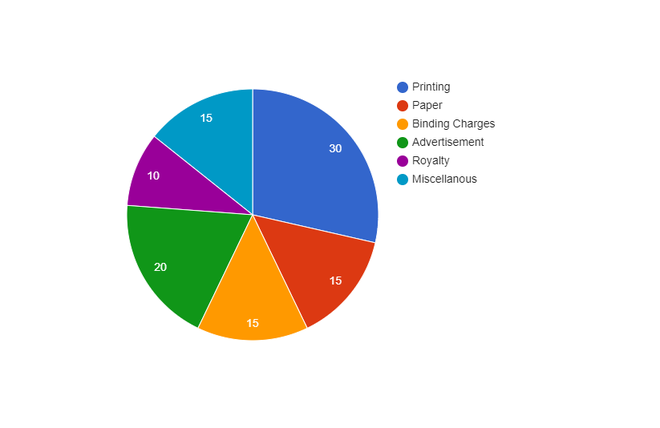
| Printing | Paper | Binding Charges | Advertisement | Royalty | Miscellaneous |
| 30% | 15% | 15% | 20% | 10% | 15% |
Solution:
Given that, total cost of production of book = 105%
Therefore,
Central angle = (component value/105) × 360°
Now the central angle for each activity will be calculated as follows :
Items Expenditure (in %) Central Angle Printing 30 30/105 * 360 = 102.9 Paper 15 15/105 * 360 = 51.4 Binding Charges 15 15/105 * 360 = 51.4 Advertisement 20 20/105 * 360 = 68.6 Royalty 10 10/105 * 360 = 34.3 Miscellaneous 15 15/105 * 360 = 51.4 Steps to construct pie chart using above data :
Step 1. First draw the circle of an appropriate radius.
Step 2. Now draw a vertical radius anywhere inside the circle.
Step 3. Now choose the largest central angle. Then construct a sector of central angle, whose one radius coincides with the radius drawn in step 2 and the other radius is in clockwise direction to the vertical radius.
Step 4. Construct other sectors representing other values in clockwise direction in descending order of values of their central angles.
Step 5. Shade the sectors so obtained by different colors and label them.
👁 Image
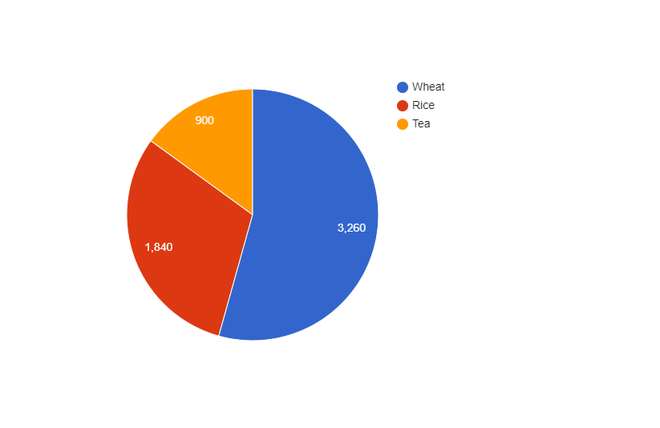
| Items | Wheat | Rice | Tea |
| Production (in metric tons) | 3260 | 1840 | 900 |
Solution:
Given that, total cost of production = 6000 metric tons
Therefore,
Central angle = (component value/6000) × 360°
Now the central angle for each activity will be calculated as follows :
Items Production Central Angle Wheat 3260 3260/6000 * 360 = 195.6 Rice 1840 1840/6000 * 360 = 110.4 Tea 900 900/6000 * 360 = 54 Steps to construct pie chart using above data :
Step 1. First draw the circle of an appropriate radius.
Step 2. Now draw a vertical radius anywhere inside the circle.
Step 3. Now choose the largest central angle then construct a sector of central angle, whose one radius coincides with the radius drawn in step 2 and the other radius is in clockwise direction to the vertical radius.
Step 4. Construct other sectors representing other values in clockwise direction in descending order of values of their central angles.
Step 5. Shade the sectors so obtained by different colors and label them.
👁 Image
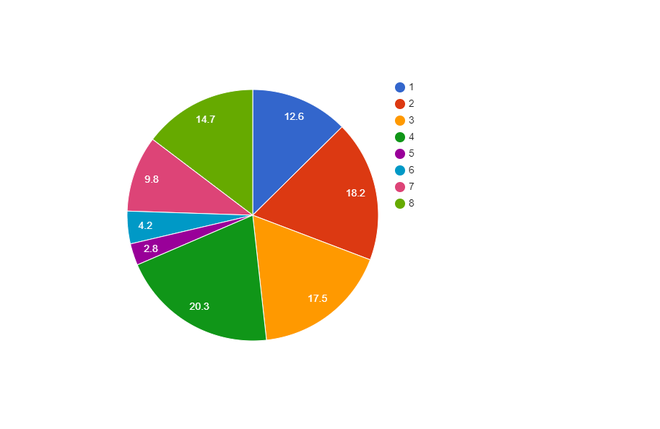
12.6, 18.2, 17.5, 20.3, 2.8, 4.2, 9.8, 14.7
Solution:
Given that, total amount = 100.1%
Therefore,
Central angle = (component value/100.1) × 360°
Now the central angle for each activity will be calculated as follows :
Class Amount (in %) Central Angle 1 12.6 12.6/100.1 * 360 = 45.3 2 18.2 18.2/100.1 * 360 = 65.5 3 17.5 17.5/100.1 * 360 = 62.9 4 20.3 20.3/100.1 * 360 = 73 5 2.8 2.8/100.1 * 360 = 10.1 6 4.2 4.2/100.1 * 360 = 15.1 7 9.8 9.8/100.1 * 360 = 35.2 8 14.7 14.7/100.1 * 360 = 52.9 Steps to construct pie chart using above data :
Step 1. First draw the circle of an appropriate radius.
Step 2. Now draw a vertical radius anywhere inside the circle.
Step 3. Now choose the largest central angle then construct a sector of central angle, whose one radius coincides with the radius drawn in step 2 and the other radius is in clockwise direction to the vertical radius.
Step 4. Construct other sectors representing other values in clockwise direction in descending order of values of their central angles.
Step 5. Shade the sectors so obtained by different colors and label them.
👁 Image
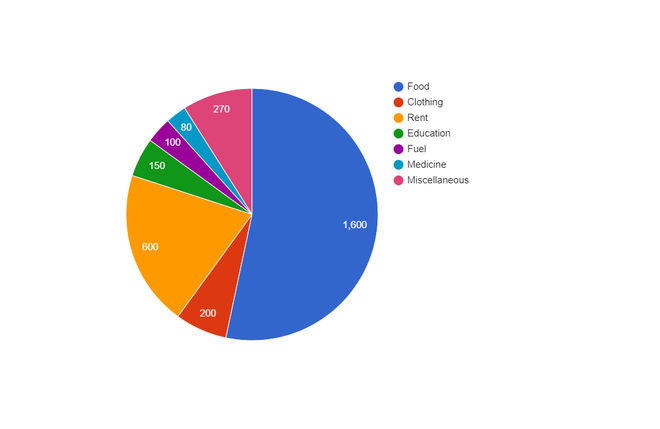
| Items | Food | Clothing | Rent | Education | Fuel etc | Medicine | Miscellaneous |
| Expenditure (in Rs) | 1600 | 200 | 600 | 150 | 100 | 80 | 270 |
Solution:
Given that, total expenditure = 3000 Rs
Therefore,
Central angle = (component value/3000) × 360°
Now the central angle for each activity will be calculated as follows :
Items Expenditure (in Rs) Central Angle Food 1600 1600/3000 * 360 = 192 Clothing 200 200/3000 * 360 = 24 Rent 600 600/3000 * 360 = 72 Education 150 150/3000 * 360 = 18 Fuel 100 100/3000 * 360 = 12 Medicine 80 80/3000 * 360 = 9.6 Miscellaneous 270 270/3000 * 360 = 32.4 Steps to construct pie chart using above data :
Step 1. First draw the circle of an appropriate radius.
Step 2. Now draw a vertical radius anywhere inside the circle.
Step 3. Now choose the largest central angle then construct a sector of central angle, whose one radius coincides with the radius drawn in step 2 and the other radius is in clockwise direction to the vertical radius.
Step 4. Construct other sectors representing other values in clockwise direction in descending order of values of their central angles.
Step 5. Shade the sectors so obtained by different colors and label them.
👁 Image
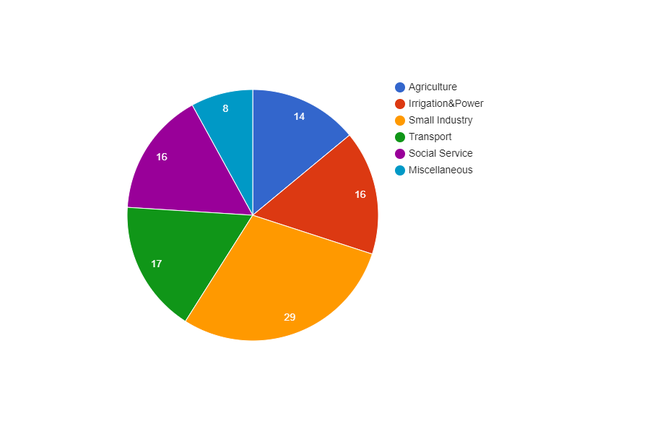
| Agriculture | Irrigation and Power | Small Industries | Transport | Social Service | Miscellaneous |
| 14% | 16% | 29% | 17% | 16% | 8% |
Solution:
Given that, total investment = 100%
Therefore,
Central angle = (component value/100) × 360°
Now the central angle for each activity will be calculated as follows :
Data Investment (in %) Central Angle Agriculture 14 14/100 * 360 = 50.4 Irrigation and Power 16 16/100 * 360 = 57.6 Small Industries 29 29/100 * 360 = 104.4 Transport 17 17/100 * 360 = 61.2 Social Services 16 16/100 * 360 = 57.6 Miscellaneous 8 8/100 * 360 = 28.8 Steps to construct pie chart using above data :
Step 1. First draw the circle of an appropriate radius.
Step 2. Now draw a vertical radius anywhere inside the circle.
Step 3. Now choose the largest central angle then construct a sector of central angle, whose one radius coincides with the radius drawn in step 2 and the other radius is in clockwise direction to the vertical radius.
Step 4. Construct other sectors representing other values in clockwise direction in descending order of values of their central angles.
Step 5. Shade the sectors so obtained by different colors and label them.
👁 Image