|
VOOZH | about |
|
VOOZH | about |
Chapter 1 of the Class 9 NCERT Mathematics textbook, titled "Number System," introduces students to various types of numbers, including real numbers, irrational numbers, and the representation of numbers on the number line. Exercise 1.3 focuses on the representation of irrational numbers on the number line and helps students understand how to approximate and locate these numbers using geometrical methods.
This section provides detailed solutions for Exercise 1.3 from Chapter 1 of the Class 9 NCERT Mathematics textbook. The solutions guide students through the process of representing irrational numbers on the number line and understanding their properties.
NCERT Solutions for Class 9 Maths, Chapter 1, Number Systems, Exercise 1.3, meticulously crafted by our subject experts, facilitating effortless learning for students. These solutions serve as a valuable reference for students tackling exercise problems. Exercise 1.3 delves into the realm of real numbers and their decimal expansions, aiding in a comprehensive understanding of the topic.
Solution:
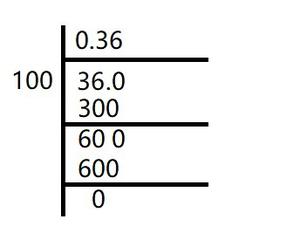
In the given question, we get
👁 ImageHere, the remainder becomes zero.
Hence, decimal expansion becomes terminating.
36/100 = 0.36
Solution:
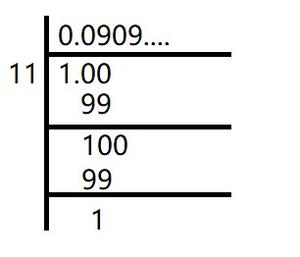
In the given question, we get
👁 ImageHere, the remainder never becomes zero and remainders repeat after a certain stage.
Hence, decimal expansion is non-terminating recurring
1/11 =
Solution:
Here,
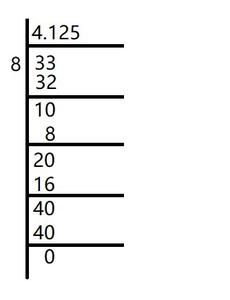
In the given question, we get
👁 ImageHere, the remainder becomes zero.
Hence, decimal expansion becomes terminating.
= 4.125
Solution:
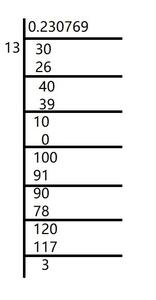
In the given question, we get
👁 ImageHere, the remainder never becomes zero and remainders repeat after a certain stage.
Hence, decimal expansion is non-terminating recurring
3/13 =
Solution:
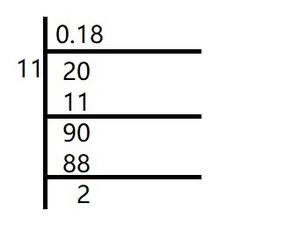
In the given question, we get
👁 ImageHere, the remainder never becomes zero and remainders repeat after a certain stage.
Hence, decimal expansion is non-terminating recurring
2/11 =
Solution:
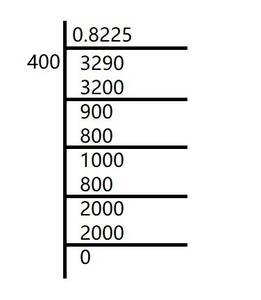
In the given question, we get
👁 ImageHere, the remainder becomes zero.
Hence, decimal expansion becomes terminating.
329/400 = 0.8225
Solution:
As it is given,
So,
Solution:
= 0.66666......
Lets's take, x = 0.66666......
10x = 6.666....
So,
10x - x = (6.6666.....) - (0.66666........)
9x = 6
x = 6/9
x = 2/3
Hence, x is in the form p/q, here p and q are integers and q ≠ 0.
Solution:
= 0.4777777......
Lets's take, x = 0.4777777......
10x = 4.77777.......
So,
10x - x = (4.77777.......) - (0.4777777......)
9x = 4.3
9x = 43/10
x = 43/90
Hence, x is in the form p/q, here p and q are integers and q ≠ 0.
Solution:
= 0.001001001......
Lets's take, x = 0.001001001......
1000x = 1.001001001......
So,
1000x - x = (1.001001001......) - (0.001001001......)
999x = 1
x = 1/999
Hence, x is in the form p/q, here p and q are integers and q ≠ 0.
Solution:
Lets's take, x = 0.99999......
10x = 9.99999....
So,
10x - x = (9.99999.....) - (0.99999........)
9x = 9
x = 1
As, 0.9999..... just goes on, then at some point of time there is no gap between 1 and 0.9999....
We can observe that, 0.999 is too much near 1, hence, 1 is justified as the answer.
Hence, x is in the form p/q, where p and q are integers and q ≠ 0.
Solution:
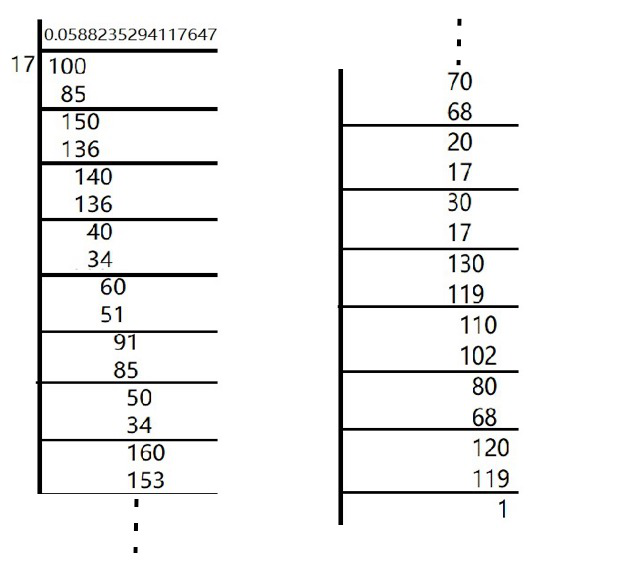
In the given question,
👁 ImageThere are 16 digits in the repeating block of the decimal expansion of 1/17
Here, the remainder never becomes zero and remainders repeat after a certain stage.
Hence, decimal expansion is non-terminating recurring
1/17 =
Solution:
We observe that when q is 2, 4, 5, 8, 10… Then the decimal expansion is terminating.
Let's take some example,
1/2 = 0. 5, denominator q = 21
7/8 = 0. 875, denominator q =23
4/5 = 0. 8, denominator q = 51
So, we conclude that terminating decimal may be obtained in the situation where
prime factorization of the denominator of the given fractions has the power
of only 2 or only 5 or both.
In the form of 2m × 5n, where n, m are natural numbers.
Solution:
As we know that all irrational numbers are non-terminating non-recurring.
So,
√5 = 2.23606798.......
√27 =5.19615242......
√41 = 6.40312424.....
Solution:
As, decimal expansion of
5/7 =
9/11 =
Hence, three different irrational numbers between them can be as follows,
0.73073007300073000073…
0.75075007300075000075…
0.76076007600076000076…
Solution:
√23 = 4.79583152......
As the number is non-terminating non-recurring.
It is an irrational number.
Solution:
√225 = 15 = 15/1
As the number can be represented in p/q form, where q ≠ 0.
It is a rational number.
Solution:
As, the number 0.3796, is terminating.
It is a rational number.
Solution:
As, the number 7.478478, is non-terminating but recurring.
It is a rational number.
Solution:
As, the number 1.101001000100001..., is non-terminating but recurring.
It is a rational number.
Class 9 Maths Number System: