|
VOOZH | about |
|
VOOZH | about |
In Class 9 Mathematics, Chapter 10 of the NCERT textbook focuses on the "Circles". This chapter explores the various properties and theorems related to circles which are fundamental in geometry. Exercise 10.4, a part of this chapter provides a series of problems designed to reinforce the concepts discussed. Understanding these problems is crucial as they help in mastering the properties of the circles and their applications in geometry.
A circle is a fundamental shape in geometry characterized by all points in a plane being equidistant from a fixed point called the center. The properties of circles form the basis for many geometric constructions and proofs. Chapter 10 of the Class 9 NCERT textbook delves into these properties and Exercise 10.4 is specifically designed to test students' understanding of theorems related to circles. The Mastery of this exercise is important for solving more complex geometric problems and for preparing for higher-level mathematics.
Solution:
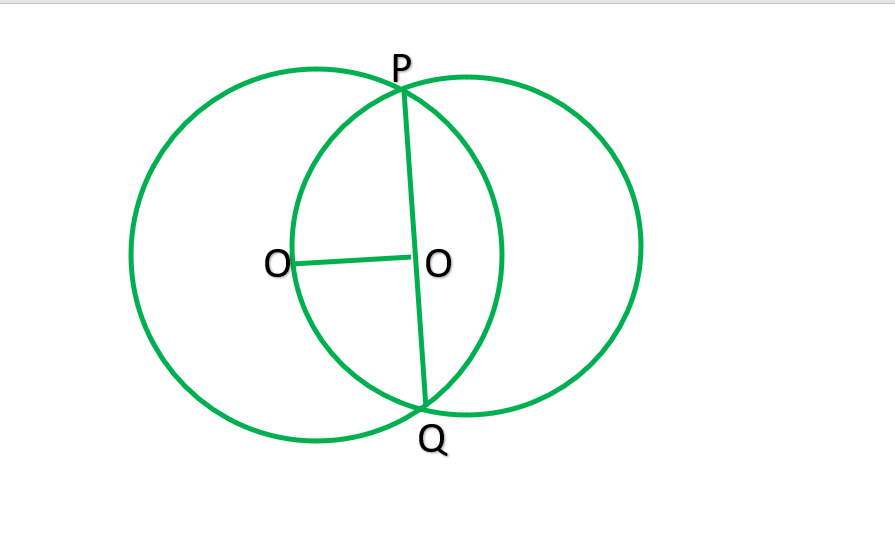
Given: OP=4cm, AP=3cm, QR=5cm
To find: In ∆APO:
AO²=5²=25
OP²=4²=16
AP²=3²=9
OP²+AP²=AO²
BY converse of Pythagoras theorem
ΔAPO: is a right ∠D=P
Now, in the bigger circle OP is perpendicular AB
AP=½AB ----------------(perpendicular from the center of circle to a chord bisect the chord )
3=½AB
6=AB
∴Therefore the length of common chord is 6cm.
👁 Image
Solution:
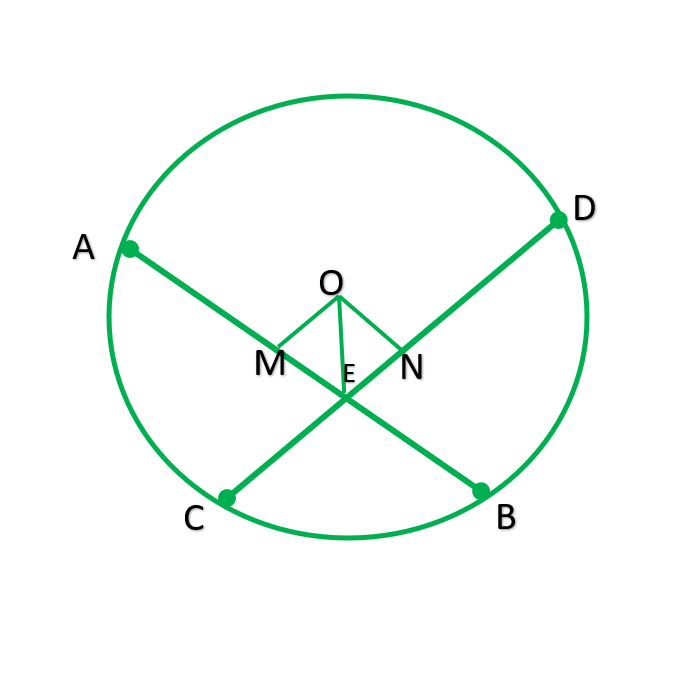
Given: Equal chord AB & CD intersect at P.
To find: AP=PD and PB=PC
Construction: Draw OM perpendicular AB ,ON perpendicular CD and join OP.
Because perpendicular from center bisect the chord
∴AM=MB=½AB also CN=ND=½CD
AM=MB=CN=ND ------------------1
Now, In ∆OMP and ∆ONP
ANGLE M=ANGLE N [90° both]
OP=OP [COMMON]
ON=OM [equal chords are equilateral from center]
∴∆OMP≅∆ONP
Therefore MP=PN (C.P.C.T.) ------------------2
i)from 1 and 2
AM+MP=ND+AN
AP=PD
ii)MB-MP=CN=PN
PB=PC
👁 Image
Solution:
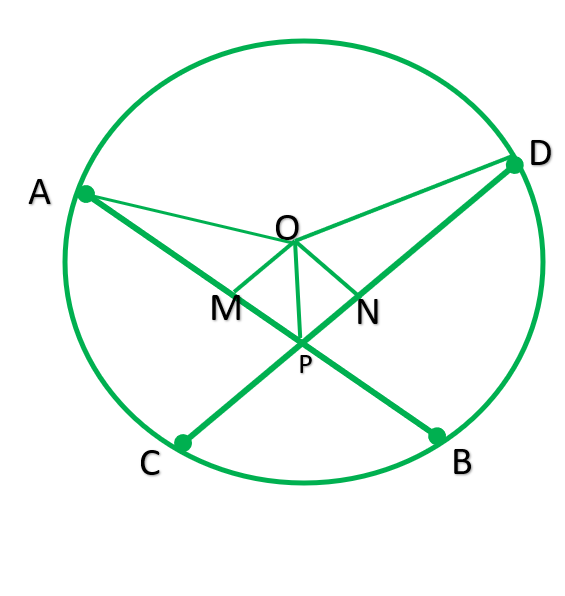
Given: Equal chords AB and CD intersect at P.
To prove: angle1=angle=2
Construction: Draw OM perpendicular AB & ON perpendicular CD.
Solution: In ∆OMP & ∆ONP
Angle M= Angel N [90 ° each]
OP=OP [common]
OM=ON ---------------[ Equal chords are equal distant from center]
∴∆OMP≅∆ONP ----------[R.H.S]
∴∠1=∠2 -----------[C.P.C.T]
👁 Image
Solution:
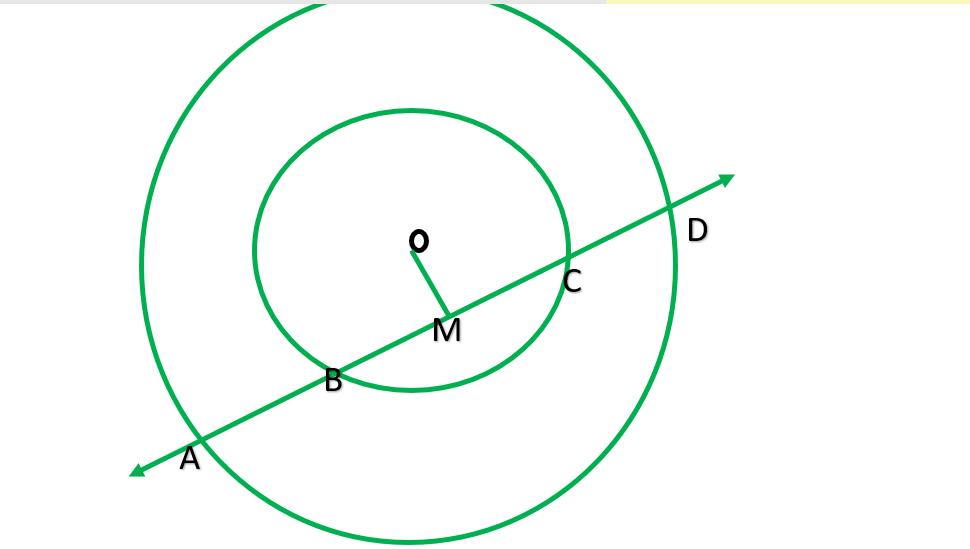
Given : two concentric circle with O. A line intersect them at A, B, C , and D
To prove: AB=CD
construction: Draw OM ⊥ AD ,In bigger circle AD is chord OM ⊥ AD.
∴AM=MD ----------------[⊥ from center of circle of a circle bisects the chord] __________ 1
The smaller circle :
BC is chord OM ⊥ BC
BM=MC -------------------[⊥ from center of circle of a circle bisects the chord] __________ 2
subtracting 1-2
AM-BM=MD-MC
AB=CD
👁 Image
Solution:
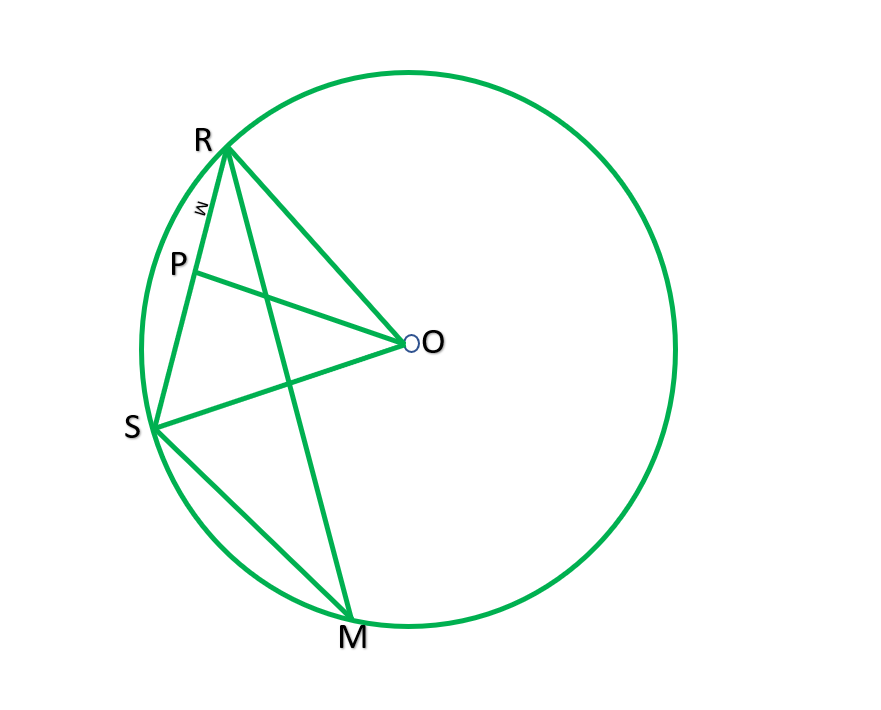
To find RM=?
Let Reshma, Salma and Mandip be R,S,M
Construction: Draw OP ⊥ RS join OR and OS.
RP=½RS ___________[⊥ from center bisects the chord]
RP=½*6=3m
In right ΔORP
OP²=OR²- PR²
OP= √ 5² -3²
=√259 =√16 =4
Area of ΔORS=½*RS*OP
=½*6*4=12m² -----------------1
Now, ∠N=90°
Area of ΔORS=½*SO*RN
=½*SO*RN -------------------2
Above ,1=2
12=½*5*RN
12/5*2=RN
RN=4.8
RM=2*RN _________________[⊥ from center bisects the chord]
=2*4.8
9.6m
👁 Image
Solution:
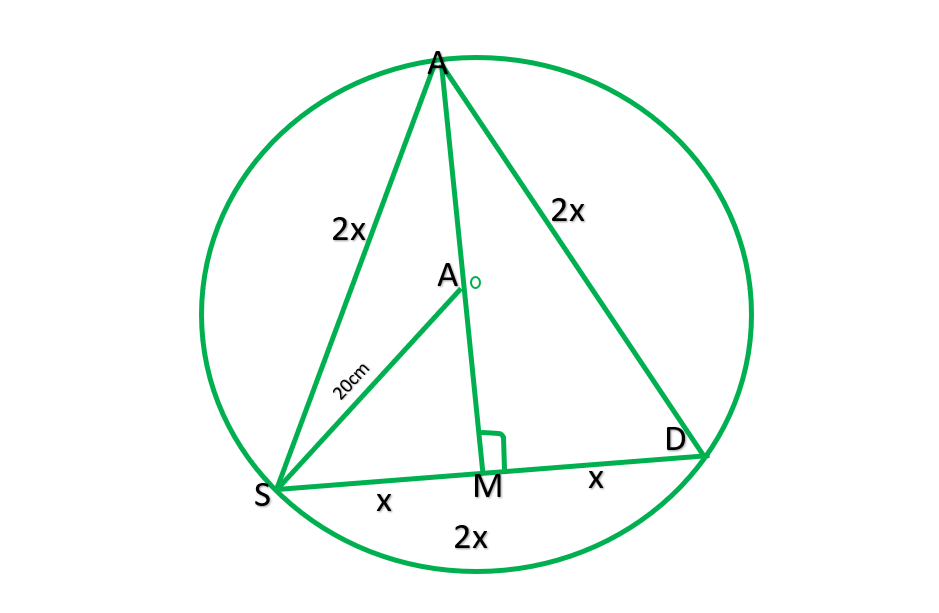
Draw AM⊥SD
AS=SD=AD
∴ASD is the equilateral Δ
Let each side of Δ-2xm
SM=2x/2=x
Now in Δ DMS, by the Pythagoras theorem
AM²+SM²=AS²
AM²= AS²- SM²
AM=√(2x²+x² )
==√(3x² )
AM =√3x
OM=AM-AO
OM=√3x-20
Now in right ΔOMS
OM²+SM²=SO²
(√3x-20)²+2x²+x²=20²
20²+400-40√3x+x^2=400
4x²=40√3x
4xx=40√3x
X=(40√3)/4
X=10√3x
Length of each string =2x
=2*10√3xm
👁 Image
Read More: