|
VOOZH | about |
|
VOOZH | about |
In Class 9 mathematics, the study of circles is a fundamental topic that forms a cornerstone of the geometric principles. Chapter 10, "Circles" in the NCERT textbook delves into the various properties and theorems related to circles. Exercise 10.5 specifically focuses on the practical applications and problem-solving related to these properties. Understanding this exercise is crucial as it reinforces key concepts of circle geometry and prepares students for the more advanced topics in mathematics.
A circle is a fundamental shape in geometry defined as the set of all points in a plane that are equidistant from the fixed point known as the center. Chapter 10 of the Class 9 NCERT textbook explores the various properties and theorems related to the circles including the tangents, chords, and angles subtended by arcs. Exercise 10.5 challenges students to apply these concepts through practical problems enhancing their problem-solving skills and understanding of the geometric principles.
Solution:
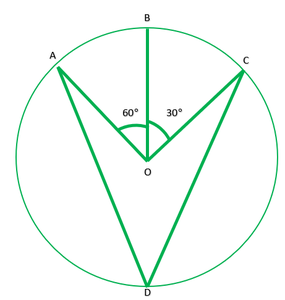
👁 ImageGiven: ∠BOC=30° and ∠AOB=60°
To find: ∠ADC
Solution: ∠AOC=2∠ADC ---------[The angle subtended by an arc at the centre is double the angle the angle subtended by it any point on the remaining part of the circle.]
∠AOB+∠BOC=2∠ADC
60°+30°=2∠ADC
90+30=2∠ADC
90/2=∠ADC
45=∠ADC
Solution:
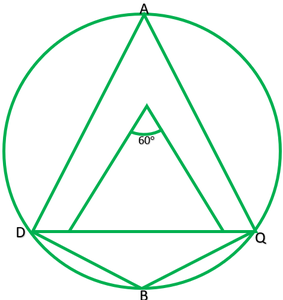
👁 ImageGiven: PQ=OP
To find: Angle on major arc is ∠A=?
Angle on the minor arc is ∠B=?
Since, =PO=OQ
∴∠POQ=60°
∠POQ=2∠PAQ [The angle subtended by an arc at the centre is double the angle subtended by it any point on the remaining point of the circle]
Reflex ∠POQ=360°-60°
Reflex ∠POQ=300°
Reflex ∠POQ=2∠POQ
300°=2∠PBQ
300°/2=∠PBQ
150°=∠PBQ
Solution:
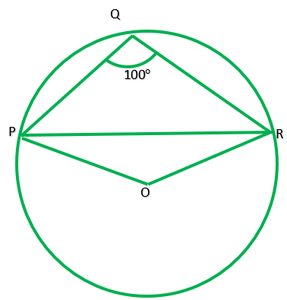
👁 ImageGiven: ∠PQR=100°
To find: ∠OPR=?
Reflex ∠POR=2∠PQR --------[ The angle subtended by an arc at the centre is double the angle subtended by it any point on the remaining point of the circle]
Reflex ∠PQR=2*100
=200°
∠POR=360°-200°
Now in ∆POR,OP=QR [ Radii of same circle]
∠P=∠R and let each =x.
∴∠P+∠O+∠R=180° [angle sum property of ∆]
x+160°+x=180°-160°
2x+160°=180°
x=20°/2=10°
∴∠OPR=10°
Solution:
👁 ImageGiven: ∠ABC=69°,∠ACB=31°
To find: ∠BDC=?
Solution: In ∆ABC
∠A+∠B+∠C=180° ---------[Angle sum property of ∆]
∠A+69°+31°=180°
∠A=180°-100°
∠A=80°
∠A and ∠D lie on the same segment therefore,
∠D=∠A
∠D=80°
∠BDC=80°
Solution:
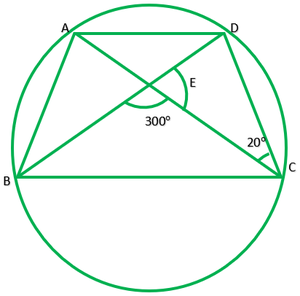
👁 ImageGiven: ∠BEC=130°,∠ECD=20°
To find: ∠BAC?
Solution: In ∆EDC
∠E=180°-130° ---------[linear pair]
∠E=50°
∠E+∠C+∠D=180° ------[angle sum property of triangle]
50°+20°+∠D=180°
70°+∠D=180°
∠D=180/70=110°
Since, ∠A and ∠D line in the same segment
∴∠A=∠D
∠A=110°
∠BAC=110°
Solution:
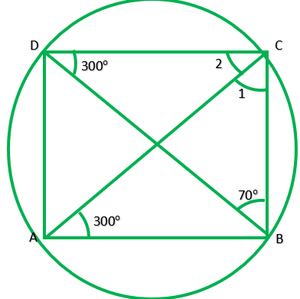
👁 ImageGiven: ABCD is a cyclic quadrilateral diagonal intersect at E ∠DBC=70°, ∠BAC is 30°. If AB=BC.
To find: ∠BCD and ∠ECD
∠BDC=∠BAC=30° -------[angle in the same segment]
In ∆BCD,
∠B+∠C+∠D=180° --------[angle sum property of triangle]
∠C+100°=180°
∠C=180°-100°=80°
∴∠BCD=80°
If AB=BC,
Then, ∠BAC=∠BCA
30°=∠BCA
Now, ∠BCA+∠ECD=∠BCD
30°+∠ECD=80°
∠ECD=80°-30°
∴∠ECD=50°
Solution:
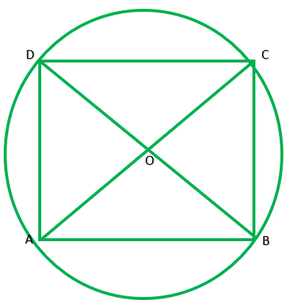
👁 ImageGiven: ABCD is a cyclic quadrilateral. Diagonals of ABCD are also diameters of circle.
To prove: ABCD is a rectangle
AC=BD ----------[diameters of same circle]
OA=OA ---------[radii of the same circle]
OA=OC=1/2AC ---------2
OB=OD=1/2BD ----------2
From I and 2 diagonals are equal and bisect each other
∴ABCD is a rectangle
Solution:
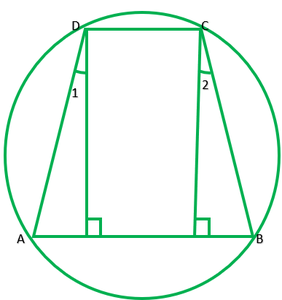
👁 ImageDraw DL perpendicular AB and EF perpendicular AB
In ∆DEA and ∆CEB
∠E=∠F --------[each 90°]
AD=BC --------[given]
DE=CF --------[distance between || lines is same every line]
∴∆DEA≅∆CFB --------[R.H.S]
∠A=∠B ---------[by c.p.c.t.] 1
∠1=∠2 (from 1)
Adding 90° on each sides
∠1+90°=∠2+90°
∠1+∠EDC=∠2+FCD
∠ADC=∠BCD
∠D=∠C 2
Now,
∠A+∠A+∠C+∠C=360°
2∠A+2∠C=360°
2(∠A+∠C)=360°
∠A+∠C=360°/2=190°
Because sum of opposite angles is 180°.
ABCD is parallelogram.
Solution:
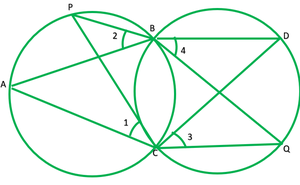
👁 ImageTo prove: ∠ACP=∠QCD or ∠1=∠2
∠1=∠2 ------ [angles in the same segment are equal] 1
∠ 3=∠ 4 ------- [angles in the same segment are equal] 2
∠2=∠4 ------- [vertically opposite angles] 3
From 1 2 and 3
∠1=∠3
∴∠ACP=∠QCB
Solution:
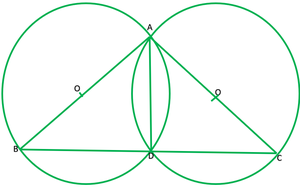
👁 ImageGiven: ABC is ∆ and AB and AC are diameters of two circles
To prove: Point of intersection is D, lies on the BC.
Construction: Join AD
∠ADB=90° -------[angles in semicircle] 1
∠ADC=90 ° ------[angles in semicircle] 2
Adding 1 and 2
∠ADB+∠ADC=90°+90°
∠BDC=180°
BDC is a straight line therefore D lies on BC.
Solution:
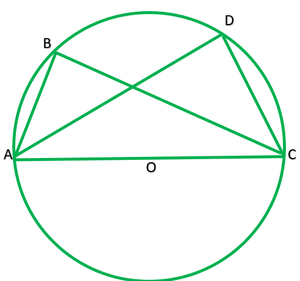
👁 ImageGiven: ABC and ADC are two right angle triangles with common hypotenuse AC.
To prove: ∠ADB=∠CBD
Solution: ∠ABC=∠ADC=90°
Circle drawn by taking AC as diameter passes through B and D.
For chord CD
∠CAD=∠CBD -------[angle in the same segment]
Solution:
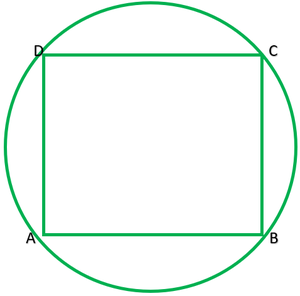
👁 ImageGiven: ABC is a cyclic ||gm
To prove: ABCD is a rectangle.
Because ABCD is a cyclic ||gm
∴∠A+∠C=180°
∠A=∠C [opposite angle of ||gm]
∴∠A=∠C=(180°)/2=90°
∠A=90°
∠C=90°
Similarly,
∠B+∠D=180°
∴∠B=∠D =(180°)/2=90° ----------[opposite of a ||gm]
Each angle of ABCD is 90°
∠B=90°
∠D=90°
Thus, ABCD is a rectangle.
Read More: