|
VOOZH | about |
|
VOOZH | about |
Chapter 12 of the Class 9 NCERT Mathematics textbook introduces Heron's Formula a vital concept in the geometry used to calculate the area of a triangle when the lengths of all three sides are known. Exercise 12.2 focuses on applying Heron's Formula to solve problems involving the different triangles. This exercise helps in understanding the practical application of the formula and enhances problem-solving skills in geometry.
Heron's Formula provides a method to calculate the area of the triangle when the lengths of its sides are known. The formula is named after the ancient Greek mathematician Hero of Alexandria. Given a triangle with sides of lengths a, b and c the area A can be calculated using the following steps:
Compute the semi-perimeter
Apply Heron's Formula to find the area
where s is the semi-perimeter of the triangle and a, b and c are the lengths of the sides. This formula is useful for the calculating the area of the triangle when the height is not known but the side lengths are provided.
Solution:
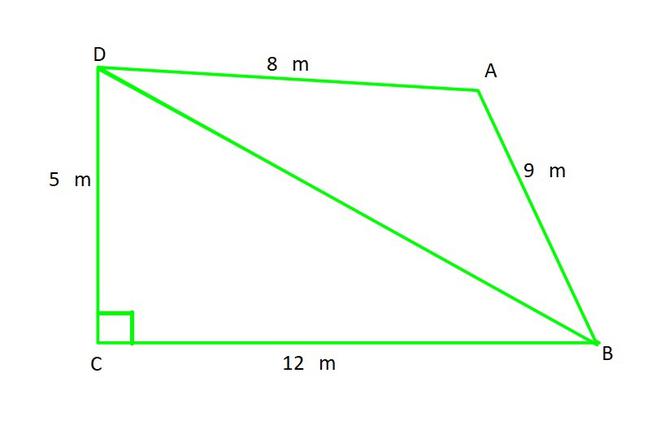
Given, a quadrilateral ABCD where ∠C = 90º.
Construction: Join diagonal BD.
👁 ImageAs we can see that, △DCB is right-angled at C
Hence, BC is the base and CD is height of △DCB, so
ar(△DCB) = × Base × Height
= × 12 × 5
= 30 m2..........................................(1)
As △DCB is right angle triangle we can calculate third side by Pythagoras theorem
BD2 = CB2 + CD2
BD2 = 122 + 52
BD = √(144+25)
BD = √169
BD =13 m
Now, Area of △DAB can be calculated by Heron's Formula, where
AB = a = 9 m
AD = b = 8 m
BD = c = 13 m
Semi Perimeter (s) =
s =
s = 15 m
ar(△DAB) = √s(s-a)(s-b)(s-c)
= √15(15-9)(15-8)(15-13)
= √15×(6)×(7)×(2)
= 6√35 m2............................................(2)
From (1) and (2), we can conclude that,
ar(ABCD) = ar(△DCB)+ar(△DAB)
= (30 + 6√35)
= (30 + 35.5)
≈ 65.5 m2 (approx.)
Solution:
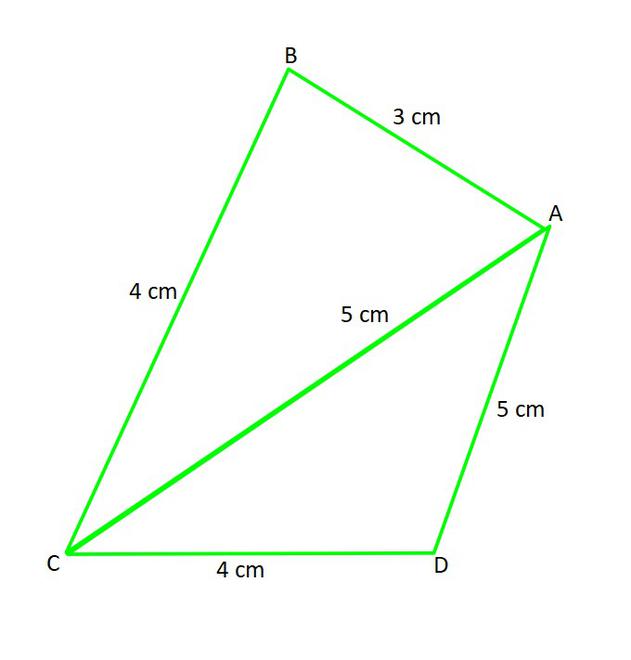
👁 ImageHere, we can notice that in △ABC
AC2 = AB2 + BC2
52 = 32 + 42
25 = 25
LHS = RHS
As this triangle is satisfying the Pythagoras theorem, Therefore, △ABC is a right angle triangle, 90° at B.
Hence, BC is the base and AB is height of △ABC. so
So, ar(△ABC) = × Base × Height
= × 4 × 3
= 6 cm2.....................................(1)
Now, Area of △DAC can be calculated by Heron's Formula, where
AD = a = 5 cm
DC = b = 4 cm
AC = c = 5 cm
Semi Perimeter (s) =
s =
s = 7 cm
ar(△DAC) = √s(s-a)(s-b)(s-c)
= √7(7-5)(7-4)(7-5)
= √7×(2)×(3)×(2)
= 2√21 cm2............................................(2)
From (1) and (2), we can conclude that,
ar(ABCD) = ar(△ABC)+ar(△DAC)
= (6 + 2√21)
= (6 + 9.2(approx.))
≈ 15.2 cm2 (approx.)
Solution:
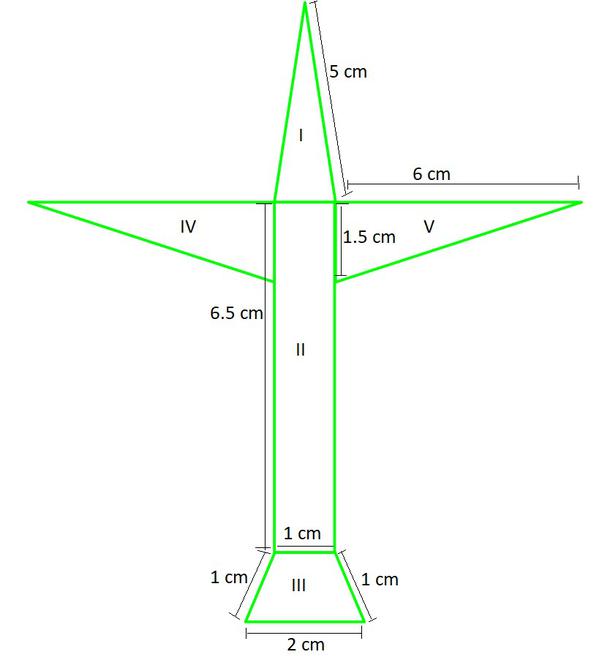
Total area of the paper used = (Area I + Area II + Area III + Area IV + Area V)
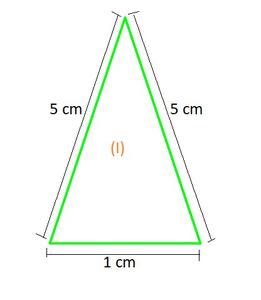
👁 ImageNow, Area of triangle can be calculated by Heron's Formula, where
a = 5 cm
b = 5 cm
c = 1 cm
Semi Perimeter (s) =
s =
s = 5.5 cm
ar(△) = √s(s-a)(s-b)(s-c)
= √5.5(5.5-5)(5.5-5)(5.5-1)
= √5.5×(0.5)×(0.5)×(4.5)
= 0.5×0.5×3√11
= 0.75√11
≈ 2.5 cm2 ............................................(1)
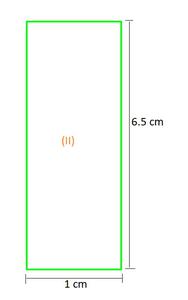
👁 ImageArea of Rectangle = length×Breadth
= 1 × 6.5 = 6.5 cm2.....................................(2)
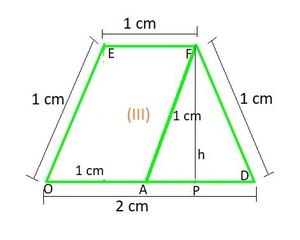
= Area of parallelogram EFAO + △ AFD
👁 ImageOD = 2cm
AD = OD-OA = 2-1 = 1 cm
Hence, △ AFD is equilateral.
PD = AD = cm
△ PFD is right angled at P, Pythagoras theorem is applicable
12=h2 +()2
h = √(1-)
h = √ cm
Area III:
= (Base × Height) + ( × Base × Height)
= (1 × ) + ( × 1 × )
=
= = 1.29 cm2.......................................(3)
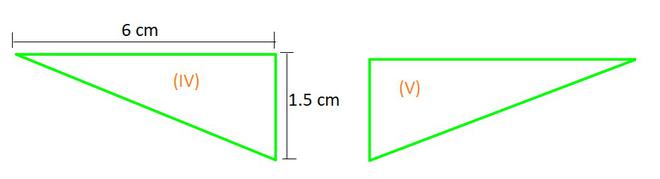
👁 Imagear(△) = × Base × Height
= × 6 × 1.5
= 4.5 cm2
Area IV + Area V = 2×ar(△)
= 2×4.5
= 9 cm2 .......................................(4)
Hence, Total area of the paper used = (Area I + Area II + Area III + Area IV + Area V)
= (1) + (2) + (3) + (4)
= 2.5 + 6.5 + 1.29 +9
= 19.29 cm2
Solution:
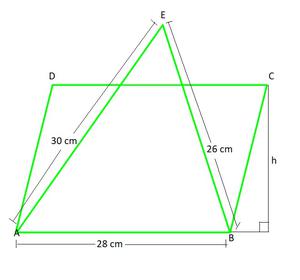
👁 ImageNow, Area of △AEB can be calculated by Heron's Formula, where
AE = a = 28 cm
EB = b = 30 cm
AB = c = 26 cm
Semi Perimeter (s) =
s = (28+30+26)/2
s = 42 cm
ar(△AEB) = √s(s-a)(s-b)(s-c)
= √42(42-28)(42-30)(42-26)
= √42×(14)×(12)×(16)
= 336 cm2
As it is given, ar(△AEB) = ar(parallelogram ABCD)
336 = Base × Height
336 = 28 × h
h =
h = 12 cm
Hence, the height of the parallelogram = 12 cm
Solution:
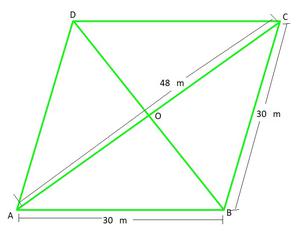
ABCD is a rhombus having diagonal AC = 48 cm
side AB=BC=CD=AD=30 cm
Diagonal of Rhombus divides the area into two equal parts.
👁 ImageNow, ar(△ABC) can be calculated by Heron's Formula, where
AB = a = 30 m
BC = b = 30 m
AC = c = 48 m
Semi Perimeter (s) =
s =
s = 54 m
ar(△ABC) = √s(s-a)(s-b)(s-c)
= √54(54-30)(54-30)(54-48)
= √54×(24)×(24)×(6)
= 432 m2
Hence, Area of rhombus = 2 × (ar(△))
= 2 × 432 = 864 m2
Area for 18 cows = 864 m2
Area for each cow = 864 / 18 = 48 m2
Solution:
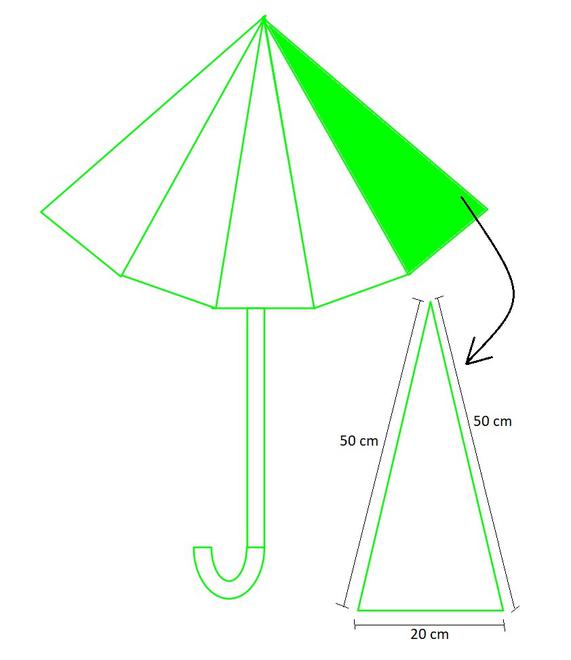
Let's consider for each triangle.
👁 ImageNow, for each ar(△)can be calculated by Heron's Formula, where
a = 50 cm
b = 50 cm
c = 20 cm
Semi Perimeter (s) =
s =
s = 60 cm
ar(△) = √s(s-a)(s-b)(s-c)
= √60(60-50)(60-50)(60-20)
= √60×(10)×(10)×(40)
= 200√6 cm2
Hence, the Total Area = 5×200√6
= 1000√6 cm2
Solution:
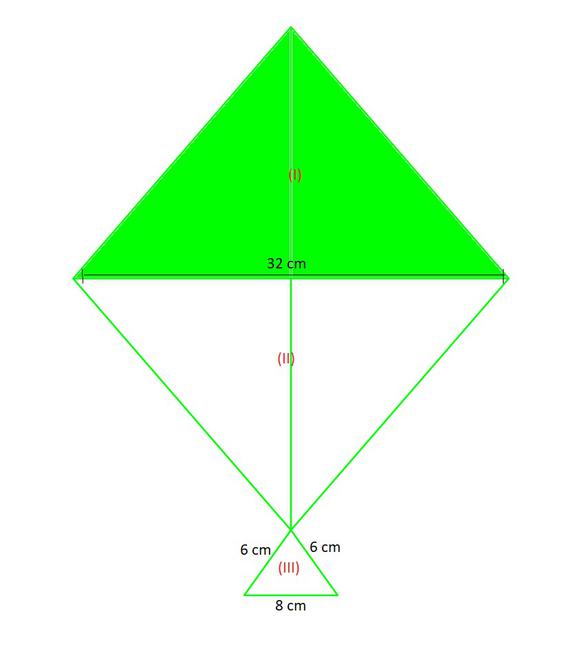
👁 ImageAs the area of kite is in the square, it area will be
Area of kite = ×(diagonal)2
= ×32×32
= 512 cm2
Diagonal divides area into equal areas.
512 = 2 × Area I
Area I =Area II = 256 cm2...................................(1)
Now, for each ar(△)can be calculated by Heron's Formula, where
a = 6 cm
b = 6 cm
c = 8 cm
Semi Perimeter (s) =
s =
s = 10 cm
ar(△) = √s(s-a)(s-b)(s-c)
= √10(10-6)(10-6)(10-8)
= √10×(4)×(4)×(2)
= 8√5 cm2....................................(2)
Solution:
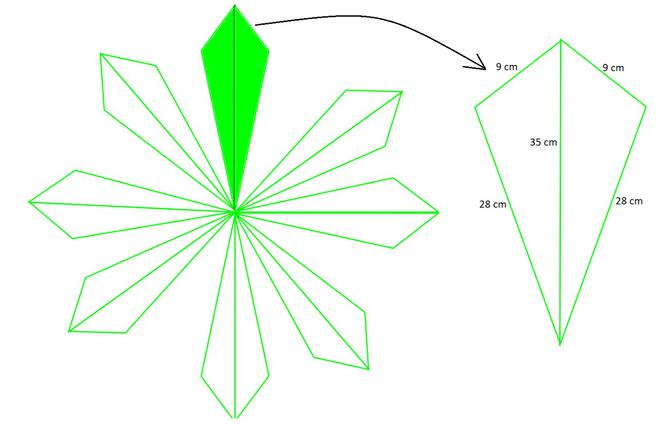
👁 ImageArea for each triangle will be:
Now, for each ar(△)can be calculated by Heron's Formula, where
a = 9 cm
b = 28 cm
c = 35 cm
Semi Perimeter (s) =
s =
s = 36 cm
ar(△) = √s(s-a)(s-b)(s-c)
= √36(36-9)(36-28)(36-35)
= √36×(27)×(8)×(1)
= 36√6 cm2
As there are 16 tiles, so total area = 16 × 36√6
= 1410.906 cm2
As 1 cm2 = 50 p = ₹ 0.5
1410.906 cm2 = ₹ 0.5 ×1410.906
= ₹ 705.45
Solution:
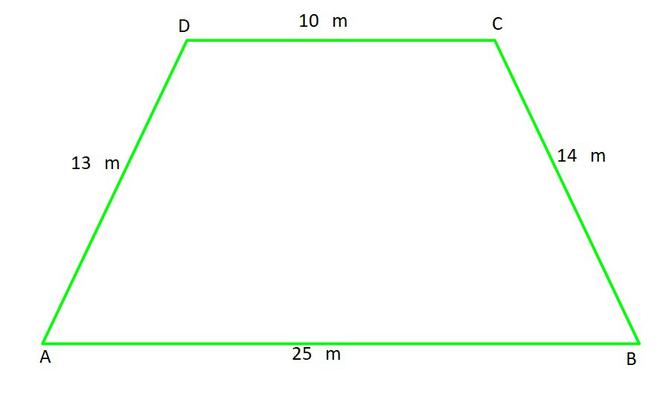
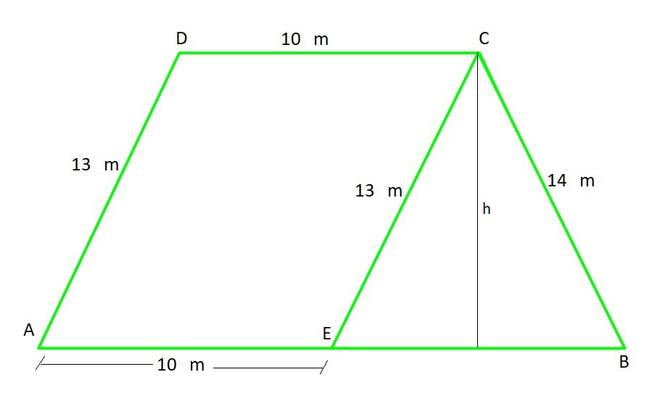
👁 ImageAB = 25 m
EB = AB-AE = 25-10 = 15 m
Now, for ar(△ECB) can be calculated by Heron's Formula, where
a = 13 m
b = 14 m
c = 15 m
Semi Perimeter (s) =
s =
s = 21 m
ar(△ECB) = √s(s-a)(s-b)(s-c)
= √21(21-3)(21-14)(21-15)
= √21×(18)×(7)×(6)
= 84 m2 ...............................(1)
ar(△ECB) = × Base × Height
84 m2= × 15 × h
h = m
h = 11.2 m
Total Area = Area of parallelogram AECD + ar(△ECB)
= (Base × Height) + 84m2
= 10 × 11.2 + 84
Total Area = 196 m2
The Heron's Formula is a powerful tool for the calculating the area of the triangle using the only the lengths of its sides. Exercise 12.2 in Chapter 12 of the Class 9 NCERT textbook helps students practice this formula and apply it to solve the various geometric problems. Mastery of Heron's Formula enhances understanding of the triangle properties and improves overall problem-solving abilities in geometry.