|
VOOZH | about |
|
VOOZH | about |
In Chapter 7 of the Class 9 NCERT textbook, you will explore the properties and theorems related to the triangles. Exercise 7.2 focuses on proving congruence in the triangles using the various congruence rules. Understanding the fundamentals of triangles is essential for solving problems related to geometry. Let's begin by discussing what a triangle is and the key concepts involved in this chapter.
A triangle is a three-sided polygon with three vertices and three edges. It is one of the basic shapes in geometry. The sum of the interior angles of the triangle is always 180°. Based on the sides and angles triangles can be classified into different types such as:
Solution:
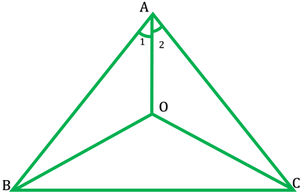
👁 ImageGiven: (i) An isosceles ∆ABC in which AB=AC
(ii) bisects of ∠B and ∠C each other at O.
Show: (i) OB=OC
(ii) AO bisects ∠A (∠1=∠2)
(i) In ∆ABC,
AB = AC
∠B =∠C [angles opposite to equal sides are equal]
1/2 ∠B = 1/2∠C
∠OBC=∠OCB
∴OB = OC [sides opposite equal ∠ are equal]
(ii) In ∆AOB and ADC
AB = AC [given side]
1/2 ∠B = 1/2∠C
∠ABO = ∠ACO [Angle]
BO = OC [proved above side]
∴∆AOB ≅ AOC
Thus ∠1 = ∠2
Therefore, AO bisects ∠A
Solution:
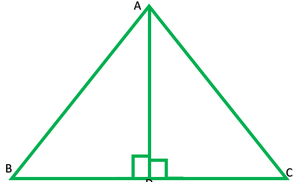
Given: AD is ⊥ bisector of BC
Show: AB=BC
In ∆ABD and ∆ACD
BD=DC [AD is ⊥ bisector side]
∠ADB=∠ADC [Each 90° angle]
AD=AD [common side]
∴∆ABD≅∆ACD [S.A.S]
AB=AC [C.P.C.T]
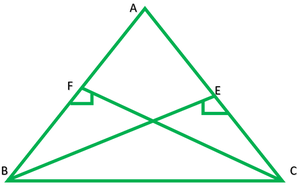
Question 3. ABC is an isosceles triangle in which altitudes BE and CF are drawn to equal sides AC and AB respectively (see Fig.). Show that these altitudes are equal.
👁 ImageSolution:
Given: AB=AC,BE and CF are altitudes
Show: BE=CF
In ∆AEB and ∆AFC,
∠E=∠F [Each 90° angle]
∠A=∠A [common angle]
AB=AC [given side]
∴∆AEB≅∆AFC [A.A.S]
BE=CF [C.P.C.T]
Solution:
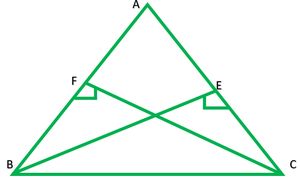
Given: Altitudes BE and CF to sides AC and AB are equal
Show: (i) ΔABE ≅ ΔACF
(ii) AB = AC
(i) In ∆ABF and ∆ACF,
∠E=∠F [Each 90° angle]
∠A=∠A [common angle]
AB=AC [given] S
∴∆AEB≅∆AFC [A.A.S]
(ii) AB=AC [C.P.C.T]
Solution:
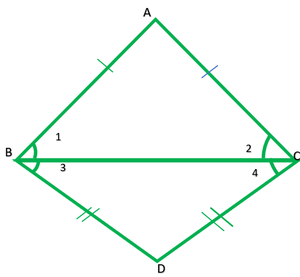
Given: AB=AC,BD=DC
Show: ∠ABD = ∠ACD
In ∆ABD,
AD=AC
∴∠1=∠2 [angle opposite to equal sides are equal] [1]
In ∆BDC,
BD=DC
∴∠3=∠4 [angle opposite to equal sides are equal] [2]
Adding 1 and 2
∠1+∠2= ∠2+∠4
∠ABD=∠ACD
Solution:
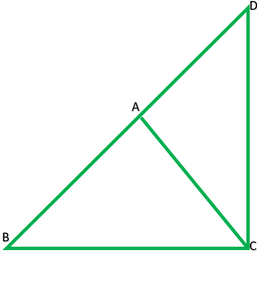
In ∆ABC,
AB=AC
∠ACB=∠ABC [1]
In ∆ACD,
AC=AD
∠ACD=∠ADC [2]
Adding 1 and 2
∠ACB+∠ACD=∠ABC+∠ADC
∠BCD=∠ABC+∠BDC
Adding ∠BCD on both side
∠BCD+∠BCD=∠ABC+∠BDC+∠BCD
2∠BCD=180°
∠BCD=(180°)/2=90°
Solution:
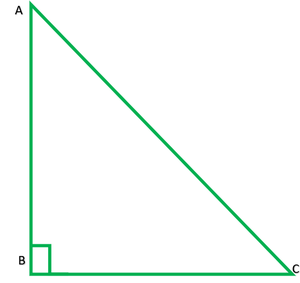
👁 ImageFind: ∠B=? and ∠C?
In ∆ABC,
AB=AC
∴∠B=∠C [angle opposite to equal side are equal]
∠A+∠B+∠C=180° [angle sum property of triangle]
90°+∠B+∠B=180°
2∠B=180°-90°
∠B=(90°)/2=45°
Therefore, ∠B=45° and ∠C =45°
Solution:
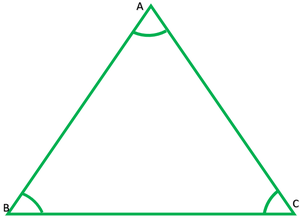
👁 ImageGiven: Let ∆ABC is an equilateral ∆
Show: ∠A=∠B=∠C=60°
In ∆ABC,
AB=AC
∠B=∠C [1]
Also
AC=BC
∠B=∠A [2]
From 1,2 and 2
∠A=∠B=∠C
In ∆ABC,
∠A+∠B+∠C=180° [angle sum property of triangle]
∠A+∠A+∠A=180°
3∠A=180°
∠A=(180°)/3=60°
∠A=60°
∴∠B=60° and ∠C=60°
Exercise 7.2 in Chapter 7 provides an opportunity to apply congruence rules such as the SAS, ASA and SSS to prove the equality of the triangles. These rules are essential tools in geometry for the establishing the relationship between the triangles and their properties. By mastering these concepts students can strengthen their understanding of the geometric principles.