|
VOOZH | about |
|
VOOZH | about |
Solution:
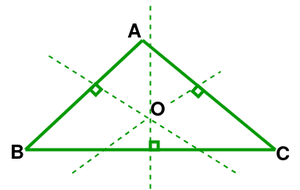
👁 ImageTo obtain a point which is equidistant from all vertices of a triangle we construct perpendicular bisectors of all sides (AB, BC, CA) of the triangle (ΔABC). The point of intersection of these bisectors is known as Circumcenter(O) which is equidistant from all vertices.
Solution:
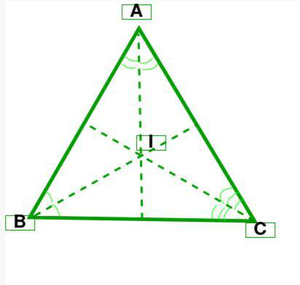
👁 ImageTo obtain a point which is equidistant from all sides of a triangle we construct angle bisectors of all angles present in ΔABC i.e ∠BAC, ∠ABC, ∠ACB. The point of intersection of these bisectors is called Incentre(I) which is equidistant from all sides.
Solution:
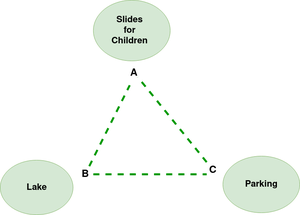
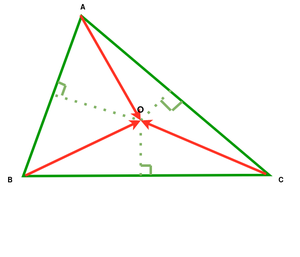
👁 ImageThe ice-cream parlour must be set somewhere so that it's easily available for the public. So for such point it should be at a equal distance from point A, B, C & such point is termed as circumcenter.
Solution:
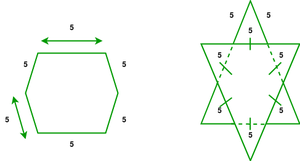
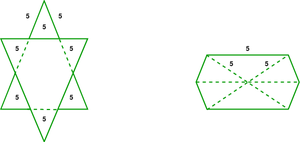
👁 ImageWe need to find the number of triangles that can get fit the above figures i.e the hexagon and the star.
So,
Area of hexagon = (Area of small triangle inside hexagon) * 6
Area of small equilateral triangle = √3/4 * a2
= √3/4 * 52
= √3/4 * 25 = 25√3/4
So,
Area of hexagon = 25√3/4 * 6
= 150√3/4 cm2
Area of Star = Area of 6 triangles and 1 hexagon
= 6 * 25√3/4 + 150√3/4
= 300√3/4 cm2
Area of triangles of 1cm side that are to be fitted = √3/4 * 12
= √3/4 cm2
Number of triangles that can be accommodated inside hexagon and stars :
a. For Hexagon : Area of hexagon/ Area of 1cm side triangle
= 150√3/4 cm2 / √3/4 cm2
= 150 triangles
b. For Star : Area of star/ Area of 1cm triangle
= 300√3/4 cm2 / √3/4 cm2
= 300 triangles
Hence, the star can accommodate 150 more triangles than the hexagon.