|
VOOZH | about |
|
VOOZH | about |
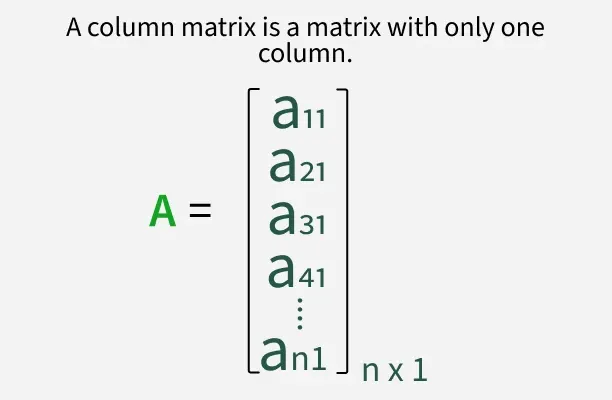
A column matrix is defined as a matrix that has only one column and any number of rows.
Below is the visual representation of the column matrix:
Some important properties of a column matrix are given below,
Different algebraic operations, such as addition, subtraction, and multiplication, can be performed on column matrices, but division cannot be performed because its inverse does not exist.
Any two-column matrices can be added if the order of both matrices is the same. If the orders of both matrices are the same, then the corresponding entries are added.
Any two-column matrices can be subtracted if the order of both matrices is the same. If the orders of both matrices are the same, then the corresponding entries are subtracted.
The multiplication of a column matrix is possible only with a row matrix if and only if the number of rows in the column matrix is equal to the number of columns in the given row matrix. A square matrix is obtained when a column matrix and a row matrix are multiplied.
We can see that the resultant matrix is a square matrix of order "3 × 3."
The common difference between row and column matrices is listed in the following table:
| Column Matrix | Row Matrix |
|---|---|
| A matrix with only one column. | A matrix with only one row. |
| Written vertically. | Written horizontally. |
| The number of elements in a column is the number of rows in the matrix. | The number of elements in a row is the number of columns in the matrix. |
| Dimension is m × 1, where m is the number of rows. | Dimension is 1 × n, where n is the number of columns. |
| Representing vectors or sets of data in linear algebra. | Representing a set of data points or coefficients in linear equations. |
Example 1: Find the value of Q − 2P, if
Solution:
Example 2: Prove that the transpose of a column matrix is a row matrix.
Solution:
Let us consider an example, to prove that the transpose of a column matrix is a row matrix.
The above matrix is a column matrix of order "3 × 1." We know that the transpose of a matrix is obtained by interchanging the entries of rows and columns. So, the order of the transpose of the given matrix will be "1 × 3."
We can see that the resultant matrix is a row matrix.
Hence proved.
Example 3: Find the product of the matrices given below.
Solution:
Example 4: Find the value of M − N, if
Solution: