|
VOOZH | about |
|
VOOZH | about |
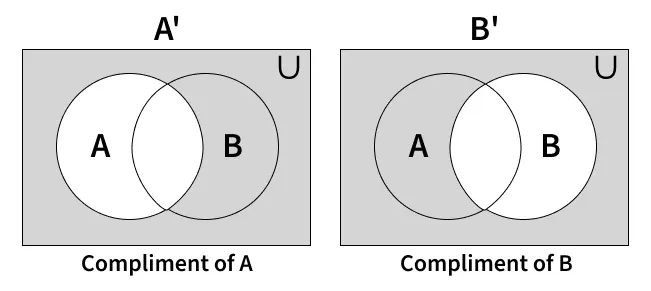
The complement of a set is the set that consists of all the elements from the universal set that are not already included in the given set. In other words, the difference between the universal set and the given set represents the complement of that set.
The complement of a set A is mathematically expressed as:
A' = {x ∈ U and x ∉ A}
Where x denotes the elements in Universal Set, U but not in A.
The complement of a set is simply found by excluding the elements of the given set from the universal set.
Example: Find the complement of set S = {4, 8, 12, 16}, where the universal set is all multiples of 4 that are smaller than 50.
Solution:
Step 1: Identify the universal set (U) and the set (S) for which you want to find the complement.
Universal Set(U) = {4, 8, 12, 16, 20, 24, 28, 32, 36, 40, 44, 48}Also, given: S = {4, 8, 12, 16}
Step 2: Calculate the complement of set S by excluding the elements of S from the universal set U i.e., S' = U - S.
S' = U - S = {4, 8, 12, 16, 20, 24, 28, 32, 36, 40, 44, 48} - {4, 8, 12, 16}Step 3: Simplify the resulting set to obtain the complement.
Thus, S' = {20, 24, 28, 32, 36, 40, 44, 48}
There are various properties of the Complement of a Set; some of these properties are discussed as follows:
Example: If U = {10, 11, 12, 13, 14} and S = {10, 11, 12}; then S' = {13, 14}.
Example: If U = {10, 11, 12, 13, 14} and S = {10, 11, 12}; then S' = {13, 14}.
Now, S ∩ S’ = {10, 11, 12} ∩ {13, 14} = ∅.
Example: If U = {10, 11, 12, 13, 14} and S = {10, 11, 12}; then S' = {13, 14}.
The complement of S' = U - S' = {10, 11, 12} = set S.
Example: If U = {10, 11, 12, 13, 14}; then U' = ∅ and ∅' = U.
Example: If U = {10, 11, 12, 13, 14} and S = {13, 14} and T = {10, 11}.
Now, S ∪ T = {10, 11, 13, 14} and (S ∪ T)' = {12}.
Thus, S’ ∩ T’ = {10, 11, 12} ∩ {12, 13, 14} = {12} = (S ∪ T)'.
Example: If U = {10, 11, 12, 13, 14} and S = {13, 14} and T = {10, 11}.
Now, S ∩ T = ∅ and (S ∩ T)’ = {10, 11, 12, 13, 14}.
Thus, S’ ∪ T’ = {10, 11, 12} ∪ {12, 13, 14} = {10, 11, 12, 13, 14} = S’ ∪ T’.
Learn various Practice Questions on Complement of a Set.
Question 1. If D = { x | x is a multiple of 10, x ∈ N }, find D'.
Solution:
Given: the universal set U = set of all natural numbers = N = {1, 2, 3, 4, 5, 6,....}
Also it is given that: D = { x | x is a multiple of 10, x ∈ N }
⇒ D = {10, 20, 30, 40, 50, 60,....}
⇒ D' = U - DD' = {1, 2, 3, 4, 5, 6, 7, 8, 9, 11, 12,...19, 21, 22,..., 29, 31,.....}.
Question 2. If S and T are any two sets, prove that S' – T' = T – S.
Solution:
S' – T' = T – S is only possible when S' – T' ⊆ S – T.
Let x ∈ S' – T'
⇒ x ∈ S' and x ∉ T'
⇒ x ∉ S and x ∈ T (since, S ∩ S' = ϕ )
⇒ x ∈ S – TThe above result would be true for all x ∈ S' – T'
∴ S' – T' = T – S
Question 3. How many elements are there in the complement of the set of all vowels in the English alphabet?
Solution:
The English alphabet consists of 26 alphabets of which 5 are vowels and 21 are consonants. The difference between the universal set(U) and the set of vowels(say, V) is the complement of the set of all vowels.
Now, n(U) = 26 and n(V) = 5.
Thus, n(V') = n(U) - n(V)
⇒ n(V') = 26 - 5
⇒ n(V') = 21
Question 4. If P and Q are two sets, then prove P ∩ (P' ∪ Q') = P ∩ Q.
Solution:
LHS = P ∩ (P' ∪ Q')
Let us expand the LHS to get: (P ∩ P’) ∪ (P ∩ Q)Since, P ∩ P’ = ϕ; our LHS becomes:
LHS = ϕ ∪ (P ∩ Q)
⇒ LHS = P ∩ Q
Thus, LHS = RHSHence Proved.
Question 5. If U = {12, 13, 15, 17, 19} and S = {13, 17}, T = {12, 15, 17, 19}, then prove that (S ∪ T)' = S' ∩ T'.
Solution:
LHS = (S ∪ T)'. Let us first find S ∪ T.
S ∪ T = {12, 13, 15, 17, 19} = U
⇒ (S ∪ T)' = U – (S ∪ T) = U – U = ϕ.So, LHS = ϕ.
RHS = S' ∩ T'
S' = U – S = {12, 15, 19}
and T' = U – T = {13}
⇒ S' ∩ T' = {12, 15, 19} ∩ {13} = ϕ
So, RHS = ϕ
Thus, LHS = RHSHence Proved.
Question 6. If X and Y are two sets, prove that: X – (X – Y) = X ∩ Y.
Solution:
According to the De Morgan's Laws, (A ∪ B)’ = A’ ∩ B’ and (A ∩ B) ‘ = A’ ∪ B’.
LHS = X – (X – Y)
⇒ LHS = X ∩ (X – Y)'
⇒ LHS = X ∩ (X ∩ Y')'
⇒ LHS = X ∩ (X' ∪ Y')') ((Y')' = Y)
⇒ LHS = X ∩ (X' ∪ Y)
⇒ LHS = (X ∩ X') ∪ (X ∩ Y)
⇒ LHS = ϕ ∪ (X ∩ Y)
⇒ LHS = (X ∩ Y) [As ϕ ∪ A = A]But, RHS = (X ∩ Y)
∴ LHS = RHSHence Proved.
Question 1: Let A = {1, 2, 3, 4, 5} and the universal set U = {1, 2, 3, 4, 5, 6, 7, 8, 9, 10}. Find the complement of A, i.e., A'.
Question 2: If M = {a, b, c, d} and N = {c, d, e, f}, prove that: (M ∪ N)' = M' ∩ N'.
Question 3: The universal set U consists of all positive integers less than or equal to 20. If A = {2, 4, 6, 8, 10} and B = {1, 2, 3, 4, 5, 6}, find the complement of A ∩ B.
Question 4: If X = {3, 5, 7, 9}, Y = {1, 3, 5, 7}, and the universal set U = {1, 2, 3, 4, 5, 6, 7, 8, 9, 10}, find X' – Y.
Question 5: Let U = {10, 20, 30, 40, 50}, P = {20, 40}, and Q = {30, 50}. Find (P ∪ Q)'.
Question 6: If A = {2, 4, 6, 8, 10} and B = {1, 2, 3, 4, 5, 6}, find the number of elements in the complement of the union of A and B, i.e., (A ∪ B)'.
Question 7: If X = {a, b, c} and Y = {b, c, d}, and the universal set U = {a, b, c, d, e}, find the complement of (X ∩ Y).
Question 8: Prove that: (X ∩ Y)' = X' ∪ Y'
Question 9: If A = {1, 3, 5, 7, 9}, B = {2, 4, 6, 8, 10}, and the universal set U = {1, 2, 3, 4, 5, 6, 7, 8, 9, 10}, find A' ∩ B'.
Question 10: If the universal set U = {1, 2, 3, 4, 5, 6}, and A = {2, 3, 4}, find the number of elements in A' and B = {1, 5, 6}.