|
VOOZH | about |
|
VOOZH | about |
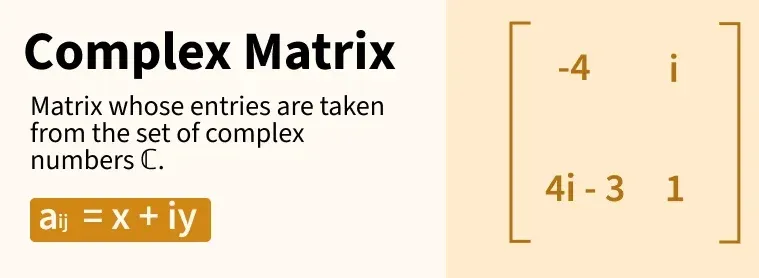
A complex matrix is made up of complex numbers in the form x + iy, where i = √-1.
A complex matrix A∈ Cm×n has entries aij = Real(aij) + i⋅Imaginary(aij)
A complex matrix is a fundamental tool in various fields, including computer science, engineering, physics, etc. We will delve more into the complex matrices, operations, properties, and special classes of complex matrices here.
Addition and subtraction is done element-wise in complex matrices.
Example:
Solution:
A + B =
Scalar multiplication is done by multiplying each entry by a complex scalar.
Example:
For A ∈ Cm×p, B∈Cp×n, the product C = AB has entries: cij= ∑i = 1 to k aikbkj.
Example:
Denoted as
The complex conjugate of a complex number is the number with an equal real part and an imaginary part equal in magnitude but opposite in sign.
The complex conjugate of a+bi is a-bi. Taking the conjugate of all the terms in a complex matrix we will get the complex conjugate of that matrix.
Example:
Denoted as A∗ or AH.
i
The transpose of a the complex conjugate is called the conjugate transpose.
Example:
Let A and B be complex matrices, and let λ be a complex number.
A Hermitian matrix (or self-adjoint matrix) is a complex square matrix that is equal to its own conjugate transpose.
H* = H
where is the conjugate transpose. This implies:
Example:
An invertible complex square matrix U is unitary if its matrix inverse U−1 equals its conjugate transpose U*.
U-1 = U*
Equivalently, U*U = UU* = In
Example:
Complex matrices have applications in many fields, especially in computer science. Some of their applications include:
H = 1/√2 [[1, 1], [1, -1]] but in complex space)H = [[a+bi, c+di], [e+fi, g+hi]]