|
VOOZH | about |
|
VOOZH | about |
A function is continuous at a point if there is no sudden jump, break, or hole at that point.
👁 functionFor example, think of driving a car along a road. If the road is smooth and you don’t have to stop or make sharp turns, that’s like a function being continuous. But if there’s a gap in the road or a sudden bump, it’s like a break in the function, meaning it's not continuous at that point.
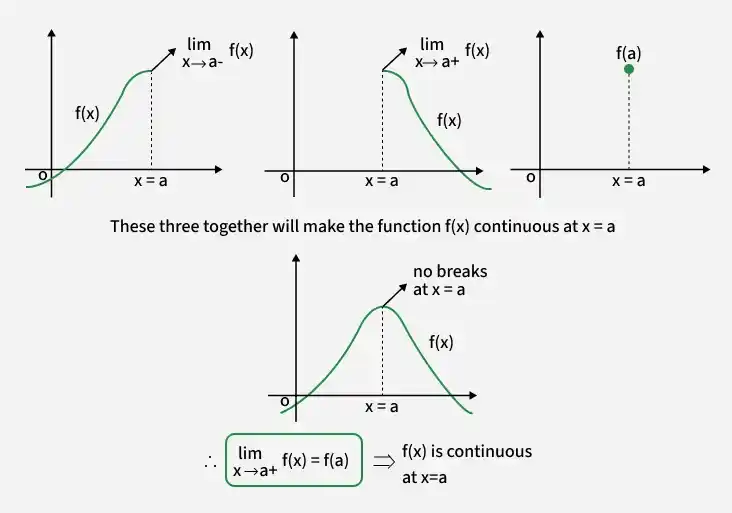
A function f(x) is said to be continuous at a point x = c if the following three conditions are satisfied:
- f(c) is defined: The function must have a value at x = c.
- The left-hand limit and right-hand limit must both exist and be equal, i.e.,
- The limit of the function as x approaches a must equal the actual value of the function at a, i.e.,.
If any of the above conditions fail, the function is said to be discontinuous at c.
Example: f(x) = x2. To check the continuity at x = 2:
- f(2) = 4, so the function is defined at x = 2.
- , so the limit exists.
- , so the limit equals the function value.
Since all three conditions are satisfied, f(x) = x2 is continuous at x = 2.
Here are the steps to determine the continuity of a function at a point x = c:
1. Check if the function is defined at x = c.
Find the value of the function at x = c, i.e., f(c).
If f(c) exists (i.e., it is finite), proceed to the next step.
If f(c) does not exist, the function is not continuous at x = c.
2. Check if the limit exists as x approaches c.
Compute the left-hand and the right-hand limit .
If both limits exist and are equal, proceed to the next step.
If the limits do not exist or are not equal, the function is not continuous at x = c.
3. Verify if the limit equals the function value at x = c.
Check if .
If they are equal, the function is continuous at x = c.
If they are not equal, the function is not continuous at x = c.
If all three steps are satisfied, the function is continuous at x = c.
A function f(x) is not continuous at x=a if any one of the following conditions fails:
Example 1: Determine if the function f(x) = 2x + 3 is continuous at x = 1.
For a function to be continuous at x = 1, we need to check three conditions:
- f(1) exists.
- exists.
Check if f(1) exists:
f(1) = 2(1) + 3 = 5.Find :
\lim_{{x \to 1}} (2x + 3) = 2(1) + 3 = 5.Compare the limit and the function value:
Since , the function is continuous at x = 1.Thus, f(x) = 2x + 3 is continuous at x = 1.
Example 2: Check if the function is continuous at x = 1.
Check if g(1) exists:
, which is indeterminate and hence undefined.Find :
for x ≠ 1.Now, .
Since g(1) is undefined but , the function is not continuous at x = 1.
Example 3: Is the function h(x) = |x| continuous at x = 0?
Check if h(0) exists:
h(0) = |0| = 0.Find :
For x > 0, h(x) = x, and for x < 0, h(x) = -x.So, , and .
Since both the left-hand and right-hand limits are equal, \lim_{{x \to 0}} h(x) = 0.
, so h(x) = |x| is continuous at x = 0.
Example 4: Determine if the function is continuous at x = 2.
Check if f(2) exists: f(2) = 4.
Find :
, and
.Since both the left-hand and right-hand limits are equal, .
, so the function is continuous at x = 2.
Question 1: Check whether the function is continuous at x = 3.
Question 2: Determine if the following piecewise function is continuous at x = 1:
Question 3: Is the function g(x) = sin(x) continuous at x = π/2?
Question 4: Check the continuity of at x = 2.
Question 5: Determine if the function is continuous at x = 2.
Question 6: Is the absolute value function f(x) = |x - 3| continuous at x = 3?
Question 7: Determine if the function f(x) = ex is continuous at x = 0.
Question 8: Check the continuity of the following piecewise function at x = 0:
Answer Key
- No, the function is not continuous at x = 3.
- Yes, the function is continuous at x = 1.
- Yes, the function is continuous at x = π/2.
- No, the function is not continuous at x = 2.
- No, the function is not continuous at x = 2.
- Yes, the function is continuous at x = 3.
- Yes, the function is continuous at x = 0.
- Yes, the function is continuous at x = 0.