|
VOOZH | about |
|
VOOZH | about |
In mathematics, we often deal with uncertain or variable outcomes, like how long it will take for a server to respond, or how tall a randomly chosen person might be. These outcomes are not fixed values, but a part of a range. To model such a situation, we use a continuous probability distribution.
Continuous probability distributions (CPDs) are probability distributions that apply to continuous random variables. It describes events that can take on any value within a specific range, like the height of a person or the amount of time it takes to complete a task.
When a variable is continuous, it means:
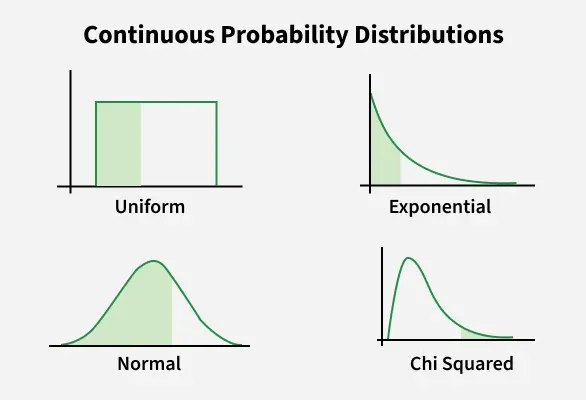
Common Types of Continuous Probability Distributions:
A probability distribution is a mathematical function that describes the likelihood of different outcomes for a random variable. Continuous probability distributions (CPDs) are probability distributions that apply to continuous random variables.
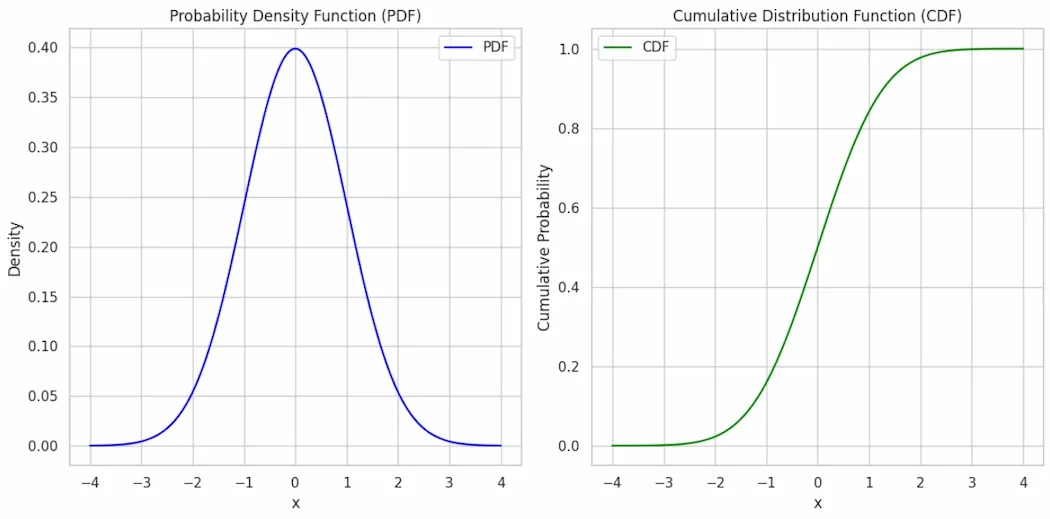
In continuous probability distributions, two key functions describe the likelihood of a variable taking on specific values:
The PDF gives the relative likelihood that a continuous random variable takes on a value within a small interval.
It is defined as:
The CDF gives the probability that the random variable is less than or equal to a certain value.
It is defined as :
A continuous probability distribution describes variables that can take any value within a given range. Different types of distributions are used depending on the nature of the data and the problem being solved.
The Gaussian Distribution is a bell-shaped, symmetrical, basic continuous probability distribution. Two factors define it:
For a random variable, x is expressed in
a
The Uniform Distribution is a continuous probability distribution where all values within a specified range are equally likely to occur.
The exponential distribution is a continuous probability distribution that represents the duration between occurrences in a Poisson process, which occurs continuously and independently at a constant average rate.
For a random variable x, it is expressed as
The Chi-Squared Distribution is a continuous probability distribution that arises in statistics, particularly in hypothesis testing and confidence interval estimation.
For a random variable x, it is expressed as
Question 1: The probability density function (PDF) of a continuous random variable X is given by: . Find the probability that X lies between 0.25 and 0.75.
Solution:
We use the formula for continuous probability:
Substitute the Values:
P(0.25≤X≤0.75) =
= (0.75)2 - (0.25)2 = 0.5625 - 0.0625 = 0.5
P(0.25 ≤ X≤ 0.75) = 0.5
Question 2: Let the probability density function (PDF) be: f(x) = 2x, for 0 ≤ x ≤ 1. Find the Cumulative Distribution Function (CDF), F(x).
Solution:
Case 1: x<0
Since the support of f(x) is only from 0 to 1,
F(x) = 0
Case 2: 0≤x≤10
Case 3: x>1
Since the total area under the PDF must be 1,
F(x)=1
So,
Question 1: Let f(x) = 3x2 for 0 ≤ x ≤ 1. Find the value of P(0.2 ≤ X ≤ 0.8)
Question 2.PDF of a continuous random variable is given as f(x)=1/5, for 0 ≤ x ≤ 5. Find the mean and variance of the distribution.
Question3: Suppose the time (in hours) taken to complete a task is exponentially distributed with parameter λ = 2. What is the probability that the task takes less than 1 hour?
Question 4: A random variable X has a normal distribution with mean μ = 50 and standard deviation σ = 10. What is the probability that X lies between 40 and 60?
- Mean μ = 2.5, Variance σ2 = 25/12
- P(X<1)=1−e−2(1)=1−e−2
- P(40 ≤ X ≤ 60) ≈ 0.6826