|
VOOZH | about |
|
VOOZH | about |
Decimals are numbers that lie between integers on a number line. Decimals are another method to express fractions. The numbers to the left of the decimal point are integers or whole numbers, while the numbers to the right are decimal fractions. If we proceed right from one place, the following place will be (1/10) times smaller, resulting in a (1/10)th or tenth place value. Example: 0.50, 10.20, 25.6, etc., are some examples of Decimals form. Fractions are defined as a numerical value that represents a part of a whole.
In this article, we have covered, Decimal definitions and Mixed Number definitions, Decimals To Mixed Numbers conversions and others in detail.
Table of Content
Decimals are a way to express numbers that fall between whole numbers, allowing for a more precise representation of quantities. They are a fundamental part of our numerical system and consist of a decimal point (.) followed by digits that can extend infinitely to the right.
👁 Reading-DecimalsSome examples of decimals are: 12.4, 1.89, -91.34, etc.
Mixed Numbers are also called Mixed Fractions, mixed fraction is a form of the fraction that has both a whole number and a fractional part. A mixed fraction is defined as a fraction formed by combining a whole number and a fraction. A mixed fraction is expressed by its quotient and remainder.
👁 mixed-fractionsFor example is a mixed fraction in which 3 is the quotient and 1 is the remainder. A mixed fraction is, therefore, the product of a whole number and a proper fraction.
To convert a decimal to a mixed number, follow the steps added below:
Step 1: Determine how many decimal places are in the given number.
Step 2: Remove decimal point from the number and divide it by a power of ten equal to the number of decimal places. So, if there are two decimal places, we must divide the number by 102, which is 100. To put it another way, the number of zeros should be equal to the number of decimal places.
Step 3: Simplify the fraction and, if necessary, convert it to a mixed number if it is an improper fraction.
Example 1: Convert 7.5 into a mixed fraction.
Solution:
To convert a decimal to a mixed number, perform these steps:
Step 1: Determine how many decimal places are in the given number.
Step 2: Remove the decimal point from the number and divide it by a power of ten equal to the number of decimal places. So, if there are two decimal places, we must divide the number by 102, which is 100. To put it another way, the number of zeros should be equal to the number of decimal places. Take away the decimal point, Rewrite in fraction form,
7.5 = 75/10
Step 3: Simplify the fraction and, if necessary, convert it to a mixed number if it is an improper fraction.
Thus, 7.5 = 75/10
= 15/2
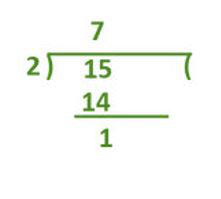
Now convert it into mixed number,
= 15/2
By simplifying,
Here, we simplify 15/2 in a mixed fraction 7 1/2, here 7 is quotient and 1 remainder.
Therefore, 7.5 = 15/2 = in a mixed fraction.
Example 2: Convert 3.25 into a mixed fraction?
Solution:
We will use steps to convert decimal to fraction.
Step 1: Determine the place value of the digits after the decimal in the number, if there are 1 digit after decimal then divide it by 10 and two digits divide by 100 and so on.
Step 2: Use it to figure out what the fraction's denominator is 100
Step 3: Take away the decimal point. Rewrite it in fraction form, then simplify it
Numerator/Denominator = 325/100
Step 4: Express it in terms of the smallest Simplest Fraction: 325/100
Thus, 3.25 = 325/100
= 65/20
= 13/4 is an improper fraction.
Therefore , convert 13/4 in to mixed fraction,
13/4 =
So, 3.25 in mixed fraction will be
Example 3: Convert 42.56 into a mixed fraction?
Solution:
We will use steps to convert decimal to fraction,
Step 1: Determine the place value of the digits after the decimal in the number , if there are 1 digit after decimal then divide it by 10 and two digits divide by 100 and so on
Step 2: Use it to figure out what the fraction's denominator is 100
Step 3: Take away the decimal point. Rewrite it in fraction form, then simplify it
Numerator/Denominator = 4256/100
Step 4: Express it in terms of the smallest Simplest Fraction: 4256/100
Thus, 42.56 = 4256/100
= 2128/50
= 1064/25
= 42
Example 4: Convert 0.25 into a Mixed fraction?
Solution:
We will use steps to convert decimal to fraction .
Step 1: Determine the place value of the digits after the decimal in the number, if there are 1 digit after decimal then divide it byb 10 and two digits divide by 100 and so on.
Step 2: Use it to figure out what the fraction's denominator is 100.
Step 3: Take away the decimal point. Rewrite it in fraction form, then simplify it.
Numerator/Denominator = 25/100
Step 4: Express it in terms of the smallest Simplest Fraction: 25/100
Thus, 0.25 = 25/100
= 1/4
Example 5: Convert 9.745 into a mixed fraction?
Solution:
We will use steps to convert decimal to fraction.
Step 1: Determine the place value of the digits after the decimal in the number , if there are 1 digit after decimal then divide it by 10 and two digits divide by 100 and so on.
Step 2: Use it to figure out what the fraction's denominator is 1000.
Step 3: Take away the decimal point. Rewrite it in fraction form, then simplify it.
Numerator/Denominator = 9745/100
Step 4: Express it in terms of the smallest Simplest Fraction: 9745/1000
Thus, 9.745 = 9745/1000
= 1949/200
Now convert into mixed fraction
Therefore, 9.745 = 1949/200 =
Example 6: Convert 2.98 into a mixed fraction?
Solution:
We will use steps to convert decimal to fraction.
Step 1: Determine the place value of the digits after the decimal in the number, if there are 1 digit after decimal then divide it by 10 and two digits divide by 100 and so on.
Step 2: Use it to figure out what the fraction's denominator is 100.
Step 3: Take away the decimal point. Rewrite it in fraction form, then simplify it.
Numerator/Denominator = 298/100
Step 4: Express it in terms of the smallest Simplest Fraction : 298/100
Thus, 2.98 = 298/100
= 149/25
Here its an improper fraction , now , convert it into mixed fraction :
= 149/25
So, 2.98 = 149/25 =