|
VOOZH | about |
|
VOOZH | about |
Cramer's Rule is used to find the unknowns in the given system of linear equations. Cramer's Rule is the most commonly used formula for finding the solution to the given system of linear equations in matrix form.
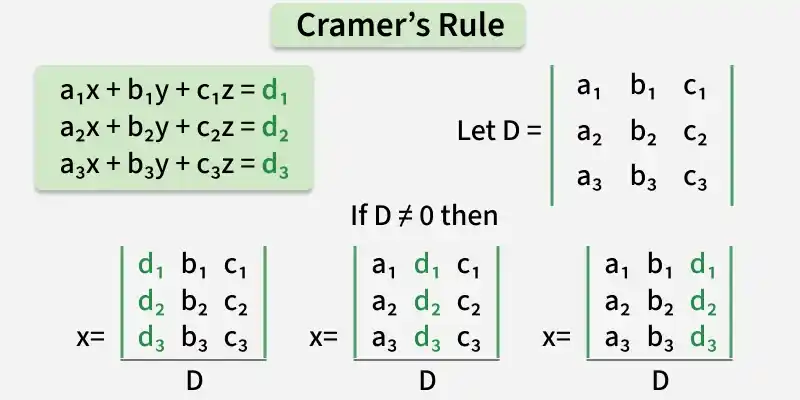
Cramer's Rule Formula is used to solve the system of equations in the form
AX = B
where,
Now the value of X is calculated using the formula given in the diagram below,
The individual values of x, y, and z are calculated with the help of the formula discussed in the above figure.
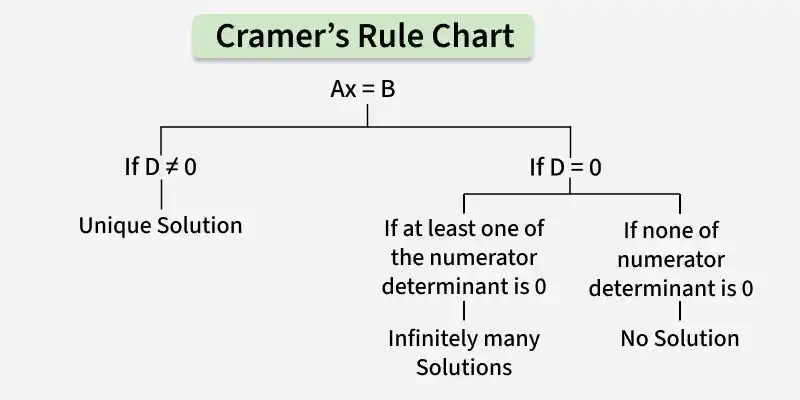
Cramer’s rule is applicable only when certain conditions are satisfied. The important condition of Cramer's rules are,
- The system AX = B has a unique solution if D ≠ 0 i.e. determinant is non-zero.
- If D = 0 we have two conditions and any of them can be true,
First Condition: Infinitely many solutions, this situation arises when D = 0 and at least one determinant of the numerator is zero.
Second Condition: No solution, this situation arises when D = 0 and at no determinant of the numerator is zero.
Now let us solve a system of 2 equations in 2 variables using Cramer's rule. Given equation,
Follow the steps to solve the system of 2 × 2 equations with two unknowns x and y using Cramer's rule.
Step 1: Write the given system of the equation in matrix form as AX = B
Step 2: Find the determinant (D) of A and find Dₓ and Dᵧ where
Dₓ = det (A) where B replaces the first column of A
Dᵧ = det (A) where B replaces the second column of A
Step 3: Find the values of the variables x and y as,
Now let us solve a system of 3 equations in 3 variables using Cramer's rule. Given equation,
Follow the steps to solve the system of 3 × 3 equations with two unknowns x and y using Cramer's rule.
Step 1: Write the given system of the equation in matrix form as AX = B
Step 2: Find the determinant (D) of A and find Dx, Dy, and Dz where
Step 3: Find the values of the variables x, y, and z as,
Study the following steps to solve the linear equations using Creamer's Rule,
Example 1: Solve
The given equations in the form of AX = B
A = ,
B = ,
X =
Then, the determinant D of matrix
A =
= 12 × 20 - 3 × (-10) = 240 + 30 = 270
Now, find Dx and Dy
Dx =
= [46×20 - (-10)×(-11)] = 920 - 110 = 810
Dy =
=[12×(-11) - 3×46] = -132 -138 = -270
Now, find x = Dx/D, y = Dy/D
x = 810/270 = 3, y = -270/270 = -1
x = 3, y = -1
Example 2: Solve
The given equations in the form of AX = B
A =
B =
X =
Then, the determinant D of matrix
A = = 6.6×8.6 - 4.2×0.95 = 56.76 - 3.99 =52.77
Now, find Dx and Dy
Dx = = 5.2 × 8.6 - 19.3 × 0.95 = 44.72 - 18.335 = 26.385
Dy = = 6.6×19.3 - 4.2×5.2 = 127.38 - 21.84 = 105.54
Now, find x = Dx/D , y = Dy/D
x = 26.385/52.77 = 0.5, y = 105.54/52.77 = 2
x = 0.5, y = 2
Example 3: Solve
Let x2 = a, y2 = b ---(1)
Then, the equation can be written as,
The given equations in the form of AX = B
A =
B =
X =
Then, the determinant D of matrix A = = 3×(-1) - 6×4 = -3-24 = -27
Now, find Da and Db
Da =
= 91×(-1) - 38×4 = - 91 - 152
= -243
Db =
= 3×38 - 6×91 = 114 - 546
= -432
Now, find a = Da/D, b = Db/D
a = -243/-27 = 9, b = -432/-27 = 16
a = 9, b = 16
We have to find x and y, so we substitute the values into equation (1).
Now x2 = a = 9, x = √9 = 3
y2 = b = 16, y = √16 = +4 or -4
Example 4: Solve
The given equations in the form of AX = B
A =
B =
X =
Then, the determinant D of matrix A = = 3(20 - 26) - (-4)(80 - 12) + 8(-52-(-6)) = 3×(-6) + 4×68 - 46×8 = -18 + 272 - 368
= -114
Now, find Dx , Dy and Dz
Dx =
= 34(20 - 26) - (-4)(20 + 122) + 8(-13 - 61)
= 34 × (-6) + 4 × 142 + 8 × (-74) = -204 + 568 - 592 = -228
Dy =
= 3(20 + 2 × 61) - 34(80 - 12) + 8(61 × 4 + 6)
= 3 × 142 - 34 × 68 + 8 × 250 = 426 - 2312 + 2000 = 114
Dz =
= 3(61+13) - (-4)(61×4 + 6) + 34(-52+6)
= 3 × 74 + 4 × 250 + 34 × (-46) = 222 + 1000 -1564 = -342
Now, find x = Dx/D, y = Dy/D, z = Dz/D
x = -228/-114 = 2, y = 114/-114 = -1, z = -342/-114 = 3
x = 2, y = -1, z = 3
Example 5: Solve
The given equations in the form of AX = B
A =
B =
X =
Then, the determinant D of matrix A = = 3(10+54) + 8(-1-18) +10(6-20)
= 3 × 64 - 8 × 19 + 10 × (-14) = 192 -152 - 140 = -100
Now, find Dx , Dy and Dz
Dx =
= 8(10+54) + 8(-15-99) + 10(90 -110)
= 8 × 64 + 8 × (-114) + 10 × (-20) = 512 - 912 - 200 = -600
Dy =
= 3(-15-99) - 8(-1-18) + 10(-11+30)
= 3 × (-114) + 8 × 19 + 10 × 19 = -342 + 152 +190 = 0
Dz =
= 3(110-90) + 8(-11+30) + 8(6-20)
= 3 × 20 + 8 × 19 + 8 × (-14) = 60 + 152 - 112 = 100
Now, find x = Dx/D, y = Dy/D, z = Dz/D
x = -600/-100 = 6, y = 0/-100 = 0, z = 100/-100 = -1
x = 6, y = 0, z = -1
Example 6: Solve
The given equations in the form of AX = B
A =
B =
X =
Then, the determinant D of matrix A = = 2(6 - 63) - 4(3 + 36) - 6(-21 - 24) = 2 × (-57) - 4 × 39 - 6 × (-45) = -114 - 156 + 270 = 0
Since |D| = 0,
which means the given system of equations does not have a unique solution, which is invalid in Cramer's Rule as it is defined only for the system of equations that have a unique solution. This means that the given system of equations either has an infinite solution or no solution.
Example 7: Solve:
The given equations in the form of AX = B
A =
B =
X =
Then, the determinant D of matrix A = = 1(6 - 24) - 1(-5 - 16) + 1(15 + 12)
= -18 + 21 + 27 = 30
Now, find Dx , Dy and Dz
Dx =
= 6(6-24) -1(-17-40) +1(51+30)
= 6(-18) + 57 + 81 = -108 + 138 = 30
Dy =
= 1(-17 - 40) - 6(-5 - 16) + 1(25 - 34)
= -57 + 126 - 9 = 60
Dz =
= 1(-30 - 51) - 1(25 - 34) + 6(15 + 12)
= -81 + 9 + 162 = 90
Now, find x = Dx/D, y = Dy/D, z = Dz/D
x = 30/30 = 1, y = 60/30 = 2, z = 90/30 = 3
x = 1, y = 2, z = 3
Question 1: Solve the following system using Cramer's Rule:
Question 2: Find the values of 𝑥 y, and z using Cramer's Rule:
Question 3: Determine if the following system has a unique solution using Cramer's Rule:
Question 4: Apply Cramer's Rule to solve:
Question 5: Use Cramer's Rule to solve for x and 𝑦:
Answers:
- x = 14/5, y = -1/5
- x = 32/13, y = 23/13, z= 35/13
- The given system of equations does not have a unique solution, which is invalid in Cramer's Rule as it is defined only for the system of equations that have a unique solution. This means that the given system of equations either has an infinite solution or no solution.
- x = 177/193, y = 14/193, z = 141/193
- x = 7/9, y = -1/9