|
VOOZH | about |
|
VOOZH | about |
Derivatives are fundamental to differential calculus. They describe how a function behaves, such as increasing or decreasing. Suppose we have two quantities, x and y, that vary together and are related by the function y = f(x). The derivative of this function, denoted as, represents the rate of change of y with respect to x. This tells us how y changes as x changes.
For example: Find the rate of change of volume of a cube whose sides are increasing at the rate of 2 m/s.
Solution:
Let's say the length of the side of cube is "a". The volume of cube is given by, V = a3.
⇒
⇒
⇒ = 6a2 m3/s.
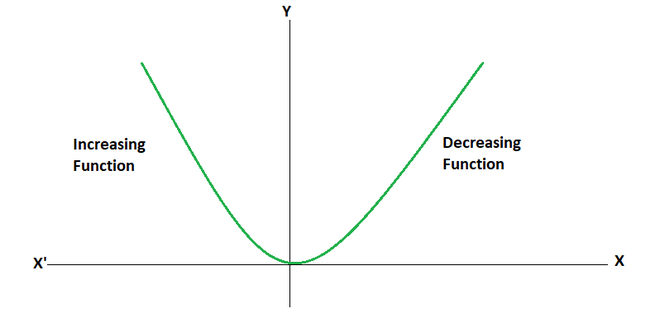
Derivatives are also used in finding out whether the function is increasing or decreasing or none of them. The figure given below shows the function f(x) = x2.
Notice in the figure, the function is decreasing in the interval (-∞, 0) and increasing in the interval (0,∞).
In an interval I contained in the domain of real valued function “f”. Then, f is said to be,
👁 Image
- Increasing on I, if x1 < x2 in I ⇒ f(x1) ≤ f(x2) for all x1, x2 ∈ I.
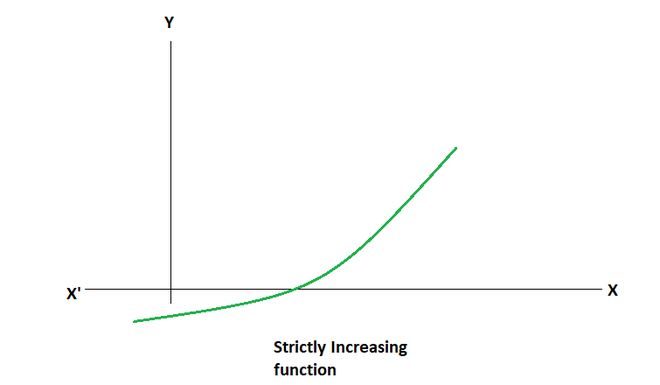
- Strictly Increasing on I, if x1 < x2 in I ⇒ f(x1) < f(x2) for all x1, x2 ∈ I.
👁 Image
- Decreasing on I, if x1 < x2 in I ⇒ f(x1) ≥ f(x2) for all x1, x2 ∈ I.
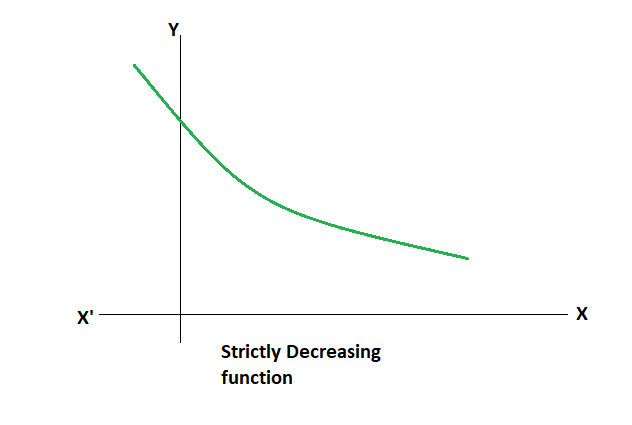
- Strictly Decreasing on I, if x1 < x2 in I ⇒ f(x1) > f(x2) for all x1, x2 ∈ I.
👁 Image
Now we know the definitions for increasing and decreasing functions. Let's see how to recognise a function that is increasing or decreasing in an interval.
Let's say f is continuous on [a, b] and differentiable on the open interval (a, b). Then,
👁 Image
- f is increasing in (a, b) if f'(x) > 0 in the interval [a, b].
- f is decreasing in (a, b) if f'(x) < 0 in the given interval.
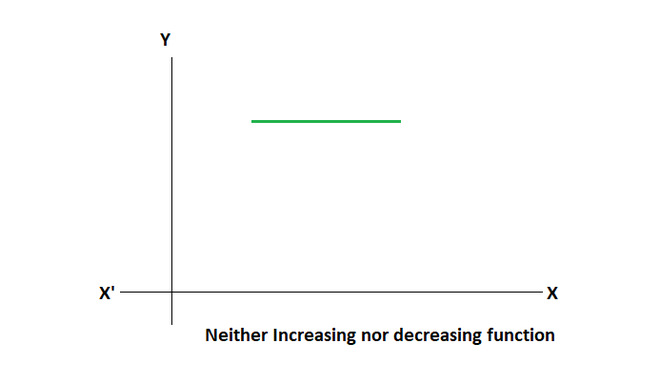
- f is constant if f'(x) = 0.
Question 1: Let's say we have a circle whose radius is increasing. Find the rate of change of area with radius when r = 4cm.
Solution:
Let's say "A" is the area of the circle and “r” be the radius of the circle.
A = πr2
Differentiating it with respect to radius.
⇒
At r = 4.
Question 2: Let's say we have a rectangle whose sides are changing every second. The length is increasing at the rate of 3 m/s while the breadth is increasing at 8 m/s. Calculate the rate at which the area of the rectangle is increasing when the length = 8m and the breadth = 5m.
Solution:
Let, x be the length of the rectangle and y be the breadth of rectangle.
And
The area of rectangle is given by,
A = xy
Differentiating the equation w.r.t time.
⇒
⇒
⇒
⇒
⇒ = 64 + 15
Question 3: For the given curve, find the points where the value of the rate of change of y is zero: y = x2 + x
Solution:
y = x2 + x
⇒
This rate of change must be zero,
2x + 1 = 0
⇒ x =
Thus, at x = the rate of change is zero.
Question 4: Prove that the function discussed above, f(x) = x2 is increasing in the interval (0, ∞).
Solution:
According to above definition, a function in increasing in any interval if its derivative is greater than zero in that interval.
f(x) = x2
Differentiating with respect to x,
f'(x) = 2x
For the given interval (0,∞) f'(x) > 0.
Thus, the function is increasing in the given interval.
Question 5: Find the intervals where the function f(x) = x2 + 5x + 6 is increasing or decreasing.
Solution:
Given f(x) = x2 + 5x + 6
f'(x) = 2x + 5
We need to study the sign of the derivative to find the intervals where this function is increasing or decreasing.
f'(x) < 0
⇒ 2x + 5 < 0
⇒ x <
f'(x) > 0
⇒ 2x + 5 > 0
⇒ x >
Thus, the function is increasing in (, ∞) and is decreasing in (-∞, ).
Question 1: If the radius of a circle is increasing at a uniform rate of 2 cm/sec, find the rate of increasing of area of circle, at the instant when the radius is 20 cm.
Question 2: The percentage error in calculating the volume of a cubical box if an error of 1% is made in measuring the length of edges of the cube is?
Question 3: if , Calculate the acceleration at the time when the velocity becomes zero.
Question 4: Prove that the function f(x) = x/log x increases on the interval (e, ∞).
Question 5: Find the intervals where the function is increasing or decreasing.