|
VOOZH | about |
|
VOOZH | about |
The process of converting a square matrix into diagonal form using a similarity transformation is called diagonalization. A matrix A is diagonalizable if there exists an invertible matrix P and a diagonal matrix D such that:
Where:
Diagonalization is useful because diagonal matrices are much easier to work with. For instance, raising a diagonal matrix to a power simply means raising its diagonal entries to that power, and its determinant is just the product of the diagonal entries.
Suppose we have a vector space V of dimension n over a field F.
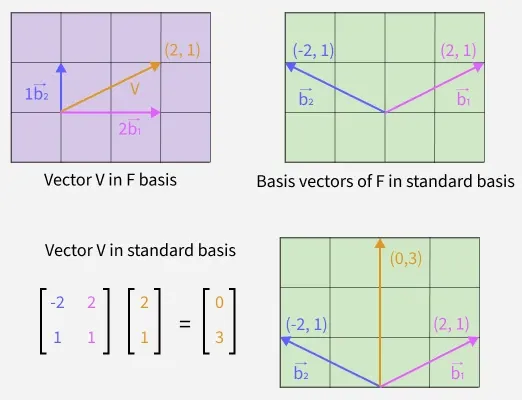
How do we convert the coordinates of v in basis F into coordinates in the standard basis?
When we multiply a vector v with the change-of-basis matrix, which is the matrix having basis vectors as columns, we get the coordinates of vector v in the standard basis.
Example: A vector in F-basis is converted to standard basis using the change-of-basis matrix.
👁 F-to-standard
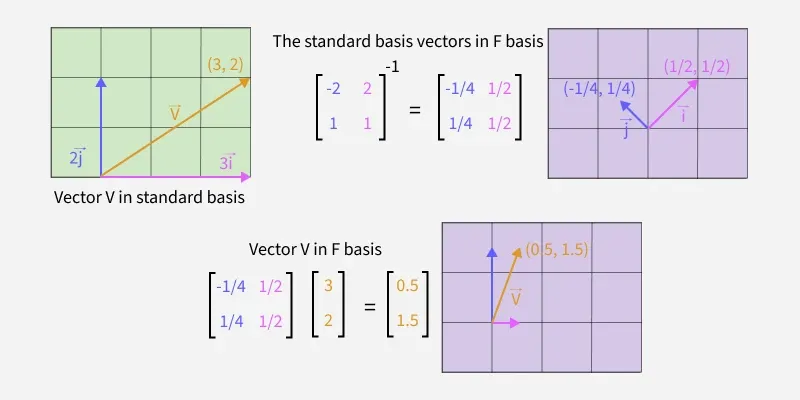
How do we convert the coordinates of v in the standard basis into coordinates in basis F?
Example: A vector in F-basis is converted to standard basis using the change-of-basis matrix.
👁 standard-to-f
The process of diagonalization can be visualized as switching into the eigenbasis, applying a simple scaling transformation, and then switching back to the standard basis. The following steps illustrate this process:
We write a matrix as:
A = PDP−1
Where:
Steps to diagonalize an n × n matrix A:
Given below are the examples for 2×2
A =
A = PDP−1
1. Find the eigenvalues:
det(A−λI) = 0
A−λI =
det(A−λI) = (4 − λ)(3 − λ) - (1)(2) = λ2 − 7λ + 12 − 2 = λ2 − 7λ + 10
λ2 − 7λ + 10 = 0 ⇒ (λ − 2)(λ − 5) = 0
Eigenvalues: λ1 = 2, λ2 = 5
2. Find the eigenvectors:
For λ1 = 2,
Solve (A−2I)v = 0A - 2I =
2x + y = 0
2x + y = 0v =
v1 =
For λ2 = 5,
Solve (A − 5I)v = 0A - 5I =
-x + y = 0
2x - 2y = 0x = y
v =
v2 =
3. Constructing P and D:
P matrix:
D matrix:
4. Finding P-1:
P = ⇒ P-1 =
5. Combining the terms:
PDP-1 = =
A =
A = PDP−1
1. Find the eigenvalues:
det(A−λI) = 0
A−λI =
det(A−λI) = (−λ)⋅(1)⋅[(−1−λ)(−1−λ)−(1)(1)] = −λ3 - 2λ2
−λ3 - 2λ2 = 0 ⇒ λ2 (λ + 2)= 0
Eigenvalues: λ1 = -2, λ2 = 0, λ3 = 0 (Note: λ = 0is an eigenvalue with algebraic multiplicity 2)
2. Find the eigenvectors:
For λ1 = -2,
Solve (A−(-2)I)v = 0A + 2I =
x+z = 0 ⇒ x = −z
y − 3z = 0 ⇒ y = 3z
v =
v1 =
For λ2 = λ3 = 0,
Solve (A − 0I)v = 0A =
x − z = 0 ⇒ x = z
v =
v2 =
v3 =
3. Constructing P and D:
P matrix:
D matrix:
4. Finding P-1:
P = ⇒ P-1 =
5. Combining the terms:
PDP-1 = =
Question 1: Determine if the given matrix is diagonalizable. If it is, find matrices P, D, and P−1 such that A = PDP−1. A = .
Question 2: Determine if the given matrix is diagonalizable. If it is, find matrices P, D, and P−1 such that A = PDP−1. A = .
Question 3: Determine if the given matrix is diagonalizable. If it is, find matrices P, D, and P−1 such that A = PDP−1. A = .
Question 4: Determine if the given matrix is diagonalizable. If it is, find matrices P, D, and P−1 such that A = PDP−1. A = .
Answers:
1. P = . D = , P -1 =
2. P = . D = , P -1 =
3. The matrix is non-diagonalizable because there is only one linearly independent eigenvectors for 2 x 2 matrix.
4. P = . D = , P -1 =