|
VOOZH | about |
|
VOOZH | about |
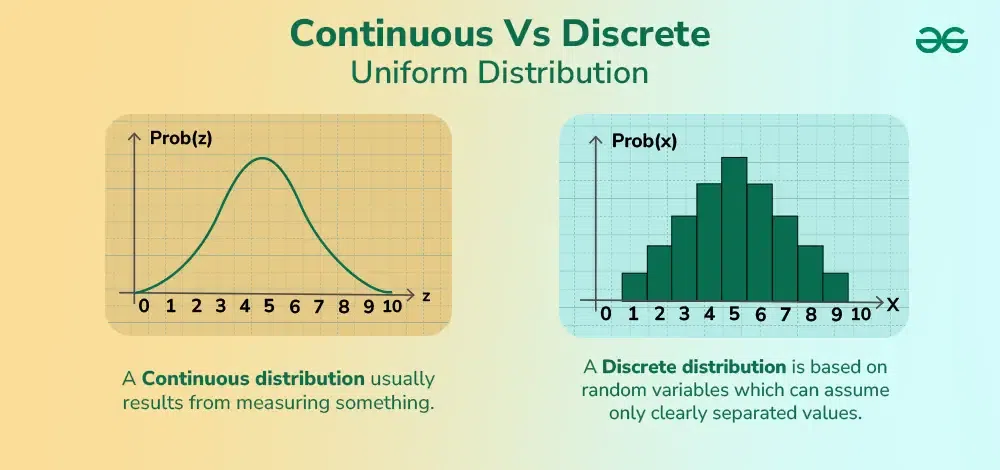
Continuous and discrete uniform distributions are two types of probability distributions. A continuous uniform distribution has an interval of equally likely values. Instead, a discrete uniform distribution applies to a finite set of outcomes with equal probabilities.
Understanding the difference between continuous and discrete uniform distribution is crucial for anyone studying probability and statistics. These two types of distributions represent data differently, with continuous uniform distribution describing outcomes over a continuous range and discrete uniform distribution dealing with distinct, separate values.
In this article, we will discuss continuous and discrete uniform distribution along with a difference between them.
Table of Content
Continuous uniform distribution is a probability distribution in which all outcomes are equally likely within a specified interval [a,b]. In other words, the probability density function (PDF) is constant over this interval, and the distribution is defined by the two parameters a and b, which are the lower and upper bounds, respectively.
In a continuous distribution:
Examples of continuous uniform distribution are:
The properties of continuous uniform distribution are:
Discrete uniform distribution is a kind of probability distribution in which every possible result has equal likelihood of occurrence. When there are limited possibilities and every one of them is equally likely, this distribution is applied.
Examples of discrete uniform distribution are:
The properties of discrete uniform distribution are:
Below are formulas of continuous and discrete uniform distribution:
Distribution Type | Description | Probability Density Function/ Probability Mass Function | Cumulative Distribution Function |
|---|---|---|---|
Discrete Uniform | Finite set of equally likely outcomes | P(X=x)= 1/n for x=x1,x2,...,xn | F(x)=Number of outcomes ≤ x/n |
Continuous Uniform | Continuous range of equally likely outcomes between a and b | f(x)= 1/(b-a) for a ≤ x ≤ b | F(x)= |
The difference between continuous distribution and discrete uniform distribution can be understood from the table given below.
Basis | Discrete Uniform Distribution | Continuous Distribution |
|---|---|---|
Nature of Outcomes | Finite and countable set of outcomes | Infinite and uncountable range of outcomes |
Probability Function | Probability Mass Function (PMF): P(X=x)= 1/n | Probability Density Function (PDF): f(x) = 1/(b-a) |
Range of Values | Specific discrete values x1,x2,...,xn | Continuous range of values between a and b |
Probability Calculation | Equal probability for each outcome: P(X=x)= 1/n | Equal density across the interval: f(x)= 1/(b-a) |
Cumulative Distribution | CDF increases stepwise with each outcome and is defined by F(x) = P(X ≤ x). | CDF is a linear function within the interval defined by F(x) = (x – a) / (b – a) for a ≤ x ≤ b |
Support | Specific values within a finite set | Continuous interval [a,b] |
Real-World Application | Games of chance, like dice rolls or card draws | Random selection within a time interval, length measurement, etc. |
Example | Rolling a fair six-sided die (outcomes: 1, 2, 3, 4, 5, 6) | Selecting a random point on a line segment from 1 to 10 |
Also Check,
The difference between continuous and discrete uniform distributions lies in their fundamental approach to representing data. Continuous uniform distributions encompass outcomes across a continuous range, ideal for scenarios where variables can take any value within a specified interval. On the other hand, discrete uniform distributions involve outcomes that are distinct and separate, suited for scenarios where variables can only take on a finite set of values with equal probability.