|
VOOZH | about |
|
VOOZH | about |
Quantities are essential in physics and mathematics for explaining the world we live in. Nevertheless, not all amounts are of equal value. Some things are only determined by their size, while others also take into account their size and the way they are oriented. This article briefly explores the difference between scalar and vector quantities, clarifying their meanings, properties, and real-world impacts.
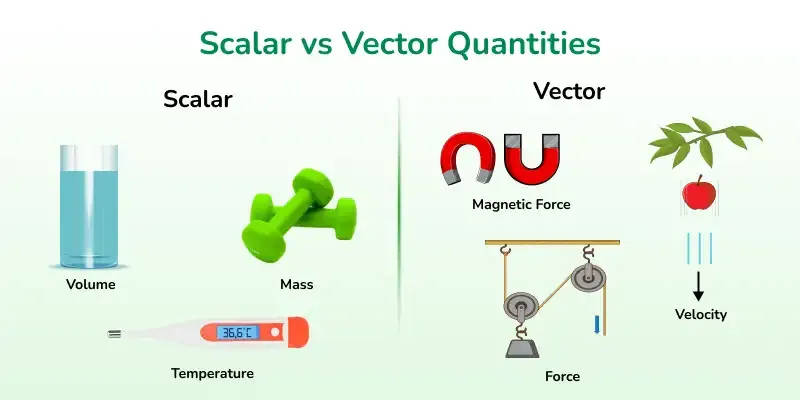
Scalar quantities are the simplest form of measurement we encounter daily, such as temperature, mass, time, or speed.
A Scalar quantity is defined as a physical quantity that has magnitude only and is completely described by a real number and its unit.
Key Characteristics:
Some examples of scalar quantities along with their SI units:
- Distance: meter (m)
- Speed: meter per second (m/s)
- Mass: kilogram (kg)
- Temperature: kelvin (K)
- Time: second (s)
- Energy: joule (J)
- Area: square meter (m²)
- Volume: cubic meter (m³)
- Density: kilogram per cubic meter (kg/m³)
- Electric Charge: coulomb (C)
Vector quantities are like giving directions in a game. They tell us how fast something is moving in a specific direction, such as "Walk 3 m in the south direction."
A Vector quantity is a physical quantity that has both magnitude and direction and is represented by a directed line segment with a specific length and direction.
Key Features:
Operations with Vectors
Some examples of vector quantities with their SI units:
- Displacement: meter (m)
- Velocity: meter per second (m/s)
- Acceleration: meter per second squared (m/s²)
- Force: newton (N)
- Momentum: kilogram meter per second (kg m/s)
- Electric Field: newton per coulomb (N/C)
- Magnetic Field: tesla (T)
- Gravitational Field: newton per kilogram (N/kg)
- Angular Momentum: kilogram meter squared per second (kg m²/s)
- Electric Current Density: ampere per square meter (A/m²)
Scalar Quantity | Vector Quantity |
|---|---|
It has only magnitude, but no direction. | It has both magnitude and direction. |
They are denoted by simple alphabets, e.g. D for distance. | Denoted with an arrow above the symbol (e.g., for velocity) |
Simple arithmetic operations (addition, subtraction, multiplication, division) | It requires vector addition and subtraction, dot and cross products |
In scalar numerical value is Notable | In vector, the direction is also notable with the magnitude |
A scalar quantity is only one-dimensional | A vector quantity can be one, two, or three-dimensional. |
Examples: distance, speed, mass, temperature, and time. | Examples: displacement, velocity, acceleration, force, and momentum. |